
How to Perform a Security Risk Assessment: A Step-by-Step Guide
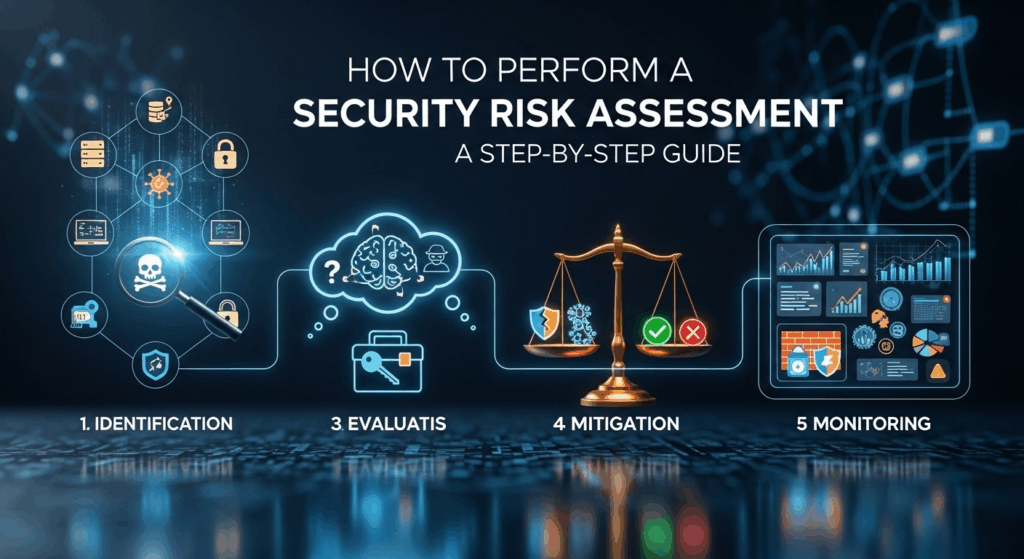
How to Perform a Security Risk Assessment: A Step-by-Step Guide
If you’re wondering how to perform a security risk assessment the right way, you’re in the right place. A well-run assessment uncovers the most important threats to your business, estimates their likelihood and impact, and gives you a prioritized roadmap to reduce risk. This step-by-step guide walks you through a modern, repeatable approach aligned with leading frameworks and long-term SEO evergreen best practices—even as tools and threats evolve, the principles here remain relevant.
What Is a Security Risk Assessment and Why It Matters
A security risk assessment is a structured process to identify, analyze, and prioritize the cybersecurity risks to your organization’s assets, systems, and data. It helps you decide where to invest limited time and budget for maximum risk reduction. Done correctly, it transforms security from a reactive checklist to a proactive business enabler.
Many organizations perform assessments to meet compliance obligations—ISO/IEC 27001, SOC 2, HIPAA, or GDPR—but the true value goes beyond checkboxes. An assessment builds a clear picture of your environment, surfaces hidden exposures, and creates a common language for executives, IT, and security teams. It’s the foundation for informed decision-making and credible security governance.
Crucially, risk assessment is not a one-off project. Threats shift, technologies change, and businesses evolve. A modern approach treats assessments as a living lifecycle that is integrated with change management, architecture reviews, incident response, vendor risk management, and audit cycles.
1. Defining Risk, Threat, and Vulnerability
In cybersecurity, a “risk” is the potential for loss or damage when a threat exploits a vulnerability. Threats are actors or events that can cause harm (for example, ransomware groups or insider misuse), while vulnerabilities are weaknesses that can be exploited (unpatched systems, weak authentication). Risk = Threat × Vulnerability × Impact (simplified) is a useful mental model.
Clarity on these terms matters. Teams often talk past each other when they label every security issue as a “risk.” An unpatched server is a vulnerability. Ransomware operators scanning the internet represent a threat. The risk is the business loss that could occur if those operators exploit the unpatched server—for example, encrypted databases, downtime, and regulatory fines.
Keeping definitions consistent makes your reporting trustworthy and comparable over time. Align your glossary with frameworks you follow (e.g., NIST, ISO 27001) so stakeholders read your findings the same way auditors and partners do.
2. The Business Value and Compliance Drivers
Security risk assessments protect reputation, revenue, and operations. They also support strategic decisions: which projects to fund, which controls to prioritize, and which risks to accept or transfer via cyber insurance. When assessments quantify potential outcomes—even directionally—they make it easier to justify budgets and explain trade-offs.
Regulatory and contractual requirements are equally compelling. SOC 2 and ISO 27001 expect a risk-based approach. HIPAA requires risk analysis and risk management. GDPR demands “appropriate technical and organizational measures” based on the risk to individuals’ rights and freedoms. A credible assessment framework aligns security with compliance without turning your program into a pure compliance exercise.
Finally, assessments create shared accountability. When business owners, IT, and security collaborate on risk decisions, security becomes a team sport—not just a security team mandate.
Step 1 — Establish Context and Scope
Clear scope and context prevent wasted effort and ensure results are actionable. At minimum, define what assets, processes, and locations you will assess, what the time horizon is, and what risk criteria you will use.
Scoping is about setting boundaries so you can go deep where it matters most. That means focusing on mission-critical services, sensitive data, internet-facing assets, and high-likelihood attack paths. Broad, shallow assessments produce long lists but little insight; focused, deep assessments produce clarity and momentum.
You’ll also define risk appetite and acceptance criteria early. If leadership is conservative about downtime for a revenue system, your thresholds for acceptable risk will be low. If a legacy system has a short remaining lifespan, you might accept more risk temporarily. Record these parameters so decisions later in the process remain consistent.
1. Set Objectives and Risk Appetite
Start with business objectives. Are you preparing for an ISO 27001 audit, launching a new product, or integrating an acquisition? Your objective shapes scope and priorities. Tie every assessment activity to a business outcome—regulatory clearance, customer trust, M&A due diligence, or operational resilience.
Next, define risk appetite qualitatively and, where possible, quantitatively. For instance: “We will not accept risks with potential impact > $250,000 and likelihood > possible in a 12-month period” or “We accept risks up to moderate on our 5-point scale when mitigations are planned within 90 days.” These thresholds guide prioritization and reduce debate later.
Finally, agree on timing and cadence. Will you perform a comprehensive assessment annually with quarterly updates, or run rolling assessments by domain (cloud, endpoint, vendors) each quarter? A clear schedule creates accountability and fits assessments into the broader governance calendar.
2. Map Stakeholders and Boundaries
Document stakeholders: CISOs, IT ops, engineering, data owners, product managers, legal, compliance, and key vendors. Each group brings different information—system architecture, process knowledge, control coverage, and business impact.
Define boundaries to avoid scope creep. For example, include production cloud accounts and third-party SaaS handling customer data, but exclude lab environments. If you can’t describe the boundary in a sentence, the scope is too fuzzy.
Capture assumptions and constraints. Are you limited to non-intrusive testing? Are there systems under change freeze? Will you rely on existing scans or run new ones? Transparency about constraints maintains credibility with auditors and executives.
Step 2 — Build a Complete Asset Inventory
You can’t assess what you don’t know. A defensible asset inventory is the backbone of any risk assessment. It should include hardware, software, data, identities, networks, third-party services, and business processes.
Modern environments are hybrid and fast-moving. Cloud resources spin up and down, containers are ephemeral, and SaaS proliferates. That means your inventory must be automated where possible and mapped to business context: what the asset does, who owns it, and what data it handles.
The goal isn’t perfection on day one. It’s to create a living inventory that improves continuously and feeds other security activities: access reviews, vulnerability management, incident response, and business continuity planning.
1. Systems, Data, and Processes
Start with systems and services: on-prem servers, cloud workloads, endpoints, network devices, and applications. Pull from CMDBs, cloud provider APIs, endpoint agents, and identity providers. Validate with SMEs to catch blind spots such as shadow IT or unmanaged SaaS.
Next, inventory data: customer PII, financial records, IP, health information, logs, and secrets. Note where it’s stored and processed, who can access it, and cross-border flows. Data drives risk—sensitive data concentrated in a high-risk system demands urgent attention.
Finally, document business processes: order-to-cash, payroll, claims handling, trading, product development. Map systems and data to these processes so impact analysis reflects how the business truly runs.
2. Classification and Criticality Scoring
Classify assets by sensitivity and criticality. Use a simple schema (e.g., Public, Internal, Confidential, Restricted) and define examples. Consistency beats complexity—people must actually use the labels for them to work.
Add criticality scoring to highlight what would hurt most if it failed or was breached. Consider:
- Financial impact (lost revenue, fines)
- Operational impact (downtime, customer disruption)
- Legal/regulatory impact
- Reputational impact
Combine classification and criticality to focus your risk analysis. A public-facing, high-criticality API hosting sensitive data outranks an internal, low-impact tool every time.
Step 3 — Identify Threats and Vulnerabilities
With scope and inventory in place, identify credible threats and the vulnerabilities they could exploit. The output should be a list of threat-scenario pairings tied to concrete assets and business impacts.
Avoid generic lists. Make threats real by connecting them to your environment: your tech stack, your industry, and your attack surface. Likewise, vulnerability data should be current, validated, and mapped to assets and owners.
This is where collaboration shines. Security brings threat intel and scanning insights; IT and engineering bring architecture realities; business teams bring process knowledge and impact nuance.
1. Threat Modeling Techniques
Use lightweight threat modeling to structure thinking. For applications, STRIDE can reveal spoofing, tampering, repudiation, information disclosure, denial of service, and elevation of privilege risks. For cloud, consider misconfiguration patterns. For identity, map potential abuse of privileged accounts.
Augment with threat intelligence. Industry ISAC bulletins, vendor reports, and your own incident history show what’s likely. Ransomware, business email compromise, supply-chain compromise, and API abuse are common, but your prioritization should reflect your unique footprint.
Work through “what could go wrong” scenarios tied to assets. For example: “Ransomware encrypts our order-processing database” or “Compromised OAuth token exfiltrates customer PII from SaaS CRM.” Scenario-driven discussions produce clearer, testable assumptions.
2. Vulnerability Discovery Pipelines
Collect vulnerabilities from multiple sources:
- Automated scans (infrastructure, application, container, mobile)
- Code analysis (SAST/DAST)
- Cloud security posture management (CSPM) for misconfigurations
- Penetration testing and red team results
- Patch and configuration management gaps
- Identity misconfigurations (excess permissions, MFA gaps)
Triage for relevance. A critical CVE on a test system behind strong controls may have lower real-world risk than a medium finding on a public-facing production workload. Context beats raw severity.
Keep evidence. Screenshots, scan IDs, timestamps, and asset IDs make your assessment reproducible and audit-ready.
3. Estimating Likelihood and Impact
Estimate how likely each threat scenario is within your time horizon and how severe the impact would be. Start qualitative (e.g., Rare to Almost Certain; Low to Severe). Where mature, layer quantitative methods by estimating loss magnitude in currency ranges.
Consider control strength when estimating likelihood. Strong MFA, network segmentation, and backup resilience reduce likelihood or impact. Document your assumptions so stakeholders can challenge and improve them.
When in doubt, use ranges and confidence levels. “Likely (60–80% in 12 months) with medium confidence” is more honest and useful than false precision.
Step 4 — Analyze and Prioritize Risks
Now you combine threat, vulnerability, likelihood, and impact into risk ratings. The aim is to create a prioritized list that everyone can rally around. This is the bridge between analysis and action.
Choose a methodology that suits your organization’s maturity. Many start qualitative and evolve toward semi-quantitative or quantitative models as data improves. The key is consistency across time so you can track progress credibly.
Output your results into a risk register with clear owners, due dates, and treatment plans. Without ownership and timelines, even well-scored risks will stall.
1. Qualitative vs. Quantitative Analysis
Qualitative analysis uses scales (e.g., 1–5) and a risk matrix (heat map). It’s simple, fast, and widely understood. The downside is subjectivity and “red box” inflation if not governed. To improve rigor, define each scale value in business terms and use calibration, not gut feel.
Quantitative analysis estimates risk in financial terms—loss event frequency and loss magnitude. The FAIR model is a common approach. Even rough bands (e.g., $10k–$50k, $50k–$250k, $250k–$1M) help leaders compare cyber risk to other business risks. Quantification supports better investment conversations and insurance discussions.

You don’t have to choose one forever. Many programs use qualitative scoring for broad triage and quantitative deep dives for top risks and board reporting.
2. Create a Risk Register and Heat Map
A risk register is your single source of truth. It should include:
- Risk ID and title
- Scenario description
- Assets affected and data classification
- Likelihood and impact (with rationale)
- Inherent vs. residual risk
- Control gaps and proposed treatments
- Owner, due date, and status
- Acceptance rationale (if applicable)
Visualize with a heat map to spotlight the top-right risks. But don’t stop at colors—link each risk to a concrete action plan and make the register part of regular governance meetings.
Step 5 — Treat Risks with Effective Controls
Treatment means deciding what to do about prioritized risks: avoid, mitigate, transfer, or accept. The right mix depends on business context, cost, and timing. Controls should target the root cause, not just the symptom.
Always evaluate residual risk—what remains after controls are implemented. If residual risk is above appetite, iterate with additional treatments or alternative strategies. Assign owners and budgets so plans become reality.
Balance quick wins and strategic investments. A patch or configuration change may reduce risk quickly, while a zero-trust initiative or privileged access management rollout is a longer-term play.
1. Choose Control Strategies (Avoid, Mitigate, Transfer, Accept)
- Avoid: Eliminate the risky activity. Example: Decommission a legacy internet-facing system. High impact, sometimes disruptive, but powerful.
- Mitigate: Reduce likelihood or impact with controls. Examples: MFA, EDR, WAF, encryption, segmentation, backups, monitoring.
- Transfer: Shift financial risk via cyber insurance or contractual clauses with vendors. Does not remove risk entirely, but helps with loss exposure.
- Accept: Documented decision to tolerate the risk within appetite, often with compensating controls or time-bound plans.
Use the table below to compare strategies.
Risk Treatment Strategy Comparison
| Strategy | When to Use | Example Control or Action | Expected Residual Risk |
|---|---|---|---|
| Avoid | Risk outweighs business value; viable alternative exists | Retire unsupported app; remove admin access from contractors | Very low to none |
| Mitigate | Risk can be reduced cost-effectively | Enforce MFA; patch critical CVEs; implement DLP; harden S3 buckets | Low to medium |
| Transfer | Financial exposure needs coverage; risk cannot be fully mitigated | Cyber insurance; vendor indemnification; SLA penalties | Medium (financial impact reduced) |
| Accept | Within risk appetite or temporary constraint; plan exists | Document acceptance for 90 days pending migration | Medium to high (time-bound) |
2. Validate, Assign Owners, and Define Residual Risk
Treatment plans must be testable. Define acceptance criteria: “Phishing-resistant MFA enabled for all admins,” “RPO 15 minutes and RTO 1 hour validated,” or “Critical patches within 7 days.” If you can’t measure completion, you can’t manage it.
Assign owners with the authority and budget to execute. Clarify dependencies across teams—security, IT, engineering, legal, vendors—and book work into delivery backlogs. Tie high-priority treatments to OKRs or program increments.
Update the risk register with expected residual risk and target dates. Review post-implementation evidence (tickets, screenshots, reports) and adjust the residual rating if outcomes differ from assumptions.
Step 6 — Report, Communicate, and Obtain Buy-In
How you present risk findings determines whether action happens. Leaders need clarity, brevity, and business relevance; practitioners need specifics. Tailor your message for each audience.
Good reporting connects risks to business processes, compliance impacts, and financial exposure. It also compares risk before and after proposed investments so decision-makers can see return on risk reduction (RoRR).
Build a repeatable reporting rhythm. Quarterly risk reviews, monthly metrics, and ad hoc executive briefings ensure sustained momentum and accountability.
1. Executive-Ready Reporting and Metrics
Create a one-page executive summary highlighting:
- Top 5 risks and trend (up/down/steady)
- Residual risk vs. appetite
- Key incidents or near-misses
- Treatment status and blockers
- Investment requests and expected risk reduction
Support with metrics:
- Patch SLAs met (%)
- MFA coverage (%)
- Backup success and restore test pass rate
- Mean time to detect/respond (MTTD/MTTR)
- Third-party risk assessment completion (%)
Executives don’t need every detail, but they need confidence the program is disciplined, measurable, and improving.
2. Telling the ROI Story with Scenarios
Translate cyber risk into scenarios with financial ranges. For instance: “If ransomware encrypts our order system, we estimate $450k–$1.2M in losses from downtime, recovery, and lost orders. Investing $180k in resilient backups, segmentation, and EDR is expected to reduce loss exposure by 60–75%.”
Use before/after graphs and timelines. Concrete stories beat abstract scores. They also align security investments with strategic goals—uptime SLAs, customer trust, and compliance.
When pushback arises, revisit appetite thresholds and assumptions with stakeholders. Back decisions with data while staying flexible as new evidence appears.
Step 7 — Continuous Monitoring and Improvement
A risk assessment gains power when embedded in daily operations. Connect it to detection, response, change management, and vendor governance. Treat it as a feedback loop, not a snapshot.
Automate where you can: asset discovery, vulnerability ingestion, control telemetry, and workflow updates. The aim is near-real-time visibility and faster risk response.
Plan a cadence for reassessment based on change, not just the calendar: new products, material incidents, significant architecture shifts, or regulatory changes.
1. KPIs, KRIs, and Automation
Track KPIs (how well controls perform) and KRIs (signals that risk is rising). Examples:
- KPI: Critical patching within 7 days (target ≥ 95%)
- KPI: Admin accounts with phishing-resistant MFA (target 100%)
- KRI: Increase in exposed services on Shodan/Censys
- KRI: Spike in credential stuffing attempts
Automate data pipelines from SIEM, EDR, CSPM, IAM, and ticketing tools into your GRC platform. Automation reduces toil and human error, enabling teams to focus on analysis and decisions.
2. Cadence, Reassessment Triggers, and 30/60/90 Plan
Set minimum cadences (e.g., quarterly) and trigger-based reassessments after major changes or significant incidents. Update risk ratings as controls strengthen or as threat activity shifts.
Use a 30/60/90 plan to maintain momentum:
30/60/90-Day Risk Assessment Timeline
| Timeframe | Key Activities | Outcomes |
|---|---|---|
| 0–30 days | Scope, stakeholders, initial inventory, quick wins (critical patches/MFA) | Baseline, early risk reduction |
| 31–60 days | Threat modeling, vulnerability validation, initial risk register, reporting to leadership | Prioritized roadmap, owner alignment |
| 61–90 days | Treatment execution, residual risk review, metrics automation, reassessment triggers defined | Sustainable program, continuous improvement loop |
This simple timeline keeps teams aligned on near-term deliverables and longer-term maturity goals.
Common Pitfalls to Avoid and Best Practices to Adopt
Even mature teams fall into traps that undermine the value of risk assessments. Recognizing them early saves time and credibility.
Pitfalls often stem from over-complexity, tool-chasing, or treating assessments as paperwork. Simplicity, consistency, and collaboration are your best antidotes.
Adopt best practices that make the process lighter to run, easier to understand, and more adaptable to change.
1. Pitfalls That Derail Assessments
- Boil-the-ocean scope: Trying to assess everything at once leads to superficial results. Focus on high-impact areas first.
- Tool-only mindset: Scanners and dashboards are helpful, but they don’t replace thoughtful analysis or business context.
- Static snapshots: Annual-only assessments miss rapid change. Without triggers and continuous data, risk ratings age quickly.
- Unclear ownership: Risks without named owners and budgets stall. Ambiguity kills progress.
- Subjective scoring: If ratings rely on gut feel, stakeholders will challenge them. Define scales and assumptions explicitly.
2. Best Practices That Drive Outcomes
- Start small, iterate: Prove value with one domain (e.g., internet-facing apps), then expand using lessons learned.
- Tie to business processes: Map risks to revenue-generating or regulated processes to sharpen impact analysis.
- Blend qualitative and quantitative: Use simple scales for breadth and dollar ranges for top risks to support investment decisions.
- Make it auditable: Keep evidence, decisions, and rationales in a centralized GRC tool. Auditability signals maturity.
- Celebrate wins: Publicize risk reductions and control improvements. Positive momentum builds a security-first culture.
Frequently Asked Questions (FAQ)
Q: How often should we perform a security risk assessment?
A: At least annually, plus after material changes (new products, major migrations) and significant incidents. Many organizations run quarterly reviews with continuous monitoring feeding into the risk register.
Q: What frameworks should we align with?
A: NIST CSF, ISO/IEC 27001, and the CIS Critical Security Controls are widely respected. Map your assessment steps to these frameworks for consistency and to support audits like SOC 2, HIPAA, or GDPR accountability.
Q: Do we need quantitative risk analysis from day one?
A: No. Start with qualitative ratings using well-defined scales. As your data improves, introduce semi-quantitative or FAIR-style analysis for top risks to support executive decision-making.
Q: How do we handle third-party and SaaS risks?
A: Include vendors in your inventory. Assess their controls via questionnaires, SIG/CAIQ, SOC 2 reports, and technical checks (SSO/MFA, data export paths). Prioritize vendors that process sensitive data or are critical to operations.
Q: What’s the difference between inherent and residual risk?
A: Inherent risk is the level before controls; residual risk is after existing or planned controls are applied. Tracking both shows the real impact of your security investments.
Q: How can small teams perform an effective assessment?
A: Narrow the scope to your most critical systems, automate inventory and scanning where possible, use simple scoring, and focus on a short list of high-value treatments like MFA, patching, backups, and monitoring.
Conclusion
A security risk assessment is more than a compliance checkbox; it’s a decision-making engine for your entire security program. By establishing a clear scope, building a living asset inventory, modeling realistic threats, and prioritizing risks with defensible methods, you create a roadmap that aligns security with business objectives.
The best assessments don’t drown teams in findings; they spotlight the few risks that truly matter and drive action with owners, budgets, and timelines. Clarity beats complexity. When you measure residual risk and demonstrate progress, you build lasting trust with executives, auditors, and customers.
Make the process continuous. Automate data flows, schedule regular reviews, and use reassessment triggers when change happens. With this step-by-step approach, you’ll know exactly how to perform a security risk assessment that is repeatable, auditable, and impactful—today and in the future.
Summary (English):
This guide explains how to perform a security risk assessment through a practical, step-by-step approach. It covers setting scope and risk appetite, building an asset inventory, identifying threats and vulnerabilities, estimating likelihood and impact, and prioritizing risks via a risk register. It details treatment options (avoid, mitigate, transfer, accept) with a comparison table, provides communication strategies for executive buy-in, and outlines continuous monitoring with KPIs and a 30/60/90-day timeline table. The article highlights common pitfalls, best practices, and FAQs, emphasizing clarity, business alignment, and measurable outcomes to build a sustainable, audit-ready risk program.