
Cybersecurity vs Information Security: Key Differences Explained
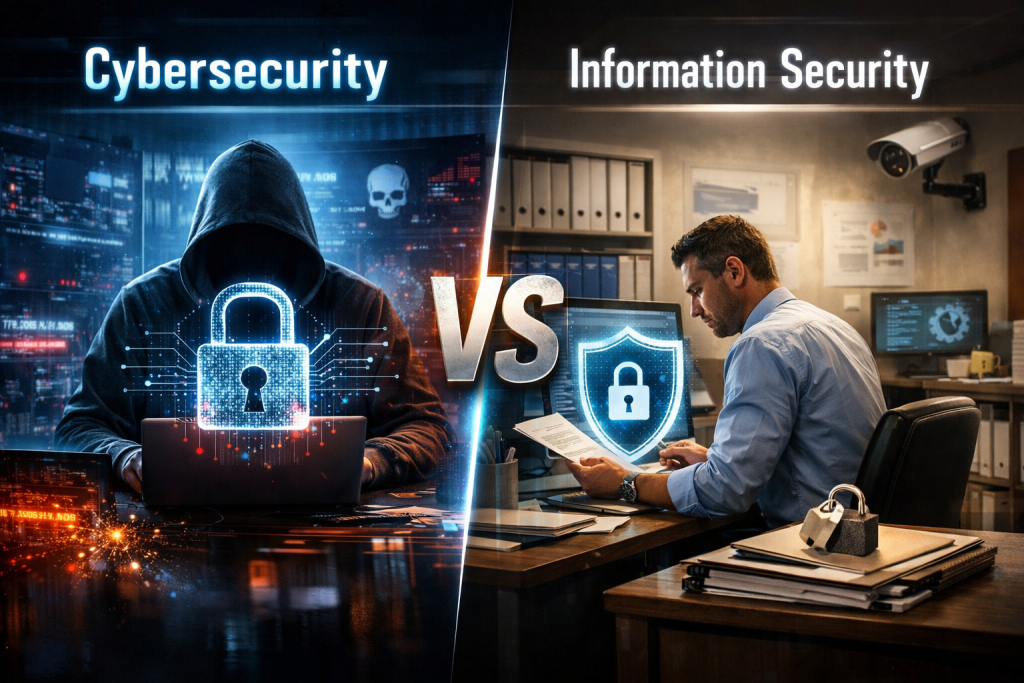
Many people searching for cybersecurity vs information security want a clear, practical explanation of how these two fields differ and where they overlap. Both aim to protect valuable assets, but they operate at different scopes and address different types of risks. Understanding the distinction helps organizations design more effective security strategies and allocate resources correctly. This article explains the differences, similarities, and real-world implications in a structured and practical way.
Understanding the Core Definitions
The comparison between cybersecurity vs information security starts with their basic definitions. Information security focuses on protecting information in all its forms, whether digital, physical, or verbal. This includes documents, printed records, intellectual property, and any data that holds value to an organization.
Cybersecurity, on the other hand, is concerned specifically with protecting digital systems, networks, and data from cyber threats. Its scope is limited to information that exists in electronic form and the technologies that store or transmit it. While cybersecurity is narrower in scope, it often requires deeper technical controls and constant monitoring.
In simple terms, information security is the broader discipline, while cybersecurity is a specialized subset within it. This distinction is foundational when discussing cybersecurity vs information security in professional contexts.
Scope and Assets Being Protected
A major difference in cybersecurity vs information security lies in what each discipline protects. Information security covers all information assets, regardless of medium. Paper files, contracts, employee records, whiteboard notes, and verbal communications all fall under its protection.
Cybersecurity is limited to digital assets such as databases, servers, cloud systems, endpoints, and network infrastructure. Its primary concern is preventing unauthorized digital access, data breaches, and system disruptions. This makes cybersecurity highly technical and tool-driven.
Because of this difference in scope, information security often includes policies and controls that have nothing to do with computers. Physical locks, secure filing cabinets, visitor logs, and confidentiality agreements are all valid information security measures.
Threat Models and Risk Focus
The threat landscape further separates cybersecurity vs information security. Information security addresses a wide range of risks, including human error, insider threats, physical theft, espionage, and accidental disclosure. A misplaced document or an overheard conversation can be just as damaging as a hacked server.
Cybersecurity focuses on threats originating from digital environments. These include malware, ransomware, phishing attacks, denial-of-service attacks, and unauthorized system access. The risks are often fast-moving, automated, and scalable, requiring constant vigilance.
Both disciplines rely on risk management, but their threat models differ significantly. Information security tends to emphasize governance and prevention across processes, while cybersecurity prioritizes detection, response, and technical resilience.
Controls, Policies, and Implementation
When comparing cybersecurity vs information security, implementation methods highlight another key difference. Information security relies heavily on policies, standards, and procedures. Examples include data classification policies, access control rules, document handling procedures, and employee awareness training.
Cybersecurity implementation is more technical by nature. It includes firewalls, intrusion detection systems, endpoint protection, encryption, vulnerability scanning, and security monitoring tools. These controls are often automated and require specialized expertise to manage.
Despite these differences, effective security programs integrate both approaches. Policies guide behavior and decision-making, while technical controls enforce protection at the system level. Separating them too rigidly can create gaps that attackers or accidents can exploit.
Roles, Skills, and Organizational Structure
The distinction between cybersecurity vs information security is also visible in professional roles and skill sets. Information security professionals often work in governance, risk, and compliance roles. Their skills include policy development, audits, risk assessments, and regulatory alignment.
Cybersecurity professionals are typically more technical. Their expertise covers network security, system hardening, incident response, and threat analysis. They often work closely with IT teams and operate security tools daily.
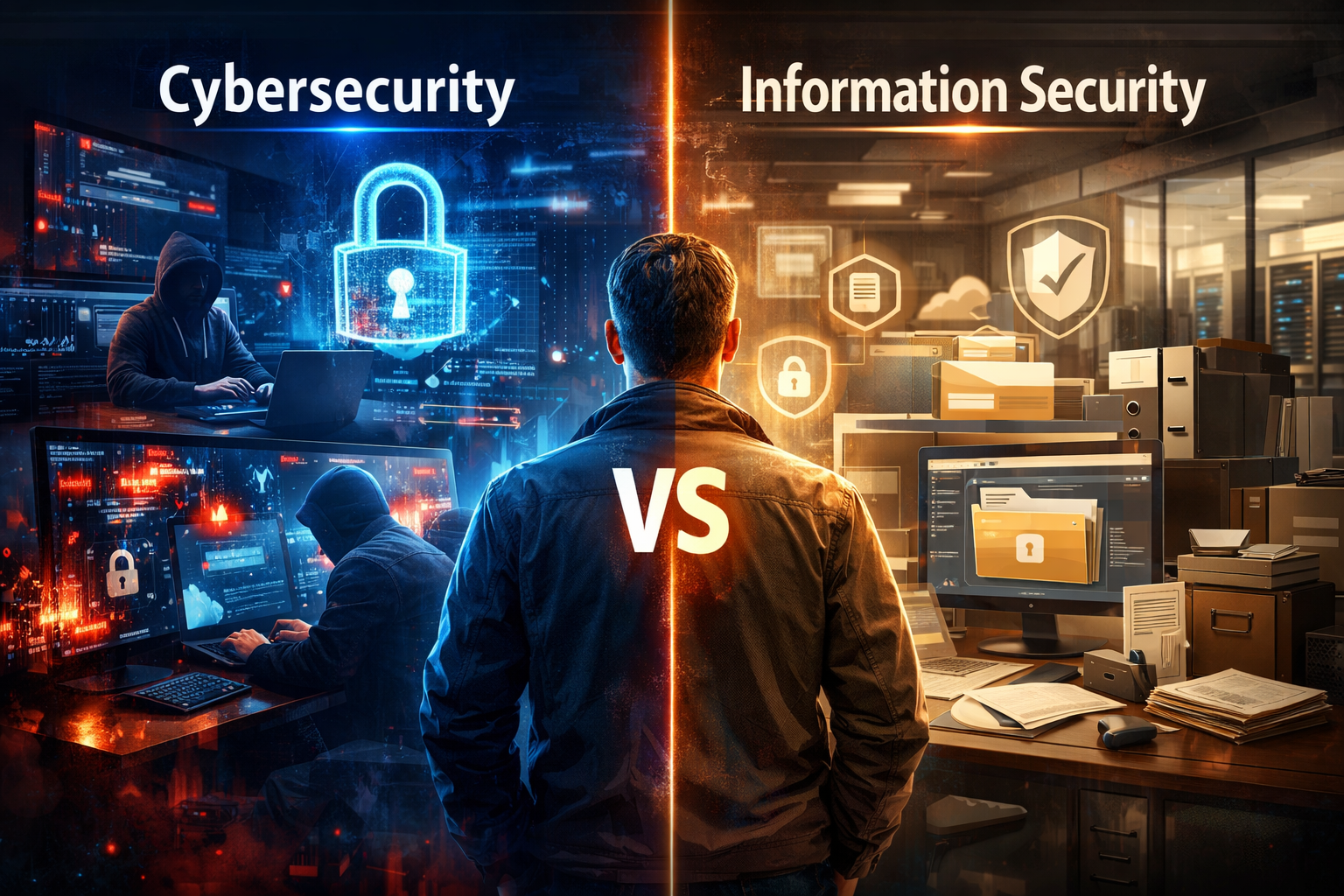
In many organizations, information security leaders define the overall security framework, while cybersecurity teams execute and maintain technical defenses. This division of labor ensures that both strategic and operational aspects of security are addressed.
Compliance, Standards, and Business Impact
Compliance requirements further clarify cybersecurity vs information security. Information security aligns closely with standards such as ISO/IEC 27001, which focuses on managing information security risks across the organization. These standards emphasize policies, risk management, and continuous improvement.
Cybersecurity contributes to compliance by implementing controls required by regulations like GDPR, HIPAA, or PCI DSS. Many of these regulations mandate specific technical protections for digital data. Without strong cybersecurity, compliance efforts often fail in practice.
From a business perspective, information security protects trust, reputation, and legal standing. Cybersecurity protects operational continuity and prevents costly digital incidents. Both have direct financial and strategic implications when neglected.
Why the Distinction Matters in Practice
Understanding cybersecurity vs information security is not just an academic exercise. Organizations that treat them as interchangeable often misallocate resources or overlook critical risks. Over-investing in tools while ignoring policies and training leaves human vulnerabilities exposed.
Conversely, focusing only on governance without technical enforcement leaves systems defenseless against modern cyber threats. Balanced security programs recognize the complementary nature of both disciplines. Each addresses risks the other cannot fully cover alone.
Clear definitions also improve communication between executives, security teams, and regulators. When everyone understands what cybersecurity and information security actually cover, decision-making becomes more precise and accountable.
Conclusion
The debate around cybersecurity vs information security is ultimately about scope, focus, and execution. Information security protects all forms of information through policies, processes, and governance, while cybersecurity safeguards digital systems through technical controls and continuous monitoring. They are not competitors but interdependent disciplines that work best when aligned. Organizations that understand and integrate both are better positioned to manage risk in an increasingly complex threat environment.
FAQ
Q: Is cybersecurity part of information security? A: Yes, cybersecurity is a subset of information security that focuses exclusively on protecting digital systems and electronic data.
Q: Which is broader, cybersecurity or information security? A: Information security is broader because it covers all forms of information, including physical and verbal, not just digital data.
Q: Do companies need both cybersecurity and information security? A: Yes, effective risk management requires both governance-based information security and technically focused cybersecurity controls.
Q: Can information security exist without cybersecurity? A: In theory yes, but in modern organizations digital data is unavoidable, making cybersecurity a necessary component.
Q: Are cybersecurity roles more technical than information security roles? A: Generally yes, cybersecurity roles focus more on technical systems, while information security roles emphasize policies, risk, and compliance.