
Cuban president promises ‘impregnable resistance’ to any US attempt to control island
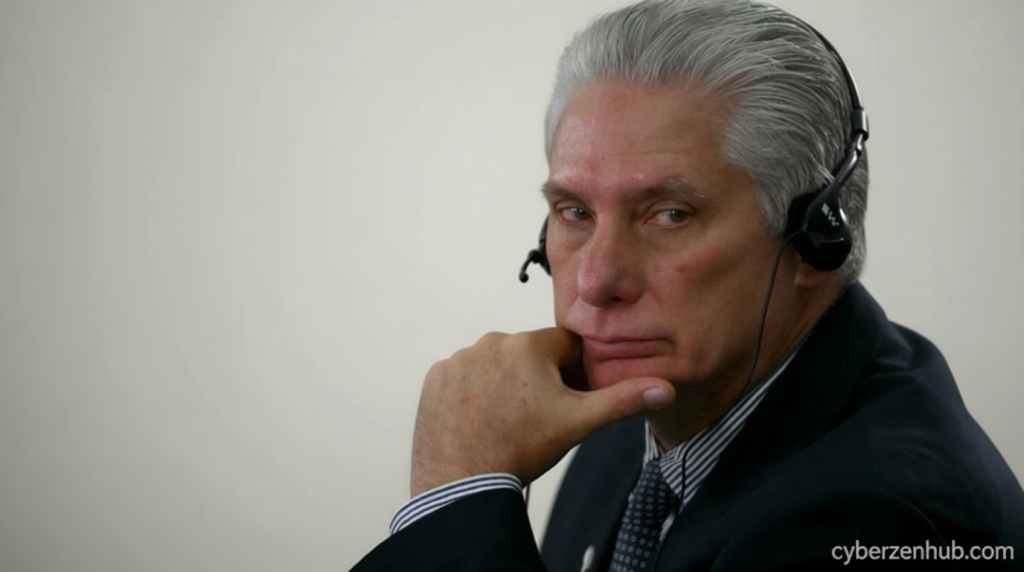
Cuban President Promises ‘Impregnable Resistance’ to Any U.S. Attempt to Control Island
Cuba’s leader, Miguel Díaz-Canel, vowed Tuesday that his nation would resist any U.S. effort to assert control, as power resumed in certain areas after a widespread grid failure. The president’s remarks came amid growing concerns about the economic strain on the island, which has been exacerbated by U.S. sanctions and trade restrictions.
Over the past six decades, successive U.S. administrations have aimed to isolate Cuba, Díaz-Canel noted in a defiant post on X. He criticized Washington for using Cuba’s economic vulnerability as a justification for intervention, claiming this is part of a broader strategy to punish the entire population. “Only in this way can the fierce economic war be explained,” he wrote, “which is applied as collective punishment against the entire people.”
“In the face of the worst scenario, Cuba is accompanied by a certainty: any external aggressor will clash with an impregnable resistance,” the president added. This statement was made as the nation grappled with its most severe blackout in recent years, leaving millions without electricity and forcing them to rely on alternative methods for basic needs.
U.S. President Donald Trump has long targeted Cuba’s communist government, often threatening to take control of the island. On Monday, he hinted at potential action, suggesting he could act as he pleased. By Tuesday, he reiterated: “We’ll be doing something with Cuba very soon.”
Secretary of State Marco Rubio echoed Trump’s stance, stating that Cuba requires “new people in charge.” “Their economy doesn’t work… They’re in a lot of trouble,” Rubio said, implying that current leaders lack the ability to address the crisis. “And the people in charge, they don’t know how to fix it, so they have to get new people in charge.”
Since the U.S. disrupted Cuba’s oil supply earlier this year, the nation has faced a major economic downturn. This has crippled its aging electricity infrastructure, leaving much of the population without power. On Monday, nearly all of Cuba’s 10 million residents were affected, with many cooking by candlelight and using torches due to the lack of fuel.
By Tuesday afternoon, electricity had been restored to approximately 55% of Havana’s residents and some regions in the west and central-east of the island. Despite this partial recovery, the outages have worsened the already challenging living conditions for Cubans, who have dealt with frequent blackouts for months.
“We, as people, as civilians, aren’t prepared for a war,” said Marianela Alvarez, a resident of Havana. “I want Trump to understand, to leave us alone.”
“I truly believe that there will be dialogue and understanding,” said Luis Enrique Garcia, another Havana resident. “It is love that should unite human beings, not war.”
“I don’t trust a dialogue with Trump,” remarked Amed Echenique, a local in Havana. “I don’t trust Trump as a person, even with the little I know about him. And so that’s something that doesn’t really give me hope.”
Díaz-Canel acknowledged that Cuban officials had initiated discussions with the U.S. to address bilateral issues, as reported on Friday. This marked the first official confirmation from Havana that talks were underway, although Trump had previously claimed Washington was already engaging in dialogue with Cuba. The leader’s comments underscored the fragile balance between diplomacy and the looming threat of U.S. intervention.