Pilot Emerges Unharmed After F/A-18 Hornet Plunges Into Washington Mountainside
Cyberzenhub.com – Body camera recordings captured by local law enforcement reveal the immediate aftermath of a military aircraft collision with a steep mountain slope in Washington state. The dramatic footage, made public on Friday by the Yakima County Sheriff’s Office, documents how a fighter pilot navigated the moments following his emergency ejection from an F/A-18 Hornet that went down earlier in the summer.
The incident occurred on June 13 in the vicinity of Rimrock Lake, situated approximately 55 miles to the southeast of Seattle. The powerful jet struck the mountainside with considerable force, creating a massive column of dark smoke that rose into the sky and sparked a wildfire in the surrounding forest. The aircraft belonged to Marine Aircraft Group 11, which operates under the 3rd Marine Aircraft Wing based in Miramar, California.
First Contact: The Pilot Meets Responders
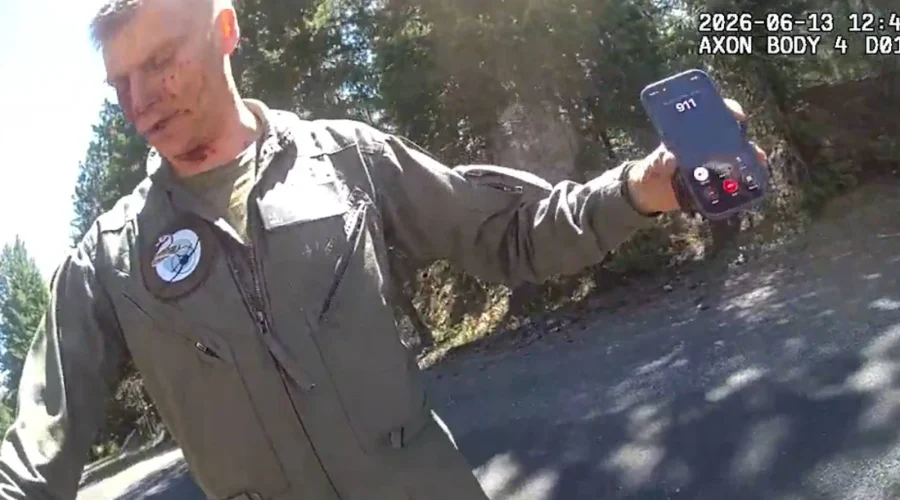
In the newly released body camera video, the pilot appears with visible blood on his face and seems visibly shaken but composed. He approaches responding deputies while holding his mobile phone, with the emergency call screen still active. One of the first responders asks what type of aircraft he was flying, to which the pilot identifies it as an F-18. When pressed further, he confirms, “Well, that was an F-18.”
“We were doing circles over the lake, doing some low-level training. …And then I tucked in, and I’m not sure exactly.”
A witness present at the scene tells the pilot, “You hit the tree bad, bud,” providing additional detail about the final moments before impact. The pilot later makes a phone call to notify others about the accident, saying simply, “Hey, buddy, I just crashed.”
Training Operations and Emergency Procedures
The aircraft was conducting routine training exercises when the incident occurred. Low-level training flights are standard operational procedures for military aviation units, allowing pilots to practice maneuvers at reduced altitudes. These exercises often involve flying in patterns over designated areas, which aligns with the pilot’s description of “doing circles over the lake.”
The F/A-18 Hornet is a versatile fighter aircraft widely used by the U.S. Navy and Marine Corps. Its ejection system is designed to safely extract pilots from failing aircraft at various altitudes and speeds. In this case, the pilot successfully ejected before the jet struck the mountain, which likely prevented more serious injuries. A parachute was later discovered hanging from a tree near the crash site, confirming the pilot’s descent path.
Injuries and Ongoing Investigation
Responding officers from the sheriff’s department reported that the pilot sustained only minor lacerations to his face. The 3rd Marine Aircraft Wing issued a statement at the time describing the event as a “non-fatal aviation mishap” during routine training operations.
Aviation safety investigations typically involve multiple phases, including examination of flight data recorders, witness interviews, and analysis of weather conditions. The Yakima County Sheriff’s Office released a still photograph from their body camera footage on August 14, 2026, showing the pilot during his initial encounter with local authorities. The official cause of the crash remains under investigation, with investigators examining all potential contributing factors.
The Rimrock Lake area, located in the Cascade Range, is known for its rugged terrain and dense forest cover. Mountainous regions present unique challenges for aviation operations, particularly during low-level training flights where pilots navigate close to natural obstacles. The wildfire ignited by the crashing aircraft was contained by local fire departments, preventing further spread into the surrounding wilderness.
Marine Aircraft Group 11 has a long history of conducting training exercises across multiple states, with Washington being one of several locations used for their operational readiness programs. The group’s presence in Miramar, California, positions it to conduct diverse training scenarios ranging from coastal operations to mountain terrain navigation.
As the investigation continues, officials have not released additional details about what may have caused the pilot to lose control or deviate from the planned flight path. Aviation safety experts note that even experienced pilots can encounter unexpected conditions during training exercises, and the successful ejection and minimal injuries demonstrate the effectiveness of modern aircraft safety systems and emergency procedures.
Related Reading
Frequently Asked Questions
What is Hey buddy I just crashed?
Hey buddy I just crashed is the main topic of this guide. The article explains the context, practical details, and next steps readers should understand.
Why does Hey buddy I just crashed matter?
Hey buddy I just crashed matters because readers are looking for a useful answer, not just a short summary. Good content should match search intent and help them decide what to do next.