Democratic Candidates Are Staking Their Campaigns on Faith, Challenging a Decades-Long Republican Grip on Religious Voters
Cyberzenhub.com – The 2026 midterm cycle is producing an unusual sight on the campaign trail: Democratic candidates openly naming their churches, their scripture, and their pastoral duties as the backbone of their political identities. For nearly four decades, the Republican Party has treated evangelical and mainline Protestant voters as a near-exclusive constituency, a relationship cemented by what scholars have described as a mass migration of religiously motivated voters beginning in the 1980s. Now, in several of the most closely watched Senate and gubernatorial contests that will determine which party controls the next Congress, Democrats are deliberately stepping into that space and asking voters to weigh their faith alongside their policy positions.
The Texas Senate Race and the Case of James Talarico
Perhaps no contest illustrates this strategy more sharply than the Texas Senate race. State Representative James Talarico, who is also enrolled as a seminarian, is challenging Republican nominee Ken Paxton, the state attorney general. Paxton’s tenure has been shadowed by multiple scandals, most notably his impeachment as the first Texas official to face that procedure since 1917. He was ultimately acquitted by the Texas Senate, but the episode left a mark on his public standing.
Talarico has framed his candidacy around a theological ethic of neighbor-love rather than partisan combat. Speaking at a campaign rally in Pasadena, Texas, on August 9, 2026, as part of his “New American Dream Tour,” he offered a pointed critique of the adversarial style that has dominated state politics.
“I think in Texas, across the political spectrum, there is a deep hunger for a different kind of politics, not one that’s rooted in fear or hate or division, but one that’s rooted in love, and that old politics that we’ve been suffering under for the last 10 years — politics as bloodsport, as trolling and owning, as as total war — that, that politics is dying, and a new politics is being born.”
For a state where Republican candidates have long courted conservative Protestant voters with moral-issues messaging, Talarico’s approach represents a direct counter-narrative: the claim that Christian ethics points toward reconciliation rather than tribal warfare.
Kansas: A Mega-Church Pastor Enters the Senate Race
In Kansas, the strategy takes a different form. Rev. Adam Hamilton, who leads what is described as the largest United Methodist congregation in the country, has entered the U.S. Senate race. Hamilton, based in Lenexa, Kansas, conducted a listening tour through April 2026, meeting voters at venues ranging from breweries to community halls. His candidacy is notable not merely because he is a Democrat running in a reliably red state, but because his primary credential in the eyes of many local voters is his pastoral role rather than any prior elected-office experience.
Iowa: Faith Woven Into Two Separate Races
Iowa’s competitive 2026 contests feature two additional examples. State Auditor Rob Sands, the Democratic nominee for governor, has tied his Lutheran upbringing to his party identification, telling supporters on the trail that “Jesus is for the little guy.” The remark positions his candidacy as an extension of his faith commitments rather than a departure from them.
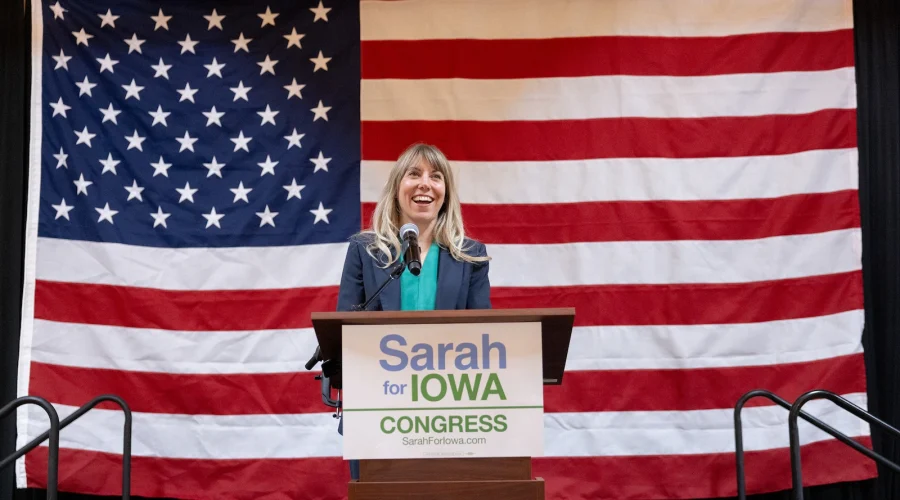
In a closely watched Iowa House district, Democratic state Senator Sarah Trone Garriott, an ordained Lutheran minister, is seeking to unseat Republican incumbent Rep. Zach Nunn. Garriott, who has served in the state senate since 2021, spent nine years preaching on weekends for the Des Moines Area Religious Council (DMARC) Food Pantry Network, an interfaith nonprofit that distributes meals to tens of thousands of people monthly. Although she no longer holds a formal role with DMARC, she continues to preach regularly, describing the practice as essential to staying “grounded in what really, really matters.”
“My faith is not a campaign strategy. It’s just a really important part of who I am.”
Garriott credits her years of interfaith ministry with building relationships that translate into electoral access. She describes winning tough statehouse races by being “really accessible to people,” a quality she attributes to her background as a religious leader who spent decades sitting across from congregants of varied denominations.
What the Data Shows About Religious Voter Alignment
The strategic logic behind these candidacies rests on shifting demographic realities. A 2024 Pew Research survey found that religiously unaffiliated voters lean Democratic by roughly 70 percent to 27 percent for Republicans. Among registered voters who attend worship services at least monthly, however, Republican alignment reaches 62 percent, compared with 41 percent among those who attend less frequently. The gap between frequent and infrequent attendees underscores why Democrats are now targeting the latter group: voters who maintain a faith identity but do not attend weekly services represent a sizable, persuadable middle ground.
Garriott herself frames the outreach in theological terms. The commandment to “love my neighbor,” she explained, applies to people “even if they’re coming from a different place,” a formulation that explicitly invites voters of other denominations or no denomination into the conversation.
An Established Precedent: Raphael Warnock
The idea that a pastor’s pulpit can translate into legislative power is not new. Senator Raphael Warnock, who serves as senior pastor of the historic Ebenezer Baptist Church in Atlanta—the same congregation where Rev. Martin Luther King Jr. once served as co-pastor alongside his father—flipped a Republican-held Georgia Senate seat in a special election. Warnock has spoken publicly about how his faith defines his public life, and his presence in the Senate has given other clergy-adjacent candidates a visible template.
Implications for the Midterm Landscape
Whether these candidates convert enough religiously motivated voters to alter the balance of power remains an open question. What is clear is that the Democratic Party is no longer treating faith-based voters as a lost cause. By placing seminarians, ordained ministers, and megachurch pastors at the center of competitive races, the party is testing whether a theology of neighbor-love can compete, in the minds of voters, with the moral-issues platform that has anchored Republican electoral strategy since the Reagan era. The answer will be written in the ballot boxes of Texas, Kansas, and Iowa this November.
Related Reading
Frequently Asked Questions
What is Some Democrats trying to reclaim the issue?
Some Democrats trying to reclaim the issue is the main topic of this guide. The article explains the context, practical details, and next steps readers should understand.
Why does Some Democrats trying to reclaim the issue matter?
Some Democrats trying to reclaim the issue matters because readers are looking for a useful answer, not just a short summary. Good content should match search intent and help them decide what to do next.