Washington’s Strait of Hormuz Doctrine Quietly Collapses as Iran Keeps Striking Shipping
Cyberzenhub.com – The United States has effectively abandoned the proportional-retaliation framework it announced at the outset of its confrontation with Iran over commercial shipping. What began as a blunt promise to answer every Iranian missile or drone with a heavier American blow has, over the course of roughly two weeks, dissolved into silence. Ships continue to take hits in the Strait of Hormuz and the Bab al-Mandeb corridor, yet no new American strike has been publicly announced since late July, and the president himself has begun describing the incidents as little more than irritations.
From “20-to-1” to “Nuisance Value”
The pivot point came on July 7, when President Donald Trump declared the June memorandum of understanding between Washington and Tehran “over” and vowed that any future Iranian attack on a merchant vessel would trigger what he framed as overwhelming American force. Speaking to reporters that day, he laid out the arithmetic of his approach:
“We just hit them very hard, and I say we hit them 20-1. Every time they hit us, we’re going to hit them 20. And when they hit, we hit back much harder.”
For the following days and nights, the rhetoric matched the action. U.S. forces carried out strikes on Iranian targets, including a stretch of thirteen consecutive nights of bombardment. In total, American military operations responded to shipping attacks across sixteen days in that initial window. Secretary of State Marco Rubio reinforced the posture publicly at the Association of Southeast Asian Nations summit in the Philippines on July 22, telling reporters:
“The president’s policy is a head for an eye. I mean, honestly, that’s what it’s going to be. I mean, they will pay a very heavy price.”
Secretary of Defense Pete Hegseth echoed the same line of reasoning on multiple occasions during that period. The message was consistent: every Iranian shot at a ship would be answered with disproportionate American force.
The Numbers Tell a Different Story Now
Since the last publicly acknowledged U.S. strike on Iranian targets on July 29, eleven commercial vessels have been struck in either the Strait of Hormuz or the Bab al-Mandeb Strait, according to data tracked by the United Kingdom Maritime Trade Operations (UKMTO) Centre. Crew members have been killed and wounded. Yet U.S. Central Command (CENTCOM), the theater command responsible for American forces across the Middle East, has issued no announcement of retaliatory operations in response to any of those eleven incidents.
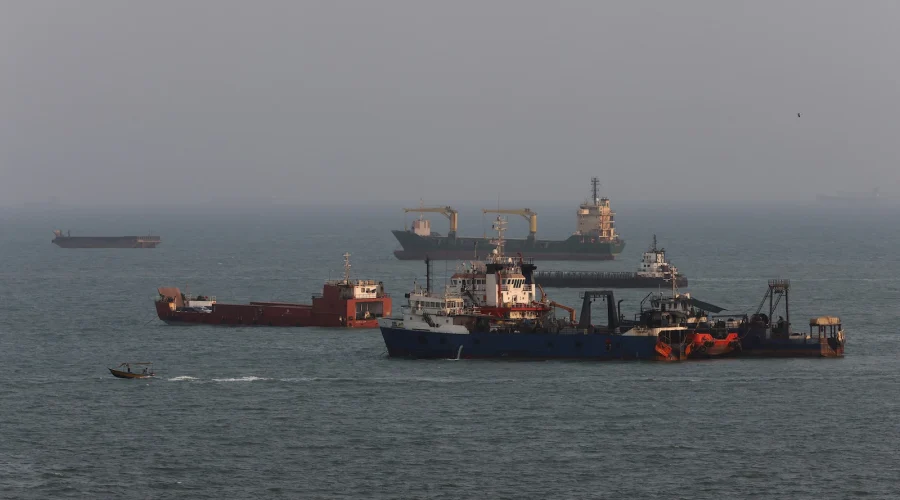
Shipping traffic through the chokepoint has contracted sharply. Ship-tracker data from Kpler showed that on the most recent Tuesday counted, transits through the Strait of Hormuz fell seventeen percent from the prior day, dropping to just ten movements — six vessels leaving the Persian Gulf and four entering. The strait, which normally carries roughly a fifth of global seaborne oil, has become a corridor where captains weigh the risk of anchoring off the coast of Bandar Abbas against the cost of rerouting around the Cape of Good Hope.
Trump’s Recalibrated Messaging
On July 22, the president posted on his social media platform that from that point forward, any Iranian shot at a ship in the strait would prompt the United States to “bomb and destroy ONE BRIDGE OR POWER PLANT, including those located next to, or in, the Capital City of Tehran.” The language was specific and threatening. Weeks later, however, his public tone has softened considerably. On Wednesday, he characterized ongoing attacks on commercial vessels as carrying only “nuisance value,” a characterization that departs sharply from the standard Washington maintained throughout the earlier phase of the conflict, when it treated every shipping strike as a casus belli warranting immediate kinetic response.
At the same time, the president continues to insist that the United States exercises “complete control” of the strait, a claim that sits uneasily alongside the documented pattern of repeated Iranian strikes and the measurable collapse in commercial transit volumes.
What the Shift Means
The strategic recalibration raises questions that have no clean answers. If the administration no longer treats individual shipping strikes as triggers for escalation, what threshold, if any, would prompt a return to kinetic retaliation? The earlier tit-for-tat formula — articulated by the president himself and reinforced by his cabinet — created expectations among regional allies, shipping insurers, and the Iranian military alike. Walking back that formula without a stated replacement leaves a gap in deterrence logic that Tehran appears to be probing with continued missile and drone launches.
For the roughly seventeen commercial vessels struck between the MOU’s collapse and the July 29 strike, the American response was immediate and repeated. For the eleven that have followed, the response has been, so far, rhetorical. The gap between those two periods is where the current crisis lives: not in any single explosion, but in the unanswered question of what Washington considers worth answering with force.
The Strait of Hormuz remains open, technically. Ships still move through it, albeit in far smaller numbers. Whether that reduced traffic represents a temporary lull or the new normal will depend on whether the administration reasserts the proportional-retaliation standard it announced in early July — or whether “nuisance value” has become the operative category for American military planning in the Gulf.
Related Reading
Frequently Asked Questions
What is Trump appears to have dropped his tit?
Trump appears to have dropped his tit is the main topic of this guide. The article explains the context, practical details, and next steps readers should understand.
Why does Trump appears to have dropped his tit matter?
Trump appears to have dropped his tit matters because readers are looking for a useful answer, not just a short summary. Good content should match search intent and help them decide what to do next.