
Deportation Flight Lands in Haiti as TPS Era Closes for Hundreds of Thousands
Cyberzenhub.com – A chartered Immigration and Customs Enforcement aircraft touched down at Cap Haitien Airport on Thursday, carrying 161 passengers who had been removed from the United States. The departure point was Alexandria, Louisiana, and the arrival was confirmed independently by a Department of Homeland Security official and by Haiti’s National Civil Aviation Office. All 161 individuals were released upon landing. Whether any of the passengers had previously held temporary protected status remains unconfirmed.
The flight marks a distinct milestone: it is the first deportation operation directed at Haiti since the Trump administration formally terminated the country’s TPS designation. ICE had conducted deportation flights to the Caribbean nation earlier in the administration’s tenure, but those operations predated the expiration of TPS protections. Thursday’s departure represents the first time the agency has moved Haitian nationals under the post-TPS enforcement regime.
The Supreme Court Decision That Triggered the Shift
The legal pathway to this moment ran through the nation’s highest court. In June, the U.S. Supreme Court issued an order permitting the administration to cancel TPS for Haiti and several other countries, including Ethiopia, Somalia, Syria, and Myanmar. The ruling cleared the way for the government to end protections that had shielded more than 350,000 Haitian residents from removal proceedings. Once the court’s order took effect, DHS moved to terminate the designation, converting what had been a protected status into a removable one for hundreds of thousands of people who had lived, worked, and built families in American communities for years.
TPS itself is a temporary immigration mechanism that Congress authorized in 1990. It allows the executive branch to grant work authorization and protection from deportation to nationals of countries experiencing armed conflict, natural disasters, or other extraordinary conditions. Haiti received TPS in 2010 following a devastating earthquake, and the status was extended repeatedly over the following decade. For many recipients, TPS became a de facto permanent residence, even though the program was always framed as interim.
Enforcement on the Ground: Ohio and Beyond
The administrative machinery behind the flights has already reached into everyday American life. In Ohio, hundreds of Haitian immigrants who had resided in the country under TPS received summons from DHS ordering them to appear for in-person check-ins at agency offices. At those appointments, some individuals were fitted with electronic ankle monitors — devices typically associated with pretrial detainees or those on supervised release — effectively placing them under continuous electronic surveillance while their cases were processed.
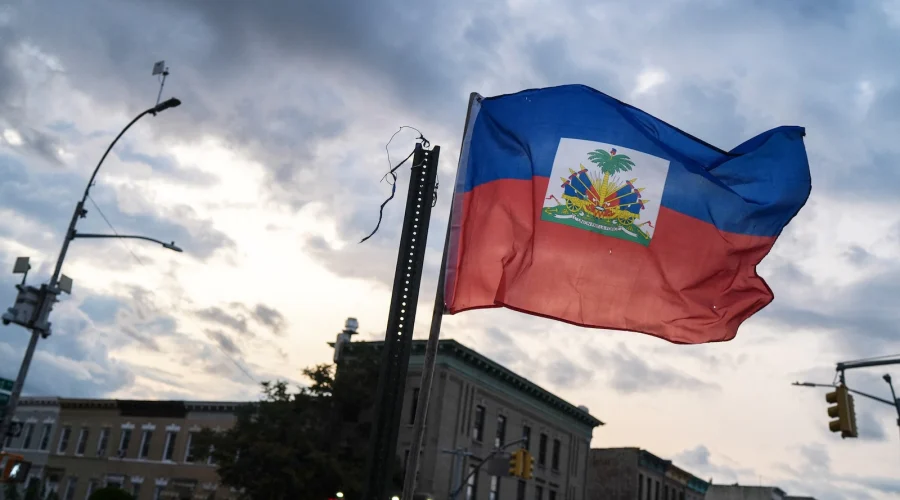
The Little Haiti neighborhood of Brooklyn, New York, where Haitian culture has taken deep root over three decades, has become a visible symbol of the community now facing displacement. A Haitian flag flying over the borough on July 29, 2026, captured by photographer Ryan Murphy for AFP via Getty Images, underscores how embedded this diaspora has become in American urban life even as federal policy moves to uproot it.
A Parallel Track: Liberia as Third-Country Destination
On the same Thursday, a separate deportation flight arrived in Liberia, representing the first forced third-country transfer to that West African nation under a bilateral deportation agreement with the United States. The Liberia operation signals that the administration is expanding its network of receiving countries beyond traditional destinations, using agreements that allow the government to send removed individuals to nations with which they may have no familial, linguistic, or economic ties.
What Happens Next
With TPS now extinguished for over 350,000 Haitians and the enforcement infrastructure actively deployed — from ankle monitors in Ohio to chartered flights out of Louisiana — the practical question for affected families is timing and logistics. DHS has indicated that check-in requirements will continue rolling out across states with significant Haitian populations. Those who fail to appear at scheduled appointments risk accelerated removal proceedings.
The broader implication extends beyond Haiti. Because the Supreme Court’s June order also cleared the cancellation of TPS for Ethiopia, Somalia, Syria, and Myanmar, similar deportation operations targeting those nationalities are likely to follow in coming months. The administrative template established by the Haiti flights — departure from a Gulf Coast airport, chartered transport, landing at a regional airport, and release into a country with limited infrastructure to absorb sudden arrivals — may become the standard operating procedure for all affected groups.
For the 161 individuals who stepped off the aircraft at Cap Haitien on Thursday, the immediate reality is a country that has endured political instability, cholera outbreaks, and economic contraction since the 2010 earthquake that originally triggered their protected status. The flight home, however it is framed in official communications, lands them in a nation still rebuilding from the very crisis that once made their temporary stay in the United States possible.
Related Reading
Frequently Asked Questions
What is Trump admin sends 1st deportation flight?
Trump admin sends 1st deportation flight is the main topic of this guide. The article explains the context, practical details, and next steps readers should understand.
Why does Trump admin sends 1st deportation flight matter?
Trump admin sends 1st deportation flight matters because readers are looking for a useful answer, not just a short summary. Good content should match search intent and help them decide what to do next.