Cyberzenhub.com – The US Treasury sanctions Ecuador to US cocaine trafficking network announcement landed Thursday, when the department named 15 individuals tied to an alleged pipeline moving thousands of kilograms of cocaine each month from Ecuadorian waters through Mexico and into American markets. The move underscores the Trump administration’s broader push to intensify joint counter-narcotics operations across Latin America, a campaign that has already seen more than 200 fishermen killed in the Caribbean and Pacific as U.S. forces ramp up interdiction activity.
Sanctions Target a 15-Member Cocaine Pipeline
According to the Treasury Department, the sanctioned individuals operate under the cover of legitimate fishing businesses. A fleet of Ecuador-based vessels stationed near the port city of Manta allegedly transfers cocaine to small power boats — commonly called “go-fast” vessels — which then transit northward through the Eastern Pacific Ocean (EPAC) toward the United States. Once the cargo reaches Mexican waters, the Sinaloa Cartel and the Cartel de Jalisco Nueva Generación (CJNG) assume responsibility for the final leg of the journey into the U.S.
Washington identified the Ecuadorian operators as members of Los Choneros and Los Lobos, two gangs previously designated by the State Department as foreign terrorist organizations. Both Mexican cartels involved in the downstream transport likewise carry FTO designations, making this one of the more tightly linked cross-border networks the Treasury has targeted under its US Treasury sanctions Ecuador to US enforcement framework.
“Operating under the guise of legitimate fishing businesses, a fleet of Ecuador-based vessels near Manta, Ecuador, secretly transfers cocaine to small power boats — known as go-fast vessels — that transit north through the Eastern Pacific Ocean (EPAC), en route to the United States.” — U.S. Treasury Department
Maritime Patrols and Ecuador’s Escalating Drug Crisis
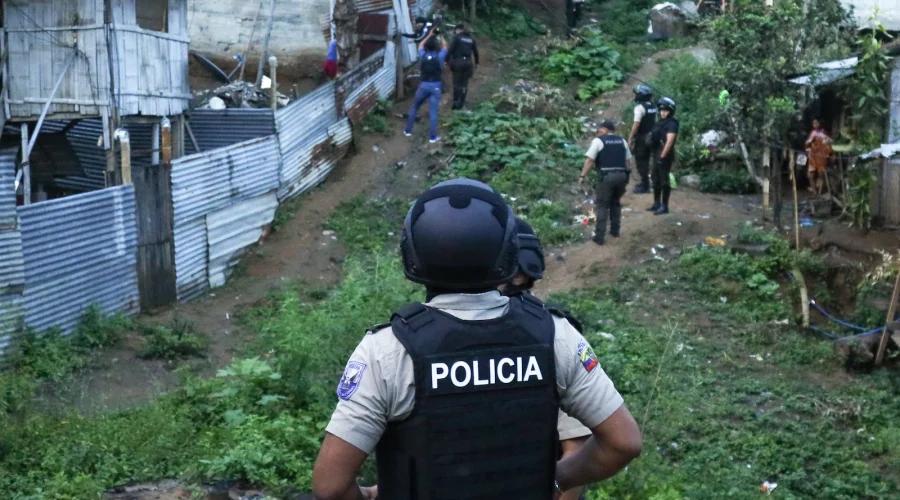
Ecuador, sandwiched between Colombia and Peru — the world’s two largest cocaine producers — has struggled to contain cartel-linked violence since 2021. Rival organizations have embedded themselves with local gangs, fighting for control of coastal ports and overland smuggling corridors. The human toll is stark: last year the country recorded its highest homicide rate in decades, at 50 murders per 100,000 residents, according to the Ministry of the Interior.
Under President Daniel Noboa, Ecuador has aligned closely with Washington on counter-narcotics policy. On Thursday, Defense Minister Gian Carlo Loffredo announced that two U.S. warships equipped with interceptor boats and helicopters will patrol Ecuador’s territorial waters to bolster the fight against trafficking. Loffredo made the announcement on his Instagram account the day after meeting General Francis Donovan, commander of U.S. Southern Command, in Manta. He did not specify a start date for the joint patrols.
“This means we will triple our interdiction capabilities in the maritime zone,” Loffredo said, adding that three Black Hawk helicopters are already positioned in Manta and will be conducting operations. The Associated Press reached out to U.S. Southern Command for further details but had not received an immediate response at the time of publication.
Frequently Asked Questions
How many people were sanctioned in this action? The U.S. Treasury named 15 individuals connected to the Ecuador-to-U.S. cocaine trafficking network.
Which gangs and cartels are involved? On the Ecuadorian side, Los Choneros and Los Lobos were identified. On the Mexican side, the Sinaloa Cartel and the Cartel de Jalisco Nueva Generación (CJNG) handle downstream transport. All four organizations carry foreign terrorist organization designations.
What route does the cocaine take? Cargo moves from Ecuador-based vessels near Manta to small “go-fast” boats, which cross the Eastern Pacific Ocean northward. Mexican cartels then carry the product through Mexico into the United States.
When will the U.S. maritime patrols begin? Defense Minister Loffredo did not specify a start date. He confirmed that three Black Hawk helicopters are already positioned in Manta and will conduct operations in coordination with Ecuadorian forces.