Roberts Halts Court Order, Keeping White House Ballroom Work Uninterrupted
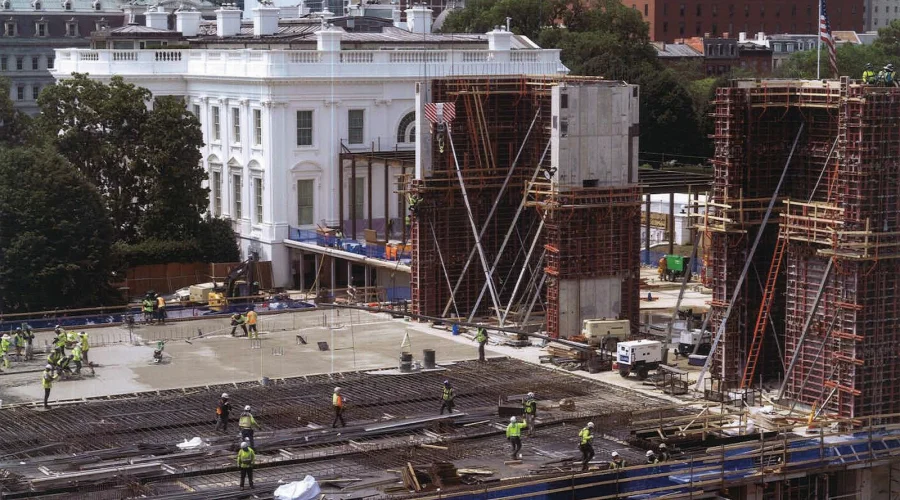
Cyberzenhub.com – Construction crews will keep hammering away at the sprawling East Wing project on the White House grounds after Chief Justice John Roberts issued a short administrative stay on Friday, blocking a lower-court injunction that was scheduled to take effect later that same day. The order, just two sentences long, pauses the judicial halt on most above-ground work at what the administration has labeled a “military complex” now roughly 65 percent finished. Officials have pegged the total cost of the ballroom undertaking at approximately $400 million.
The stay is explicitly temporary and narrow in scope. It does not signal any ruling on the merits of President Donald Trump’s appeal of the injunction, nor does it articulate why the Supreme Court requires additional time before issuing a formal decision. Its practical effect, however, is immediate: work proceeds without interruption while the justices deliberate.
The Legal Path That Brought the Case to the High Court
The dispute traces back to late 2025, when Trump ordered the unilateral demolition of the White House East Wing to clear space for a new 90,000-square-foot structure. A federal district court subsequently held that the president had exceeded his statutory authority by tearing down the wing and commencing construction of the ballroom without obtaining congressional approval. A divided appeals court affirmed that ruling earlier this month, setting the stage for the Supreme Court appeal.
The suit was brought by the National Trust for Historic Preservation, which has argued that the president must answer to federal property statutes just like any other federal actor. Under longstanding law, Congress retains control over federal property, including the grounds surrounding the Executive Residence. At the same time, that same body of law has long permitted presidents to carry out the “care, maintenance, repair, alteration, refurbishment, and improvement … of the Executive Residence.” The litigation hinges on where routine upkeep ends and a transformative new construction project begins.
The administration’s position is that upgrades to the White House fall squarely within the president’s prerogative and become unreviewable by any judge once national-security considerations enter the picture. The White House has consistently described the ballroom not as a decorative addition but as a critical military installation essential to the nation’s defense posture.
The National-Security Framing
Central to the administration’s argument is the Presidential Emergency Operations Center, or PEOC, which has occupied space beneath the East Wing since the 1940s. Trump has pointed to that subterranean command center as the reason the project transcends ordinary architecture and enters the realm of wartime preparedness.
“You know, that started off as a ballroom. And before we started work, the military came to see me. And they say, ‘Sir, we have an opportunity to do something incredible here. And we’ve been trying to do it for 100 years, but we’ve never had an opportunity like that,'” Trump said.
That framing has drawn sharp criticism from preservation advocates and legal scholars, who note that the PEOC has existed for decades without requiring a full-scale demolition and reconstruction of the wing above it. They argue the national-security label functions as a shield against judicial review rather than a genuine operational necessity.
Trump’s Own Words on the Pending Decision
Earlier in the week, a reporter pressed the president on what he would do should the Supreme Court ultimately rule against him on the ballroom construction. His response was characteristically dismissive:
“Well, we hope that doesn’t happen. I can’t imagine it happening.”
The remark underscored the administration’s confidence that the justices would side with the executive branch, a confidence now reinforced—though not conclusively—by Roberts’s stay. The chief justice’s move keeps the project alive through the pendency of the appeal but leaves open the possibility that a full bench could later reverse the lower courts’ findings and order a halt or modification of the work.
Why the Stay Matters Beyond the White House
For observers of separation-of-powers doctrine, the case carries implications well beyond one building in Washington. If the Supreme Court ultimately sides with the administration, it would effectively permit a president to reconfigure a major federal structure—complete with demolition of an existing wing—on the strength of a national-security designation, without legislative authorization. If the court sides with the district and appeals courts, it would reaffirm that Congress’s property-control statutes constrain even the most expansive executive ambitions on the White House grounds.
The two-sentence stay, for all its brevity, keeps that question alive. Until the justices issue a formal opinion, the cranes remain over the East Wing, the $400 million expenditure continues, and the legal battle over who ultimately controls the physical footprint of the presidency plays out in courtrooms rather than on the construction site.
Related Reading
Frequently Asked Questions
What is Supreme Court chief justice allows construction?
Supreme Court chief justice allows construction is the main topic of this guide. The article explains the context, practical details, and next steps readers should understand.
Why does Supreme Court chief justice allows construction matter?
Supreme Court chief justice allows construction matters because readers are looking for a useful answer, not just a short summary. Good content should match search intent and help them decide what to do next.