Federal Ballot Tracking System Takes Shape as USPS Finalizes Verification Mandate
Cyberzenhub.com – A sweeping new postal regulation would require every state to tag each outgoing mail-in ballot with a unique barcode linked to the recipient’s name and residential address, creating a federally accessible record of who received a vote-by-mail envelope before it ever enters the delivery network. The United States Postal Service finalized the rule this week, though its provisions remain frozen under a court injunction that must be lifted before any state is obligated to comply. USPS officials stated the system would activate immediately once the judicial hold is removed, leaving no transition period for state election offices to adjust their workflows.
How the Barcode-and-Portal Mechanism Would Operate
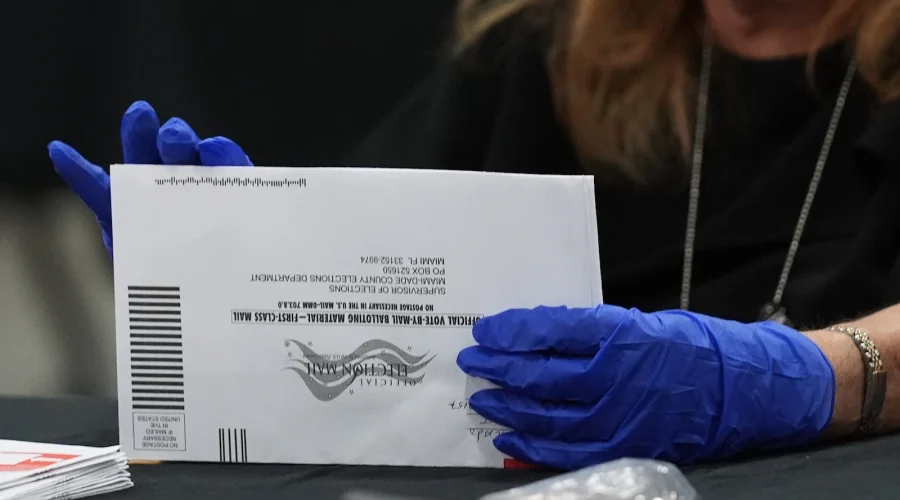
Under the finalized text, state election authorities must gather a voter’s full name and home address and encode that data into a barcode printed directly onto the ballot envelope. Before the envelope is handed to the postal system, the state office must transmit the same information into what the rule calls a “federal ballot mail portal.” Only after that electronic entry is confirmed does the ballot qualify for entry into the mail stream. USPS made clear the consequence of non-compliance: ballots bound for any state that has not implemented the verification step will simply not be delivered.
The rule explicitly draws a boundary around what data travels through the portal. The agency stated that no birthdate, Social Security number, or other voter-registration detail will be uploaded. It further declared that the Postal Service will take no part in determining voter eligibility, maintaining voter rolls, or counting ballots. In practical terms, the system functions as a delivery-verification ledger rather than a voter-eligibility database, though the line between those two roles remains a point of active debate among election-law scholars.
Constitutional and Practical Concerns
Critics argue that funneling voter-identifying data into a federal portal, even in limited form, shifts a piece of election administration from the states to Washington. The Constitution assigns the conduct of elections to state legislatures, and consolidating even basic contact information at the federal level could, opponents warn, open the door to broader federal influence over who appears on the rolls.
“If the administration can determine who is American enough to register to vote, who can prove it sufficiently, then they would have a lot of power to shape the electorate,” said Jonathan Diaz, director of voting advocacy for the bipartisan nonprofit Campaign Legal Center.
The rule’s own text acknowledges a law-enforcement dimension. USPS wrote that the collected data “will help to facilitate enforcement of federal law” and that it “will provide federal law enforcement with a list of individuals to whom states planned to mail a ballot (and who may potentially use the mail to vote), along with the associated barcode data.” That language gives federal agencies a named, address-linked roster of prospective mail-ballot voters, a dataset that did not previously exist in any centralized form.
Where the Rule Falls Short of the President’s Broader Agenda
The finalized postal rule is considerably narrower than the March executive order President Donald Trump signed on mail-in voting. That order called for statewide voter-citizenship lists drawn from Social Security Administration or immigration databases, uniform ballot formats across all fifty states, and a directive for USPS to coordinate with its Office of Inspector General and the Department of Justice to investigate suspected unlawful use of the mail involving federal election materials. Most of those elements appear in the final rule only in diluted form. Citizenship verification, uniform ballot design, and a formal DOJ investigation mandate were all dropped or softened.
The rule also stops short of a outright ban on mail-in voting. It does not incorporate the military, disability, illness, and travel exceptions the president had requested, nor does it eliminate the mail-ballot option for any category of voter. What it creates instead is a tracking-and-verification layer that follows each envelope from state office to recipient’s mailbox.
The SAVE America Act and Congressional Gridlock
The postal rule lands amid months of stalemate over the SAVE America Act, the Republican Party’s flagship election-reform bill. That legislation would require voters to present a photo identification card and proof of citizenship at registration. The president has pressed repeatedly for its passage, even calling for elimination of the Senate filibuster to clear the procedural hurdle. On social media he wrote:
“To Vote a person must show PHOTO VOTER I.D., PROOF OF CITIZENSHIP, AND THAT THERE WILL BE NO MORE CROOKED, CORRUPT, & DESTABILIZING MAIL-IN BALLOTS (EXCEPTIONS for Military, Disabled, Illness, and Travel!)”
“THE SAVE AMERICA ACT’S non-passage is CRAZY, and a serious threat to any politician who votes against it!”
Democrats and a bloc of Republican lawmakers have argued the bill’s requirements would disenfranchise millions of American voters, particularly in states where photo-ID mandates already exist at the state level and where proof-of-citizenship documentation is difficult for elderly, rural, or recently naturalized residents. The White House did not immediately respond to a request for comment on the finalized postal rule.
What Comes Next
With the injunction still in place, no state faces an immediate compliance deadline. But the rule’s architecture is now fixed: the portal, the barcode standard, and the delivery-withholding threat are all codified. If a court lifts the hold, state election offices would need to build or adapt data-entry systems, procure barcode-printing capability for ballot envelopes, and train staff on the new workflow before the next mail-ballot cycle. For voters, the visible change would be minimal—a small barcode on the back of the envelope—while the invisible change would be a federally maintained index of every person who received a vote-by-mail ballot, complete with name, address, and the timestamp of its entry into the postal system.
Related Reading
Frequently Asked Questions
What is USPS makes new rules for mail?
USPS makes new rules for mail is the main topic of this guide. The article explains the context, practical details, and next steps readers should understand.
Why does USPS makes new rules for mail matter?
USPS makes new rules for mail matters because readers are looking for a useful answer, not just a short summary. Good content should match search intent and help them decide what to do next.