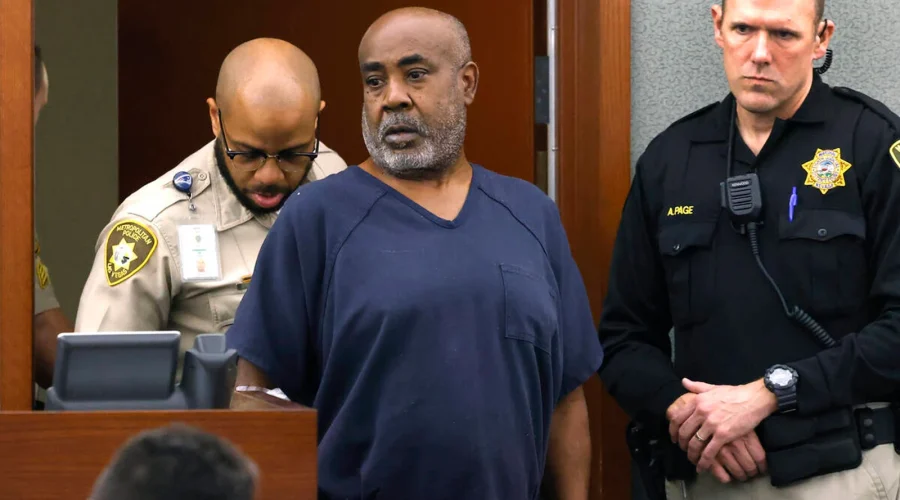
Three Decades of Waiting End: Jury Convicts Duane “Keffe D” Davis in Tupac Shakur Murder
Cyberzenhub.com – After thirty years of unanswered questions, speculation, and public frustration, a Clark County jury has delivered its verdict: Duane “Keffe D” Davis is guilty of murdering rapper Tupac Shakur. The finding came less than three hours after jurors retired to deliberate, closing one of the longest-running unsolved celebrity homicides in American popular culture.
Davis, now 63, was convicted of murder committed with a deadly weapon while intending to promote, further, or assist a criminal gang. Under Nevada sentencing guidelines, that charge carries a potential maximum penalty of life imprisonment. He stood beside his attorney as the verdict was announced, then lowered himself into his seat with his fingers interlaced on the table before him.
The Shooting That Shook a Generation
On the night of September 7, 1996, Shakur was struck by multiple bullets in a drive-by attack near the Las Vegas Strip. He was 25 years old. He died six days later at a local hospital. The killing occurred amid a volatile rivalry between two Los Angeles street gangs, and Shakur had been shot just days after a concert at the MGM Grand. For three decades, the precise mechanics of that night — who pulled the trigger, who directed the operation, who handed over the weapon — remained contested in courtrooms, tabloids, and fan forums alike.
Prosecutors maintained that Davis did not personally fire the fatal rounds. Their theory of the case placed the trigger-pull with either Orlando “Baby Lane” Anderson, Davis’ nephew, or another unidentified man seated in the rear of the vehicle. Davis, they argued, functioned as the “shot caller”: the acknowledged longtime leader of a Los Angeles street gang who coordinated the ambush and passed the murder weapon to the gunman.
Prosecution Built on Confessions and Corroboration
During closing arguments on Monday, prosecutor Binu Palal told the jury that the state’s case was “drenched with circumstantial evidence” and supported by multiple corroborating witnesses. But the centerpiece, Palal emphasized, was Davis’ own repeated admissions over nearly two decades.
“For nearly 18 years, Duane Davis has told the police, television, books, YouTube interviewers — anybody that will listen, he has told — he is responsible for the murder of Tupac Shakur,” Palal said. “Tell him you hear him — find him guilty.”
Those admissions spanned interviews with law enforcement, on-camera media appearances, and the pages of a self-published memoir in which Davis described his role in the killing. Palal argued that the consistency and longevity of those statements, layered atop the physical and testimonial evidence, left no reasonable alternative to a guilty finding.
Defense: Thirty Years Without a Single Bullet
Defense attorney Michael Sanft took a sharply different view. In his closing, Sanft contended that after three decades, the prosecution’s entire case rested on alleged confessions that he characterized as unreliable and self-serving. He pressed the jury to consider the logical gap in the state’s narrative.
“We have to ask ourselves the question really at this particular point: Why are we here 30 years later if Duane Davis had actually confessed — truly confessed?” Sanft said.
Sanft repeatedly stressed what he described as an absence of tangible physical evidence — no recovered firearm tied to Davis, no eyewitness placing him at the scene, no ballistic match linking him directly to the wound. He urged jurors to return a not-guilty verdict, calling it the “only verdict that makes sense in this case.”
A Marathon of Closings and a Cough Lozenge
The final day of trial stretched through a marathon of closing arguments that paused only briefly — once for a restroom break and once so that Judge Carli Kierny could retrieve a cough lozenge from her personal stash for Davis, who had been visibly struggling with his throat. The jurors retired that evening and returned the following day to render their decision in under three hours.
What Comes Next
Judge Kierny has scheduled Davis’ sentencing for October 13. At that hearing, the court will weigh factors including the length of time since the offense, Davis’ prior criminal record, the gang-related enhancement embedded in the charge, and any statements he makes regarding the victim’s family. Shakur’s widow, Keisha “Kiki” Shakur, and his children have followed the proceedings closely, and their presence in the courtroom was noted by observers throughout the trial.
Why This Verdict Matters Beyond the Courtroom
Tupac Shakur’s death in 1996 became a cultural watershed. His untimely end, followed eighteen months later by the killing of rival rapper The Notorious B.I.G., cemented a narrative of gang-driven violence that consumed hip-hop’s golden era. For fans, scholars, and the broader public, the question of who ordered and executed that Las Vegas shooting became almost mythic in its persistence.
The conviction does not end every legal question. Anderson, the nephew identified by prosecutors as a possible triggerman, has not been separately charged in this proceeding. Questions about other individuals who may have been present in the vehicle or who coordinated logistics remain open to future investigation. Still, the jury’s finding places the primary architectural blame squarely on Davis and closes a chapter that had remained open since the autumn of 1996.
For a generation that grew up on Shakur’s music, the verdict arrives not as closure in the emotional sense — no trial can restore a life — but as a factual determination: that the man who directed the killing has been identified, tried, and found responsible by his peers in a Nevada courtroom. Thirty years on, the question “who killed Tupac?” now has a jury-approved answer.
Related Reading
Frequently Asked Questions
What is Jury finds Duane Davis guilty in murder?
Jury finds Duane Davis guilty in murder is the main topic of this guide. The article explains the context, practical details, and next steps readers should understand.
Why does Jury finds Duane Davis guilty in murder matter?
Jury finds Duane Davis guilty in murder matters because readers are looking for a useful answer, not just a short summary. Good content should match search intent and help them decide what to do next.