Carney Demands Dignity as Washington Escalates Trade War Rhetoric
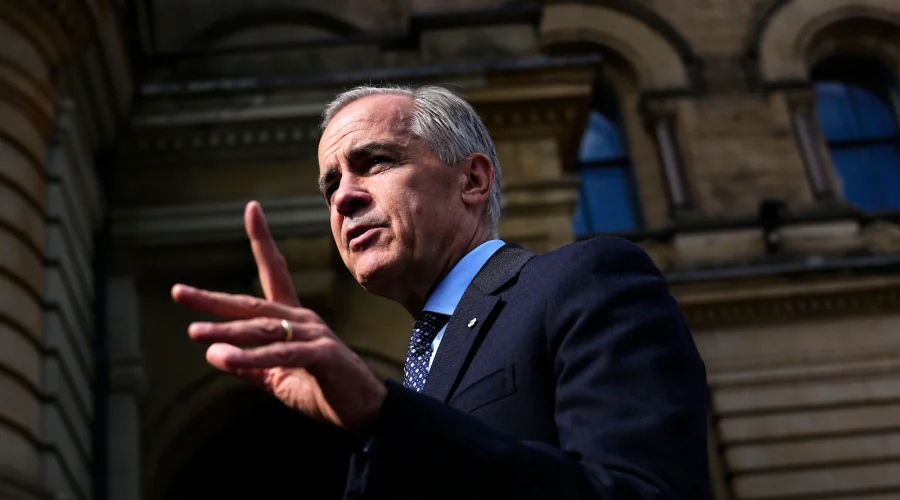
Cyberzenhub.com – Toronto — The transborder dispute between Ottawa and Washington deepened sharply on Tuesday when Prime Minister Mark Carney publicly rebuked the Trump administration, telling it to abandon what he characterized as performative aggression and return to substantive negotiation. Speaking from Canada’s capital, Carney framed the exchange not merely as a trade disagreement but as a question of national sovereignty, insisting that his country would not accept terms he described as existentially threatening to domestic industry.
“When the Americans stop doing memes, stop throwing shade and stop trying to be tough, and start being serious about having those discussions, we can have those discussions.”
The prime minister added a pointed coda to his demand for seriousness: “It’s not constructive, but that’s their democracy.” The remark landed amid a sustained campaign of public taunting from multiple figures in the U.S. government, a pattern that began after bilateral trade negotiations broke down on August 21 without agreement.
A Campaign of Public Mockery
Since the talks collapsed, the tone from Washington has shifted from diplomatic pressure to what Carney and Canadian officials describe as personal ridicule. President Donald Trump has moved to rebrand Lake Ontario as “Lake America,” a symbolic gesture that drew immediate condemnation in Ottawa. On social media, the president has repeatedly taunted Canada, reinforcing his long-stated fantasy of absorbing the country as a 51st state.
U.S. Treasury Secretary Scott Bessent weighed in by arguing that Canada simply cannot engage in reciprocal tit-for-tat retaliation against an economy roughly thirteen times its size. The comment underscored the asymmetry at the heart of the dispute: while both nations trade billions annually, the scale difference shapes every negotiation dynamic.
Perhaps the most inflammatory episode involved U.S. Secretary of War Pete Hegseth, who posted an image on Monday showing two female cadets at a British Columbia training facility. The caption read “this is real,” accompanied by a Canadian flag. Carney dismissed the post as “beneath their office.” The Pentagon, when pressed on Tuesday, offered no apology, stating simply: “The X post speaks for itself.”
The Terms Ottawa Rejects
Beyond the theatrics, Carney laid out his substantive objections to what he said Washington was demanding. In his account, the American position would effectively convert major Canadian industries into subsidiaries of U.S. parent companies, or impose conditions under which those sectors would be
“gradually wound down in Canada and wiped out.”
“We’re not going to — of course, we’re not going to accept those terms,” Carney stated flatly. He identified autos as a sector where the proposed arrangement would be particularly “uncompetitive” for Canadian manufacturers. Separately, he flagged demands touching French-language protections and cultural policy as additional deal-breakers, noting that any single one of those issues was sufficient to block an agreement.
Carney also pushed back on what he described as American attempts to constrain Canada’s future trade architecture. “Canada is a sovereign state. We will strike free trade deals with the countries we wish to strike free trade deals,” he declared, a reminder that Ottawa maintains and pursues agreements well beyond the North American corridor.
Despite the acrimony, the prime minister acknowledged that elements of a “mutually beneficial” framework had existed before negotiations derailed, leaving the door technically open should Washington recalibrate its posture.
Domestic Political Backdrop
Carney’s firm line arrives with renewed domestic political capital. On Monday, his Liberal Party swept three special elections across the country, including a decisive victory in Chicoutimi-Le Fjord, Quebec, where the Conservative candidate dropped to third place. The results lifted the Liberals to 173 seats in the 343-seat House of Commons, strengthening Carney’s mandate as he confronts Washington over trade and sovereignty questions.
The Quebec dimension carries particular weight. Nelson Wiseman, a professor emeritus of political science at the University of Toronto, noted that annexation rhetoric resonates differently in the province than elsewhere. “Quebecers have the most to lose in an apocalyptic scenario where the U.S. absorbs Canada, and the status of the French language disappears,” Wiseman observed. For a province already navigating language-rights tensions, the prospect of American political absorption is not abstract.
Tariff Mechanics and Economic Exposure
The commercial stakes are concrete. Following the August 21 breakdown, Trump imposed 50 percent tariffs on approximately $20 billion worth of Canadian goods flowing into the United States. Ottawa’s retaliatory schedule, covering nearly $20 billion in American imports, is set to take effect September 8, with duty rates spanning 15 to 50 percent depending on product category.
For Canadian exporters in autos, energy, agriculture, and manufactured goods, the tariff wall represents an immediate margin compression that few firms can absorb indefinitely. For American consumers and downstream manufacturers reliant on Canadian inputs, the reciprocal duties introduce cost pressures of their own. The economic calculus on both sides of the border now hinges on whether either government chooses de-escalation over continued posturing.
As of Tuesday, no formal mechanism for resuming talks had been announced. Carney’s message was clear: the onus for restarting dialogue rests with Washington, and the terms of re-engagement must respect Canadian industrial viability and sovereign autonomy. Until then, the rhetoric — memes, shade, and tough talk — will continue to define the transborder relationship, and the tariffs will continue to bite.
Related Reading
Frequently Asked Questions
What is Stop trying to be tough?
Stop trying to be tough is the main topic of this guide. The article explains the context, practical details, and next steps readers should understand.
Why does Stop trying to be tough matter?
Stop trying to be tough matters because readers are looking for a useful answer, not just a short summary. Good content should match search intent and help them decide what to do next.