Behind Every Casualty Number: Families Grieve as the Iran Conflict Enters Its Seventh Month
Cyberzenhub.com – The toll of the ongoing military confrontation between the United States, Israel, and Iran has grown to a scale that reshapes the lives of thousands of American households. Eight hundred and eight service members have been wounded or killed since hostilities began, and eighteen soldiers have lost their lives entirely, according to figures released by the Department of Defense. With roughly fifty thousand U.S. troops still stationed across the Middle East theater, the question of when — and whether — those forces will return home remains unanswered. President Donald Trump has yet to outline a definitive exit strategy or a timetable for withdrawal, leaving families in a state of prolonged uncertainty even as they process grief.
For the parents, spouses, and siblings of fallen soldiers, the statistics reduce to a single, unbearable reality: a phone call, a name, a life ended. Speaking with ABC News in the weeks following the deadliest phase of the campaign, several family members described the shock of learning their loved ones had been struck by Iranian fire, and the slow, disorienting work of rebuilding a household around an absence.
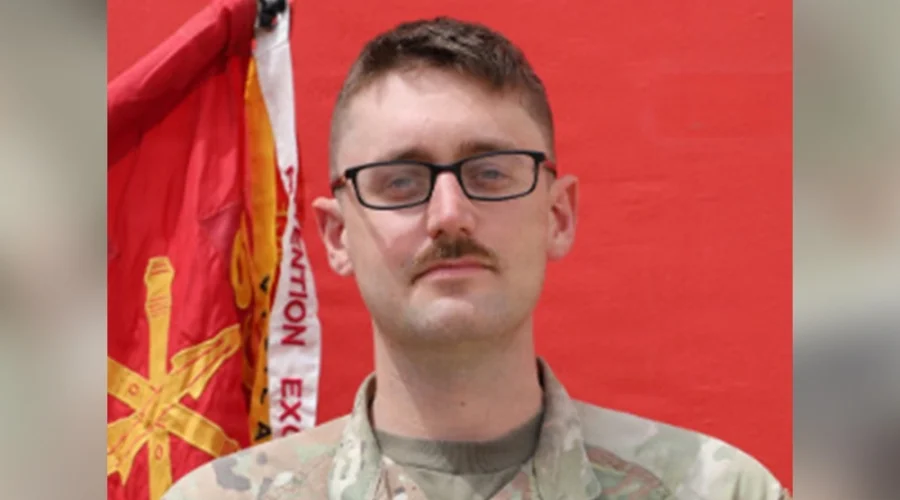
The Loss of 1st Lt. Tyler Feehan
On July 17, an Iranian ballistic missile and drone barrage struck Muwaffaq Salti Air Base in Jordan, killing 25-year-old 1st Lt. Tyler James Feehan of the 2nd Battalion, 55th Air Defense Artillery Regiment, 32nd Army Air and Missile Defense Command. The Department of Defense confirmed the date of death as July 18, and the attack remains under formal investigation. Nineteen-year-old Private Isabella Gonzales was also killed in the same strike.
Feehan had been deployed to that very base exactly one year before the missile found him. His mother, Shari Feehan, described the moment the confirmation arrived:
“It will always be the worst day of our lives. We were told that our only child, our sweet son, was gone. I believe I was in shock after being told. I remember saying ‘no’ over and over again. I couldn’t breathe.”
Before the official notification reached the family, Shari Feehan and her husband had already seen news reports of the Jordan strike and felt, in her words, a “sick feeling in the pit of our stomach.”
“Part of us knew at that time that it was Tyler. A big piece of our hearts left this earth when we got the confirmation that we had been fearing.”
Those who knew Feehan describe a young officer consumed by his soldiers’ futures. During Operation Epic Fury, when sustained combat operations cut internet access and threatened academic progress, he used his off-shift hours to research university regulations and draft memorandums on behalf of eighteen of his twenty-one enlisted men and women. The effort secured academic waivers, protected grade-point averages, and ultimately produced more than four hundred fifty completed credit hours across the unit.
His own academic ambitions were cut short. Feehan had been assembling his law-school application and was scheduled to sit for the LSAT on August 7. He never took that exam. In his memory, his parents established the CPT Tyler Feehan Legacy Foundation, an organization dedicated to providing scholarships to active-duty soldiers and assisting them in rebuilding civilian lives after deployment. Feehan is survived by his fiancé and extended family.
The Disappearance of Cmdr. Gabriel Edwards
Fourteen days before the Jordan strike, a different kind of loss was unfolding over the Arabian Sea. On July 1, Cmdr. Gabriel Edwards, 42, was aboard a four-crew MH-60S Seahawk helicopter when the aircraft made an emergency ditching into open water. Three crew members were pulled from the sea; Edwards was not found. The Navy conducted a search spanning fourteen thousand square miles over four days before terminating the effort. He is now presumed dead.
The service said the cause of the emergency remains under investigation and noted there is no indication the incident resulted from hostile action. For his mother, Rosemary Edwards, the absence of a body has not made the loss any less total:
“I can’t believe he’s gone. I just, I can’t fathom it. It’s still sinking in that he’s gone; his life is cut short.”
What Comes Next for Families and Troops Afield
The absence of a stated end date for the campaign means that every family of a deployed soldier lives in a state of suspended grief — waiting for either a phone call or a homecoming. The Department of Defense has quietly updated its internal categorization of Iran-war casualties, a bureaucratic shift that signals the conflict’s duration is being recalibrated upward. For the parents and spouses who spoke publicly in recent weeks, the most urgent question is not strategic or geopolitical. It is whether the next name on a casualty list will be theirs.
The eighteen who have died and the hundreds more who carry wounds home represent a generation of service that began with a deployment order and, for some, ended with a missile over Jordan or a helicopter sinking into the Arabian Sea. Their families are now tasked with translating that service into meaning — through foundations, through remembrance, through the daily act of carrying a name forward in a household that will never be the same.
Related Reading
Frequently Asked Questions
What is A big piece of our hearts?
A big piece of our hearts is the main topic of this guide. The article explains the context, practical details, and next steps readers should understand.
Why does A big piece of our hearts matter?
A big piece of our hearts matters because readers are looking for a useful answer, not just a short summary. Good content should match search intent and help them decide what to do next.