
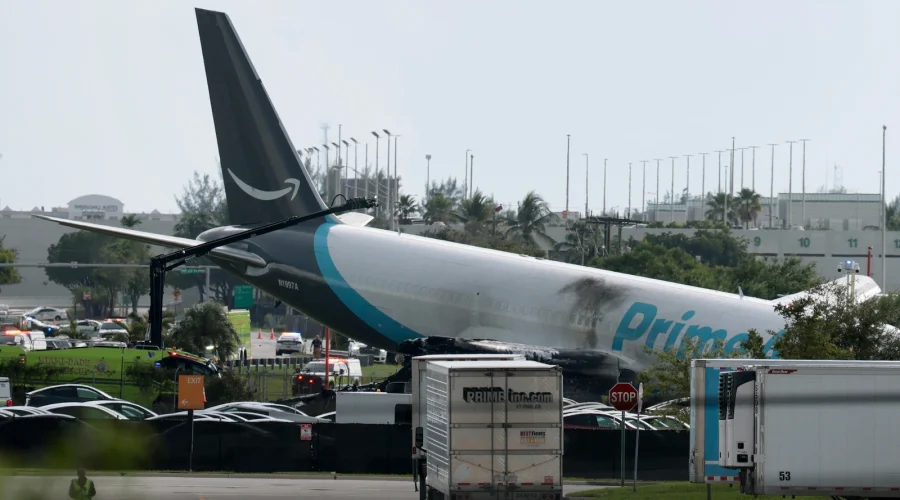
Boeing 767 Cargo Jet Overruns Runway at Miami International, Triggering Massive Fire Response
Cyberzenhub.com – A large freight aircraft operated for Amazon’s parcel-delivery network slid past the end of a runway at Miami International Airport on Sunday afternoon, Sept. 6, setting off one of the largest emergency responses in recent memory at the Florida hub. The Boeing 767-300, carrying cargo rather than passengers, departed San Juan, Puerto Rico, earlier that day and touched down near 2 p.m. local time before continuing past the paved surface. The plane came to rest disabled at the northwest end of the airport, and within minutes more than sixty fire and rescue units converged on the scene.
What the FAA and Amazon Confirmed
The Federal Aviation Administration issued a brief statement confirming the event. The agency identified the aircraft as a Boeing 767-300 cargo jet flying as Flight 7598, which had taken off from Luis Muñoz Marín International Airport in San Juan before its Sunday afternoon arrival at Miami. The FAA noted the plane overran the runway upon landing.
“21 Air Flight 7598 overran the runway after landing at Miami International Airport around 2 p.m. local time on Sunday, Sept. 6. The Boeing 767-300 cargo aircraft departed from Luis Munoz Marin International Airport in San Juan, Puerto Rico.”
Amazon, which contracts with regional carriers such as 21 Air to move packages across its logistics network, confirmed the incident through spokesperson Kelly Nantel. The company described the event as a rapidly unfolding situation and said it was coordinating with local authorities to determine the full sequence of events.
“We can confirm that an Amazon Air plane operated by 21 Air experienced an incident while attempting to land at Miami International Airport today.”
Nantel added that the company’s immediate focus was on the welfare of everyone connected to the event.
“Right now, our absolute priority is the safety, well-being, and care of everyone involved. We’re doing everything we can to support those affected.”
Airport and Fire-Rescue Response
Miami International Airport issued its own statement shortly after the overrun, noting that the aircraft had crossed the diagonal runway and was immobilized at the northwest perimeter of the field. By 3:00 p.m., every runway and taxiway at the airport had been shut down, and a full ground stop was imposed, halting all departures and arrivals.
“All runways and taxiways at MIA are currently closed as of 3:00 p.m. and a ground stop is in effect. Miami-Dade Fire Rescue (MDFR) has responded.”
Miami-Dade Fire Rescue posted on X that more than sixty of its units were deployed to the scene. The agency described arriving to find the aircraft engulfed in heavy flames and thick smoke after it struck several vehicles near the runway end. Crews worked to knock down the fire while simultaneously triaging and treating injured persons.
“Units arrived to find an airplane that had caught on fire as a result of this crash, with heavy flames and smoke showing. Firefighters are working on extinguishing the fire and assessing patients.”
Why the Aircraft Matters
The Boeing 767-300 is a wide-body twin-engine jet originally designed for transcontinental passenger service. In its freight configuration, the type can carry roughly 50 to 60 metric tons of cargo over long distances, making it a workhorse for e-commerce logistics operators that need to move high-volume shipments between major hubs. Amazon has built one of the largest commercial cargo fleets in the world, relying on a mix of owned aircraft and contracted carriers like 21 Air to shuttle packages between distribution centers and airports. A single 767-300 in freight service can move the equivalent of several truckloads of parcels in one flight, which is why a disruption to even one such aircraft can ripple through a regional delivery schedule.
Miami International’s Role and the Cost of a Ground Stop
Miami International is one of the busiest airports in the United States by passenger traffic and a critical gateway between North America, the Caribbean, and Latin America. Its diagonal runway configuration, shaped by the airport’s orientation relative to prevailing winds and the surrounding urban grid, means that a plane overrunning that surface can quickly reach the perimeter fence and adjacent roadways. A full ground stop at MIA typically idles dozens of flights per hour, forcing airlines to divert arriving aircraft to nearby fields such as Fort Lauderdale or Orlando and delaying departures until the runway is cleared, inspected, and reopened. For travelers, that translates into hours of waiting, rebooking chaos, and, in some cases, overnight stranding.
What Happens Next
The FAA, along with the National Transportation Safety Board, will investigate the cause of the overrun. Standard factors under review in such events include weather at touchdown, braking performance, runway surface conditions, aircraft weight, and pilot inputs during the landing roll. Until the investigation concludes, the disabled aircraft will remain at the northwest end of the field while salvage crews assess structural damage and determine whether the airframe can be repaired or must be written off. The airport is expected to reopen its runways once the fire is fully extinguished, debris is cleared, and engineers certify the pavement for safe operations.
As of the latest updates, authorities have not released a confirmed casualty count beyond noting that patients were being assessed by fire-rescue personnel. The incident remains a developing story, and further details on the cause, the extent of damage to nearby vehicles, and the timeline for runway reopening are expected in the coming hours.
Related Reading
Frequently Asked Questions
What is Amazon cargo plane overruns runway at Miami?
Amazon cargo plane overruns runway at Miami is the main topic of this guide. The article explains the context, practical details, and next steps readers should understand.
Why does Amazon cargo plane overruns runway at Miami matter?
Amazon cargo plane overruns runway at Miami matters because readers are looking for a useful answer, not just a short summary. Good content should match search intent and help them decide what to do next.