
They were forced to hand one son over to the Israeli army in return for another. Eight months later he was dead in prison
They were forced to hand one son over to the Israeli army in return for another. Eight months later he was dead in prison
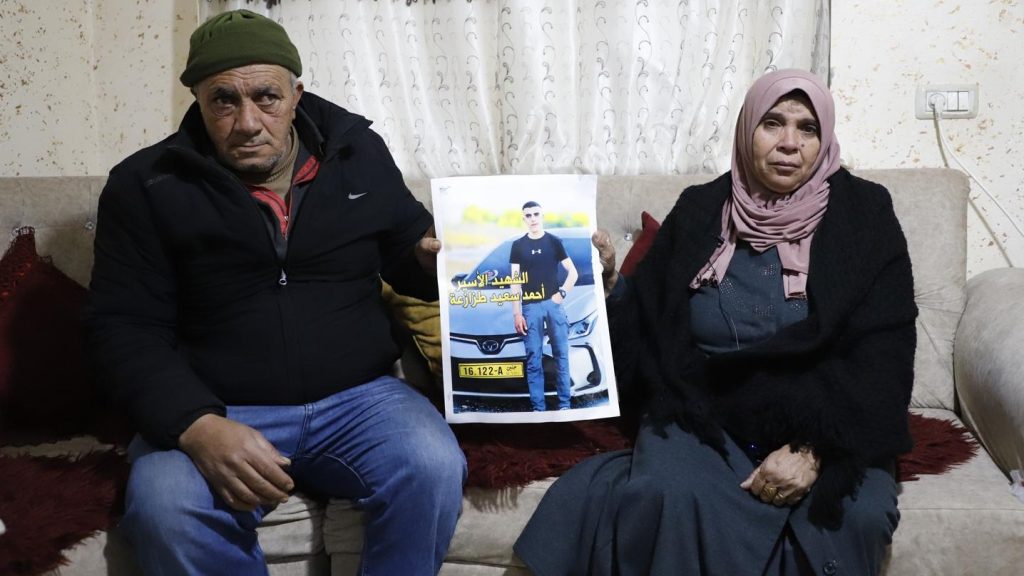
Ahmad Tazaza’s parents live with unrelenting sorrow and remorse over the young man’s death in August 2025 at Israel’s infamous Megiddo prison. The tragedy unfolded after they made a desperate trade: surrendering one of their sons to the authorities in exchange for the safety of another.
The Detention Process
Ahmad, a 20-year-old with no prior medical issues, was handed over to Israeli forces in the occupied West Bank in January 2025. His parents remain uncertain about why he was targeted, though the circumstances mirror those faced by countless Palestinian youths. He was held as an administrative detainee, a form of indefinite imprisonment without charges or legal recourse.
“They smashed the house and destroyed everything,” said Najah Abdul Qader, Ahmad’s mother. “He was not at home; he was working at the market and sleeping there that night. They took his brother and his father. In the morning, they released them and said, ‘We want him’.”
Israeli forces had repeatedly raided the Tazaza family home in Qabatiya, a northern West Bank town, seeking Ahmad. The family endured threats and intimidation, including a warning from an Israeli soldier that the house would be bombed if he did not surrender. He had narrowly escaped before by leaping from a car crushed by a bulldozer.
The Exchange
When the search yielded no results, the army detained his brother again. Saeed Tazaza, Ahmad’s father, recounted the moment they were forced to hand him over. “They said: ‘We will not release him until you bring your [other] son,’” he shared, his voice trembling. “His brother is married and has two children. So we told Ahmad we wanted to see him. We caught him and took him.”
“We handed our son over,” Qader said. “He looked at us and I knew he would not return. I felt he was not coming back when he turned his face and walked away.”
Initially, the parents believed they had spared Ahmad’s life by securing his temporary detention. But eight months later, their hope turned to despair. Ahmad’s body was still held by Israeli authorities, and they had only heard fragmented accounts of his suffering through messages from fellow prisoners.
The Post-Mortem Report
Ahmad died at age 21 on 3 August 2025, as documented in a post-mortem report provided to Middle East Eye. The report, dated 8 August, was authored by a physician affiliated with Physicians for Human Rights Israel (PHRI), a group that monitors autopsies with Israeli approval. It stated that Ahmad was “reported to be healthy” at the time of his arrest.
His prison records noted symptoms such as diarrhoea, scabies, and a sore throat. On 2 August, an on-call doctor observed blood stains on his trousers. The report detailed his collapse during a clinic visit, where he lost consciousness and vital signs after requesting to use the restroom. Resuscitation efforts failed, and he was declared dead.
“During the clinic visit, Mr Tazaza requested to go to the toilet and later collapsed to the floor, losing consciousness and vital signs,” the report read. “Resuscitation attempts were initiated, but despite intubation and CPR, he was pronounced dead.”
While the report suggested possible signs of blood cancer, it ruled out sudden death causes. Yet, without access to his body, the parents strongly contested the findings, expressing deep regret over their decision. “I handed my son to my enemy,” Qader lamented. “But that’s it. We wanted to protect him.”
The International Committee of the Red Cross (ICRC) has also been denied access to Palestinians in recent months, leaving the family to rely on secondhand accounts of their son’s final days. Their grief now lingers not only over his death but over the system that demanded their sacrifice.