
‘We must finish the job’: despite living on the frontline, northern Israelis try to maintain normality
‘We must finish the job’: despite living on the frontline, northern Israelis try to maintain normality
A Morning of Resilience in Metula
On a Thursday morning in Metula, the northernmost town in Israel, a shared sentiment emerged among locals: the previous night had been “challenging.” Sirens had stopped their wails only hours before, as military leaders claimed Hezbollah’s assault had concluded. Yet, the calm was brief. Warplanes hovered overhead, and the rhythmic thunder of missile intercepts echoed through the streets. Residents in Bela café noted the distant rumble of Israeli artillery, a constant reminder of the ongoing conflict.
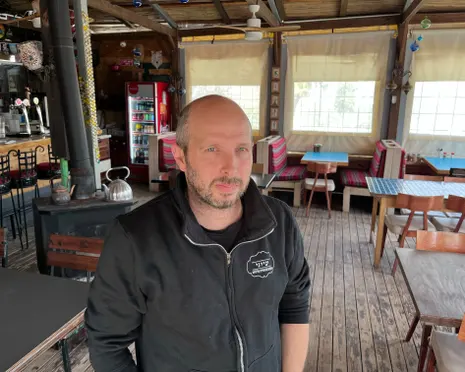
“The people of Metula don’t flee from rockets,” said Miry Menashe, 41, co-owner of Bela. “We keep the café open to preserve a sense of normalcy for the residents, our soldiers, and everyone else. They frequent the place often, and we want them to have a spot to unwind, grab a coffee, or enjoy a meal.”
Shragan Shatil, 77, joined others in the café, reflecting on the war’s impact. He believed the conflict would end only when “Mr Trump decides,” though he acknowledged Israel might act independently. “The nights have been the hardest,” he remarked. “There’s usually a pause, but by evening, the sirens return. Now, at least, we can sit in the sunlight.”
Hezbollah and Iran’s Coordinated Strike
Israeli military officials reported that Wednesday’s attacks included approximately 200 rockets and missiles, alongside 20 drones, marking the first time such an assault aligned with Iranian missile strikes. While no lives were lost in the attack, property damage was significant. To date, 12 Israelis have been killed by Iranian strikes, with hundreds more injured.
Hezbollah’s campaign, named “Operation Chewed Wheat”—a reference to a Quranic verse—represented a major escalation. Many analysts had thought the group weakened after nearly two years of Israeli airstrikes. In response, Israeli air force missions targeted southern Lebanon and Beirut’s outskirts. As of now, 634 Lebanese have been killed, and 1,586 injured, with nearly a million displaced.
Expectations for a Broader Conflict
Yaakov Selavan, deputy mayor of the Golan regional council, expressed the desire of northern Israelis for a decisive military operation against Hezbollah. “The government and military need to eliminate Hezbollah entirely,” he stated. “They should push as far north as the Litani River, 20 miles into Lebanon.”
The region’s residents, many of whom have endured repeated clashes, share this sentiment. Following the Hamas attack in southern Israel in October 2023, tens of thousands were evacuated. Since then, tensions have remained high, with frequent exchanges of fire, Israeli incursions into Lebanon, and direct confrontations with Iran, which views Hezbollah as a key proxy in its struggle against Israel.
“Hezbollah must be disarmed,” said Daniel Dorfman, 43, who recently reopened his restaurant in Metula. “We’ve learned over the years that finishing the job is essential. The Lebanese government lacks the strength to do it alone.”
Dorfman likened Iran to “the head of the octopus” and “the main driver of terrorism in the Middle East,” a view echoed by Israeli leaders. “If Iran vows to destroy Israel, you have to stop them,” he added. “Like an octopus, you target the head to end the threat.”