
A free Iran is their shared dream. But the diaspora remains torn on the best path forward.
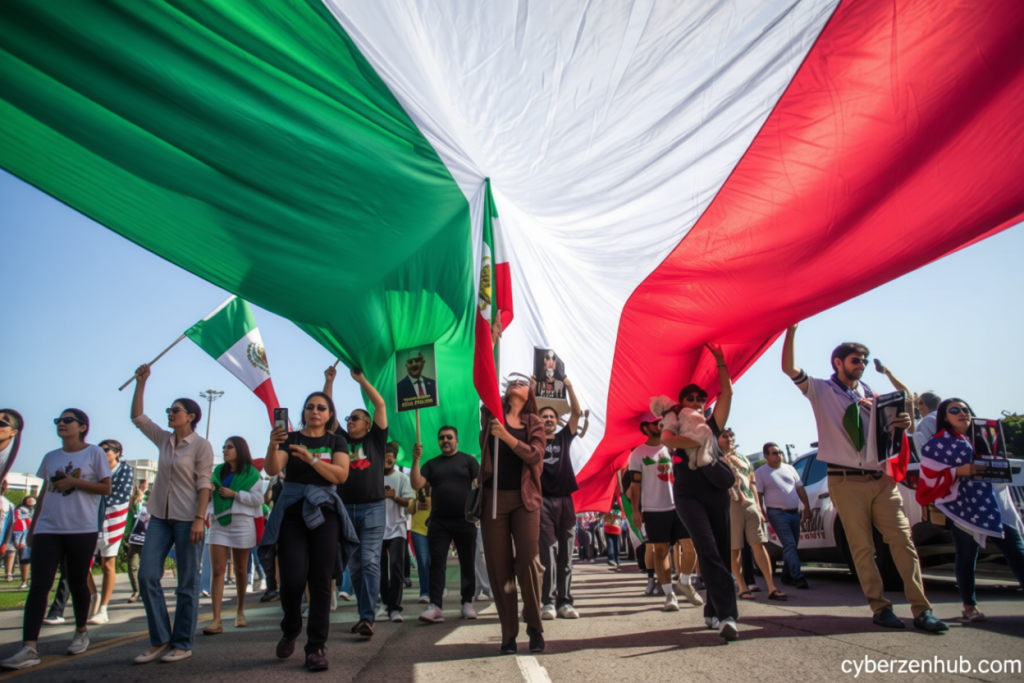
A Free Iran is Their Shared Dream. But the Diaspora Remains Torn on the Best Path Forward
Los Angeles has become a microcosm of the Iranian diaspora’s internal conflict. On Saturday, crowds gathered near City Hall to oppose the initiation of an unapproved military campaign, shouting slogans like “Stop the war in Iran” and “We the people don’t want war.” Simultaneously, on the Westside, in the neighborhood dubbed “Tehrangeles,” a separate group of Iranians in exile expressed elation over the potential downfall of their homeland’s regime, waving American, Israeli, and Iranian flags while celebrating the reported death of Ayatollah Ali Khamenei in U.S.-Israeli strikes.
Amid the rising violence in the Middle East, Iranians abroad are grappling with conflicting emotions. Some view the war as a necessary step to dismantle the theocratic regime that seized power after the 1979 Islamic Revolution. Others fear the cost of such action. “A few are so fed up with the regime that they argue, ‘At any cost, bring down this system—even if it means sacrificing parts of the country,’” explained Abbas Milani, director of Iranian studies at Stanford University. “Yet others seek to replace the regime without sacrificing the nation.”
“The images of destruction and the jubilant support for war have created more discord than we typically see within the diaspora,” Milani added. “It will take time for this tension to ease.”
Online discussions have grown more heated since the attacks on Iran. Supporters of military action are increasingly tagged as “Zionists,” a term that has evolved into a derogatory label for Jews following Hamas’s assault on Israel in October 2023. Anti-war voices, meanwhile, are accused of backing the regime. The debate also extends to who might lead Iran if the current government falls. While some champion Reza Pahlavi, the son of the last shah, others are cautious about reviving ties to the former monarchy.
Nowruz, the Persian New Year, looms as a time of reflection and renewal. However, the event now carries uncertainty, with rumors suggesting Mojtaba Khamenei, Ayatollah Khamenei’s son, could ascend as the next supreme leader. The Islamic Revolutionary Guard Corps, a powerful force in Iran, is also positioned to consolidate its influence if the conflict continues.
Meanwhile, former President Donald Trump has hinted at a desire to completely reshape Iran’s leadership, offering names for a “good leader.” Despite his plans, a recent NBC News poll revealed that 54% of potential voters disapprove of his approach to the situation. This mirrors the division within the Iranian diaspora, where 53% of respondents in a previous NIAC-YouGov survey opposed U.S. military action against Iran.
Jamal Abdi, NIAC’s president, confirmed that new polling data will be released next week, potentially updating the current statistics. “We are not a monolith,” noted the Iranian Diaspora Collective, an Instagram account with over 81,000 followers. “Millions of people will never share the same ideology or identity—and that diversity is the strength of any free society.”
Los Angeles-based pastor Ara Torosian, who fled Iran in 2010, expressed heartbreak over the destruction of historical landmarks and the loss of innocent lives, particularly children. Yet, he acknowledged that the current suffering compares to generations of hardship faced by those who opposed the regime. “I was jailed and beaten when the Revolutionary Guard discovered Christian items in my Tehran home,” he recalled. “Seeing the supreme leader fall has been a moment of relief for many, including myself.”