
Physician-Senator Cassidy Slams Trump’s Vaccine Overhaul: Families Face Tripled Visits and Costs
Cyberzenhub.com – The political rift between the White House and a senior Republican lawmaker widened sharply on Sunday when Senator Bill Cassidy, R-Louisiana, denounced President Donald Trump’s executive order restructuring the childhood immunization schedule. Cassidy, who practices medicine before serving in Congress, did not mince words: he labeled the directive “a stupid thing to do” and warned that ordinary households would absorb both financial strain and logistical chaos as a direct consequence.
The order, signed by Trump on Monday, recommends reducing the number of vaccinations administered to young children and specifically breaks apart the combined measles-mumps-rubella (MMR) shot into its three component vaccines. Under the current Centers for Disease Control and Prevention schedule, a child receives two doses of the unified MMR formulation — the first between 12 and 15 months of age, the second between four and six years old. Once separated, those same protections require six individual injections instead of two, multiplying doctor’s-office trips, missed workdays for parents, and insurance billing events by a factor of three.
“Let’s just take it from the perspective of the parent why this is a — why this is just a stupid thing to do. Now, instead of your child getting two shots, she has to get six shots. Instead of … you missing work to take your child to the doctor two times, you’re doing it six times, and instead of the insurance company paying for two visits, it’s now paying for six visits.”
Cassidy delivered those remarks during an interview with Martha Raddatz on ABC News’ “This Week,” broadcast August 16, 2026. He pressed the point from both his professional and personal identities.
“As a physician, but as a parent — as a human — I know that all that is wrong for the family.”
Why the MMR Was Combined in the First Place
The original decision to merge measles, mumps, and rubella antigens into a single injection was driven by practicality. Cassidy explained that the combination exists “to make it more convenient for the parent, to make fewer jabs for the child.” Splitting the formulation reverses decades of public-health streamlining and shifts the burden back onto families already managing school schedules, work obligations, and pediatric appointments.
The senator tied the policy directly to broader economic anxieties. He argued that the administration’s approach signals a loss of focus on household affordability and family convenience, factors he said are already inflating healthcare costs nationwide.
“This is why the president’s poll numbers are down, because you’ve lost sight of affordability for the parent, you’ve lost sight of the convenience for the American family, you’ve lost sight of that which is driving higher costs in healthcare.”
The Autism Question and What the Science Shows
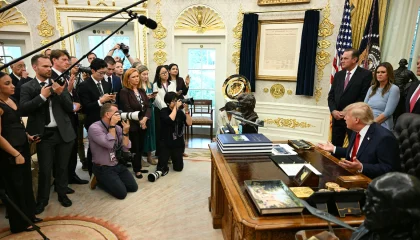
During the Oval Office signing ceremony, Trump repeatedly — and inaccurately — associated childhood vaccines with autism. Decades of high-quality epidemiological research have failed to establish any causal link between immunizations and autism spectrum disorder. Cassidy underscored that point plainly.
“There’s no evidence that vaccines causes (sic) autism, which I think is where this is supposed to come from, so it’s stupid policy.”
The senator also invoked the testimony of Jay Bhattacharya, director of the National Institutes of Health, who likewise stated there is “no connection” between vaccines and autism. Cassidy urged compassion for families navigating an autistic child’s diagnosis while cautioning against channeling public resources into a debunked hypothesis.
“We’ve got to have compassion for those families who have a child with autism. Believe me, I’m a doctor. I’ve treated patients. I understand the kind of trauma that this brings to a family.”
He added that government effort would be better directed toward identifying genuine etiologies and building preventive strategies rather than lingering in what he called “this little cul-de-sac of something which has been thoroughly disproven.”
Kennedy Confirmation and Unkept Assurances
The friction between Cassidy and the administration is not new. In February 2025, the Louisiana senator played a pivotal role in confirming Robert F. Kennedy Jr. as Secretary of Health and Human Services. At the time, Cassidy voiced serious reservations about Kennedy’s long record of promoting vaccine misinformation yet ultimately voted to advance the nomination out of committee and onto the Senate floor.
In explaining his vote, Cassidy said Kennedy and the White House had offered him specific guarantees: that the secretary would protect the public-health benefits of vaccination and would operate within existing vaccine-approval and safety-monitoring frameworks rather than constructing parallel systems.
“Mr. Kennedy and the administration reached out seeking to reassure me regarding their commitment to protecting the public health benefit of vaccination.”
Cassidy noted that Kennedy “has also committed that he would work within the current vaccine approval and safety monitoring systems, and not establish parallel systems.” The executive order now on the books — dismantling a combined vaccine formulation without new clinical evidence justifying the split — appears to contradict those assurances. Cassidy closed his interview by asking, pointedly, whether Kennedy had been lying.
What Families Should Understand
For parents navigating pediatric schedules, the practical implications are immediate. A child who previously completed two MMR visits now faces six separate appointments spread across infancy and early childhood. Each additional visit carries copayments or coinsurance costs, potential time off work, travel to a clinic, and the stress of repeated needle procedures for a young patient. Insurance carriers will process more claims; employers will absorb more absenteeism. The CDC’s existing two-dose schedule remains the scientific consensus recommendation, and no peer-reviewed trial has demonstrated that separating the antigens improves safety or efficacy.
The episode also highlights a broader tension in American public-health governance: whether executive authority can reshape immunization policy through administrative order without congressional legislation, new clinical data, or CDC rulemaking. Cassidy’s intervention — coming from a sitting senator who is himself a practicing physician — signals that the Republican caucus may not move as a monolith on vaccine questions, even under an administration whose health secretary was confirmed with their votes.
Related Reading
Frequently Asked Questions
What is GOP Sen Bill Cassidy on Trump?
GOP Sen Bill Cassidy on Trump is the main topic of this guide. The article explains the context, practical details, and next steps readers should understand.
Why does GOP Sen Bill Cassidy on Trump matter?
GOP Sen Bill Cassidy on Trump matters because readers are looking for a useful answer, not just a short summary. Good content should match search intent and help them decide what to do next.