Canada’s 50% Tariff Clock Hits Saturday as Trade Talks Enter Final Stretch
Cyberzenhub.com – A steep new wave of American duties on Canadian imports is scheduled to activate at 12:01 a.m. Eastern Time on Saturday, placing immediate pressure on a trade relationship that has oscillated between confrontation and negotiation throughout President Donald Trump’s second term. The 50% levies, which span dozens of product categories ranging from hockey sticks to wine, represent the latest escalation in a dispute that has consumed months of diplomatic energy between Washington and Ottawa.
The timing is particularly tense because Trump publicly declared earlier this week that the two governments had reached a preliminary understanding to resolve the standoff. That announcement prompted him to delay an earlier deadline, buying both sides additional days of negotiation. Yet Canada’s own government response struck a more cautious tone, acknowledging “substantial progress” while emphasizing that critical work still lay ahead — a framing that effectively tempered the president’s claim of a breakthrough.
What the Tariffs Actually Cover
Despite the headline figure, the duties are expected to touch only a slice of total U.S. imports from Canada because of significant carve-outs for energy products, potash, and other strategically important commodities. The items that do fall within scope, however, carry considerable consumer-facing weight: dairy products, honey, whey protein supplements, molasses, whiskey, vodka, and other alcoholic beverages all appear on the affected list. For American shoppers, that translates into potential price increases on grocery staples and bar shelves within days of the Saturday deadline.
Unlike earlier tariff actions, these new levies would apply even to goods that comply with the United States-Mexico-Canada Agreement (USMCA), the trilateral free-trade framework that has governed cross-border commerce since 2020. That distinction matters because it signals a departure from the tariff-free architecture the agreement was designed to protect, at least for the categories now targeted.
The Legal Mechanism: Section 338
Trump is pursuing the tariffs under Section 338 of the Tariff Act of 1930, a rarely used provision that authorizes the president to impose duties of up to 50 percent on nations found to discriminate against U.S. trade relative to how they treat other countries. Notably, this particular statutory tool has never before been invoked in American history. Its deployment here marks a first-of-its-kind exercise of presidential trade power, one that legal scholars and industry groups have been watching closely for precedent-setting implications.
The broader tariff architecture Trump has assembled this year includes sweeping duties imposed on roughly 60 trade partners, including members of the European Union. Those measures were layered atop an effort to rebuild far-reaching duties that the Supreme Court struck down earlier in the year, effectively giving the administration a second attempt at a comprehensive tariff regime.
What Trump Said — and What Carney Countered
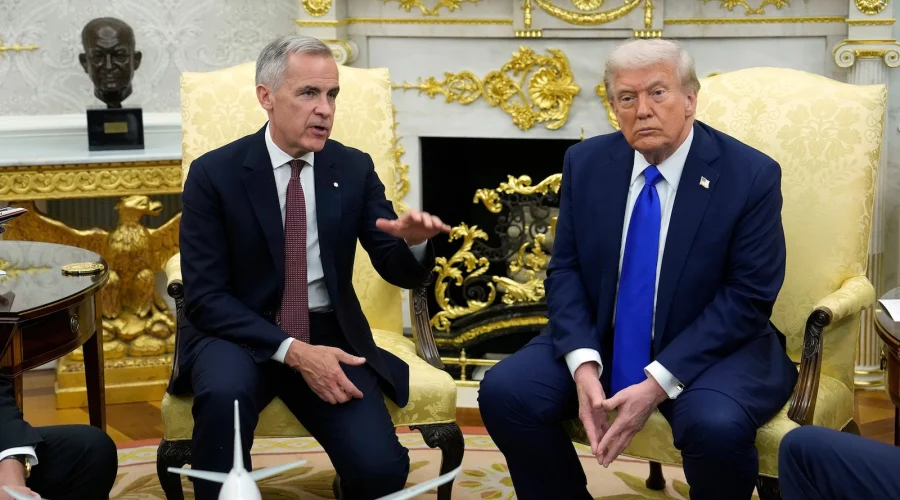
On Wednesday, the president described a “very good conversation” he held with Canadian Prime Minister Mark Carney the previous evening. He repeated his assertion that a deal had been struck to avert the 50% tariff on the hodgepodge of Canadian goods now in question.
“The tariffs will be non-existent for our farmers. Our farmers were paying tremendous tariffs into Canada. And those tariffs are going to be totally eviscerated down to zero,” Trump stated.
Pressed by a reporter on whether the arrangement would also reduce Canadian duties on American steel and aluminum, Trump offered only a noncommittal reply: “Well, we’re looking at that.”
Carney’s office issued a statement that acknowledged ongoing negotiations while steering the conversation toward domestic economic priorities.
“While we continue this work, Canada remains focused on building a stronger, more independent, and more competitive economy at home,” Carney said.
What a Final Deal Might Contain
The Office of the U.S. Trade Representative weighed in on social media Tuesday, sketching out elements that a concluded agreement could encompass. According to the USTR’s posting, the package would include comprehensive market access for American goods, economic security commitments, digital trade alignment, and additional provisions aimed at protecting U.S. workers alongside their Canadian counterparts.
Trump himself floated a more idiosyncratic component: a revived attempt to construct the Keystone XL Pipeline, a project canceled in 2021 after years of environmental controversy.
“Keystone XL Pipeline, long ago killed by Sleepy Joe Biden, may be awoken from the grave!” Trump wrote.
Why This Matters for Households and Markets
With midterm elections approaching, grocery prices remain a top-of-mind concern for many American voters. A Saturday activation of duties on dairy, honey, protein supplements, and distilled spirits would feed directly into consumer price indices within weeks, complicating the political calculus for both parties. The fact that the tariffs were delayed once already signals that both governments view the final hours of negotiation as consequential enough to warrant buying time.
For Canadian exporters, the stakes are equally acute. Even with energy and potash exempted, the affected categories represent meaningful revenue streams for provinces from Ontario’s dairy sector to British Columbia’s wine country. A prolonged tariff regime, even at partial scope, would strain supply chains that have been calibrated to USMCA’s zero-tariff framework for over half a decade.
As the Saturday deadline approaches, the gap between Trump’s public confidence in a deal and Ottawa’s more measured language leaves little room for error. Whether the tariffs activate at 12:01 a.m. or are suspended once more will hinge on negotiations that, by all available signals, remain unfinished.
Related Reading
Frequently Asked Questions
What is Trump s proposed tariffs on Canada?
Trump s proposed tariffs on Canada is the main topic of this guide. The article explains the context, practical details, and next steps readers should understand.
Why does Trump s proposed tariffs on Canada matter?
Trump s proposed tariffs on Canada matters because readers are looking for a useful answer, not just a short summary. Good content should match search intent and help them decide what to do next.