
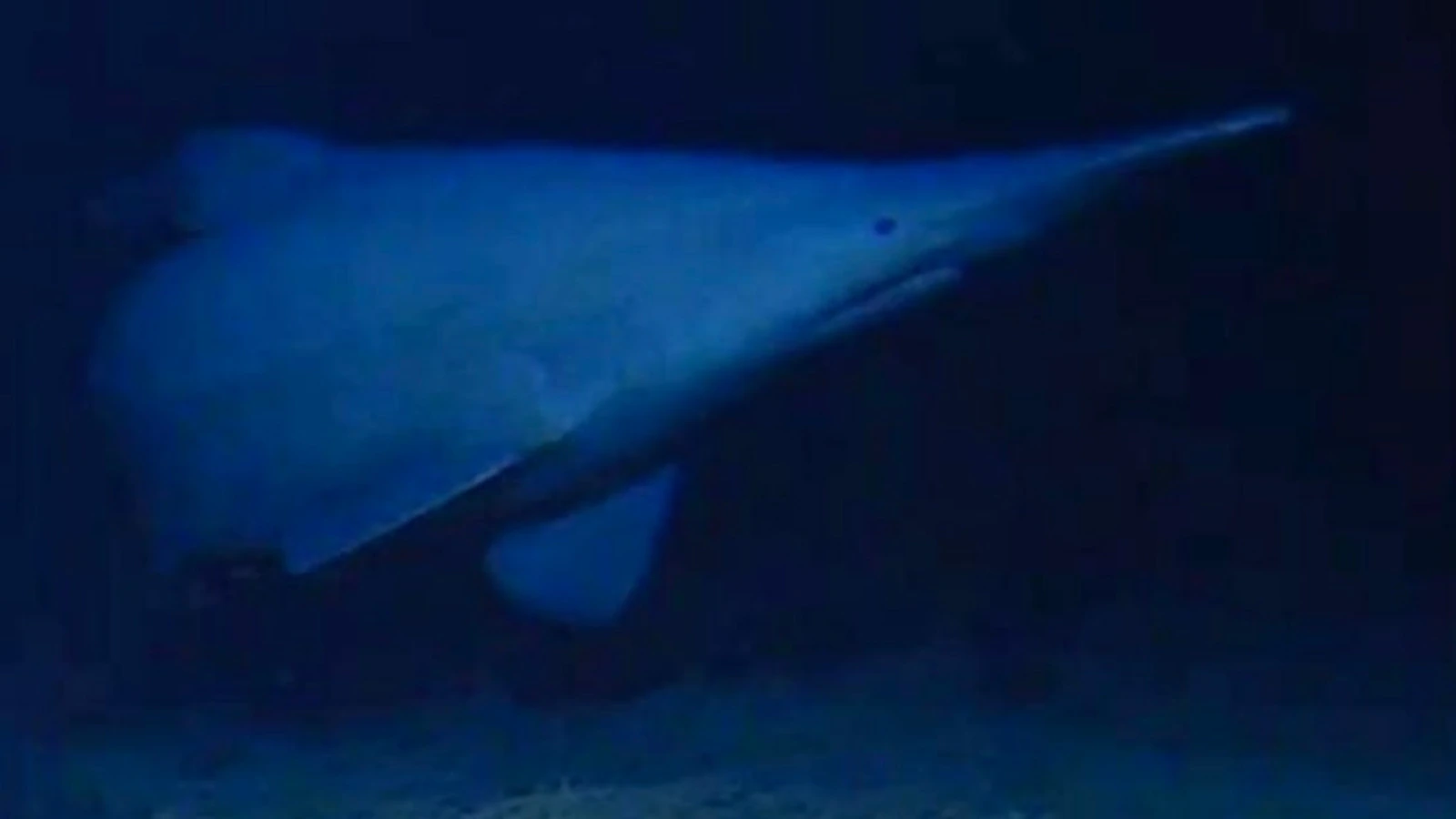
Rare Goblin Shark Filmed in the Wild for the First Time, Study Reveals
Cyberzenhub.com – A groundbreaking discovery has been made in marine biology, as researchers have finally captured and verified video footage of the goblin shark in its natural habitat. This marks the first time the elusive species, known for its prehistoric appearance, has been documented in the wild, according to a recent study published in the *Journal of Fish Biology*. The goblin shark, or *Mitsukurina owstoni*, is the sole surviving member of the ancient Mitsukurinidae family, which has existed for approximately 125 million years. Its status as a “living fossil” has long fascinated scientists, offering a rare glimpse into evolutionary history.
About the Goblin Shark
The goblin shark is distinguished by its unusual physical traits, including a distinctive, elongated snout that resembles a horn and a set of jaws capable of rapid extension to snatch prey. These features, which have remained largely unchanged over millions of years, are central to its survival in the deep ocean’s dark and nutrient-scarce environment. According to Aaron Judah, a PhD candidate at the University of Hawaii at Manoa, the shark’s snout is lined with specialized sensory organs called Ampullae of Lorenzini. These electroreceptors, filled with a gel-like substance, help the goblin shark detect the faint electrical signals emitted by squid, fish, and crustaceans, allowing it to hunt effectively even in total darkness.
The species can reach lengths of up to 10 to 12 feet, with a strikingly pale or pinkish coloration that sets it apart from most sharks. This unusual hue, which is not typical for the species, has raised questions among researchers about its adaptations. Judah, who co-authored the study, noted that the coloration may play a role in camouflage or thermoregulation in its deep-sea habitat. Such characteristics make the goblin shark a subject of great interest for understanding deep-sea ecosystems and evolutionary traits.
Discovery Details
The first confirmed sighting of the goblin shark in the wild occurred in 2019 during an expedition near Jarvis Island. The footage was captured by an remotely operated vehicle (ROV) aboard the *EV Nautilus*, a research vessel operated by the Ocean Exploration Trust. The seamount where the shark was spotted is located within the Pacific Remote Islands Marine National Monument, a U.S. territory in the Central Pacific. At the time of the observation, the creature was found about three-quarters of a mile beneath the surface, yet its identity was not immediately recognized by the onboard team.
“At the time, no one on board really knew the significance of what we had just seen,” said Steve Auscavitch, a PhD scientist at the Smithsonian Institution’s National Museum of Natural History. “It was a moment of pure surprise, and we didn’t realize it would lead to such a major discovery.”
Later, Auscavitch learned through informal discussions with fellow researchers that similar footage might have been archived in a database managed by Judah’s laboratory. This led to the confirmation of the species’ presence in the area, which was a significant range extension for the goblin shark. “This would be an enormous extension for the animal,” Judah emphasized, highlighting the importance of the find for understanding its distribution.
Two years later, in 2024, the goblin shark was spotted again near the Tonga Trench, approximately 1,250 miles southwest of Jarvis Island. This time, the footage was captured using baited cameras in collaboration with the University of Western Australia’s Deep-Sea Research Center. The discovery confirmed that the species not only inhabits seamounts but also extends its range to trench slopes, a previously unrecorded habitat. Judah described the trench as “incredibly important” for biodiversity, underscoring the role of such environments in supporting rare marine life.
Broader Implications for Conservation
While videos of goblin sharks have been taken before, most of these were captured in fisheries and lacked peer review. The newly verified footage provides a solid foundation for further research into the species’ behavior and ecology. “We normally only ever really find them in fisheries, and rarely at that,” said James Lea, CEO of the Save Our Seas Foundation. This suggests that the goblin shark’s presence in the wild is often overlooked, making the recent findings even more valuable.
With the confirmation of its habitat across the Pacific, Atlantic, and Indian Oceans, the goblin shark’s global distribution is now better understood. The International Union for Conservation of Nature (IUCN) has noted this expansion, which may influence conservation strategies for the species. As scientists continue to document rare marine creatures and their environments, the knowledge gained could lead to more effective protections for ocean biodiversity, especially as deep-sea fishing operations grow in scale and reach deeper waters.
The study’s findings also highlight the importance of technology in uncovering hidden aspects of marine life. The use of ROVs and baited cameras has allowed researchers to observe the goblin shark in its natural state, away from human interference. These tools are essential for studying species that rarely surface or interact with humans. “This is the first time a video of a live goblin shark in its natural habitat has been peer reviewed and fully confirmed,” Judah reiterated, emphasizing the validation of the footage’s scientific merit.
Looking ahead, scientists anticipate more sightings of the goblin shark as exploration efforts intensify. The recent discoveries suggest that the species may be more widespread than previously thought, prompting calls for further investigations. As the goblin shark continues to captivate researchers with its ancient traits and mysterious behavior, its role in deep-sea ecosystems becomes increasingly clear. These findings not only enrich our understanding of this rare species but also reinforce the need to protect the delicate habitats that sustain it.