South Carolina Senate Contest Turns Personal in Sole Debate
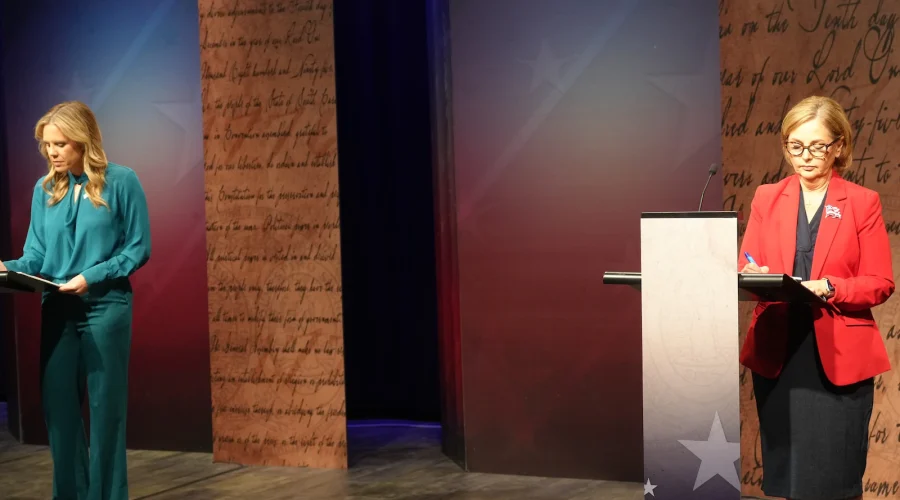
Cyberzenhub.com – South Carolina’s increasingly competitive Senate race took a sharply personal turn Sunday night as Republican Sen. Darline Graham and Democratic nominee Annie Andrews clashed over experience, party loyalty and whether either candidate is prepared to hold the seat for a full six-year term.
The hourlong debate in Columbia came three weeks before the general election and marked the candidates’ only scheduled meeting on stage. Their exchange ranged across Iran, artificial intelligence and the economy, but the central argument was unmistakable: Graham and Andrews each sought to portray the other as unfit to represent South Carolina in the Senate.
Libertarian candidate Kasie Whitener also participated, although much of the evening’s attention centered on the two major-party candidates. With three women seeking the office, the election could make history by sending South Carolina’s first woman to the U.S. Senate.
A Seat Changed by an Unexpected Vacancy
The race developed after Sen. Lindsey Graham, who had been pursuing a fifth Senate term, died suddenly in July. Though he had often faced criticism from opponents who viewed him as overly accommodating toward Democrats, he had won the June primary and had been expected to retain the seat.
Darline Graham, appointed to complete the remainder of her late brother’s term, entered a crowded special-primary field. President Donald Trump endorsed her during that contest, reflecting the close political alignment between Trump and Lindsey Graham. She reached a runoff and prevailed.
The contest has tightened since then, offering Democrats hope as they seek to regain control of Congress while Trump’s popularity remains low. Republican-aligned outside organizations have spent millions supporting Graham, spending described as an “insurance policy” for a Republican win.
Graham referenced her support for Trump several times during the debate, though less forcefully than she had during the special primary. Andrews used that relationship as a central point of criticism, saying she would challenge her own party when needed while portraying Graham as unwilling to break with the White House.
“The White House’s ambassador to South Carolina,” Andrews said of Graham.
Experience and Identity Become Flashpoints
Andrews argued that Graham’s appointment did not establish her suitability for a complete Senate term. Graham had worked in South Carolina state government and spent years supporting her brother’s political career, but had not previously held elected office herself.
The Democrat also raised questions about Graham’s use of her surname, arguing that she had sought political benefit from the family name built over her brother’s lengthy House and Senate career. Graham pushed back emotionally, saying the suggestion distorted her personal history.
“My legal name is Graham, it has always been Graham,” Graham said.
She said Nordone, her husband’s surname, had only appeared on a social-media account and never on legal documents. Graham explained that she retained her maiden name because it connected her to her parents, who both died when she was young.
“Thank you for bringing up a horrible, tragic memory for me,” Graham said.
The exchange underscored the unusual nature of a campaign in which family legacy has become part of the broader question of political qualification. Graham’s supporters can point to her current service and her familiarity with the state’s political landscape, while Andrews has argued that the office should not be treated as an extension of a relative’s career.
Foreign Policy Dispute Revives Earlier Debate Moment
Andrews also returned to a moment from a Republican runoff debate, when Graham struggled to answer a question about whether the United States has a national-security interest in Taiwan and the South China Sea. Both Democratic and Republican administrations have long regarded the region as important to U.S. national security.
Graham had acknowledged during that earlier exchange that national security was not her specialty. Andrews used the statement to question whether Graham has the knowledge necessary for a Senate role that includes major decisions on foreign affairs.
“If your surgeon said that appendectomies aren’t really his thing, would you still hand him a scalpel? No,” Andrews said.
She called Graham “unserious and unqualified.” Graham responded by arguing that acknowledging limits is preferable to misleading voters.
“Your thing apparently is not being honest with people of South Carolina. At least I’m honest. If I don’t know something, I am glad to say it, and I’ll say it again tonight,” Graham said.
Graham then accused Andrews of changing positions, saying, “You are deceiving the people of South Carolina. You have flip-flopped on everything.” The dispute carried added weight because Lindsey Graham had been widely known as a foreign-policy hawk who met with leaders around the world.
Artificial Intelligence Question Leads Back to Qualifications
A discussion about artificial intelligence and possible safeguards quickly became another argument over readiness for office. Graham praised Trump’s creation of an AI task force. Andrews replied that Graham may have been an appropriate temporary choice after her brother’s death, but said her performance since then had not demonstrated that she should receive a full term.
“Has shown time and time again that she is not up for the job,” Andrews said.
Graham rejected the criticism and noted that Andrews has never held elected office.
“I’m just as qualified as you,” Graham said.
The debate offered voters a clear preview of the final campaign stretch: a Republican seeking to retain a seat closely associated with her family and with Trump, and a Democrat arguing that the vacancy has created an opening for a different kind of representation. The candidates’ disagreements on policy were often framed through that larger contest over judgment, independence and experience.
Early voting in South Carolina begins Oct. 19 and runs for two weeks. By then, voters will have had only this single debate to compare the candidates directly before deciding who will fill the Senate seat left open by Lindsey Graham’s death.
Related Reading
Frequently Asked Questions
What is Feud spills onto South Carolina debate?
Feud spills onto South Carolina debate is the main topic of this guide. The article explains the context, practical details, and next steps readers should understand.
Why does Feud spills onto South Carolina debate matter?
Feud spills onto South Carolina debate matters because readers are looking for a useful answer, not just a short summary. Good content should match search intent and help them decide what to do next.