
Breakdown of $1 billion request for Trump’s White House ballroom project
Breakdown of $1 Billion Request for Trump’s White House Ballroom Project
Breakdown of 1 billion request for Trump – ABC News acquired a concise one-page document detailing the White House’s proposed allocation of $1 billion, a sum some Republicans aim to approve for the renovation of President Donald Trump’s East Wing. This plan includes the construction of a sprawling ballroom, which has sparked significant debate. The document, presented without further explanation, was shared by Sean Curran, director of the U.S. Secret Service, during a luncheon with Senate Republicans on Tuesday. The funding would also support other critical missions, according to related statements from Homeland Security and the Secret Service.
Funding Allocation by Project Area
The $1 billion is divided among several priorities: $220 million for enhancing the White House’s structural defenses, $180 million for a new visitor security screening facility, $175 million for Secret Service training programs, and another $175 million for upgrades to the protection of high-profile individuals. Additionally, $150 million is earmarked for addressing emerging security threats and technological advancements, while $100 million is designated for hosting events of national importance.
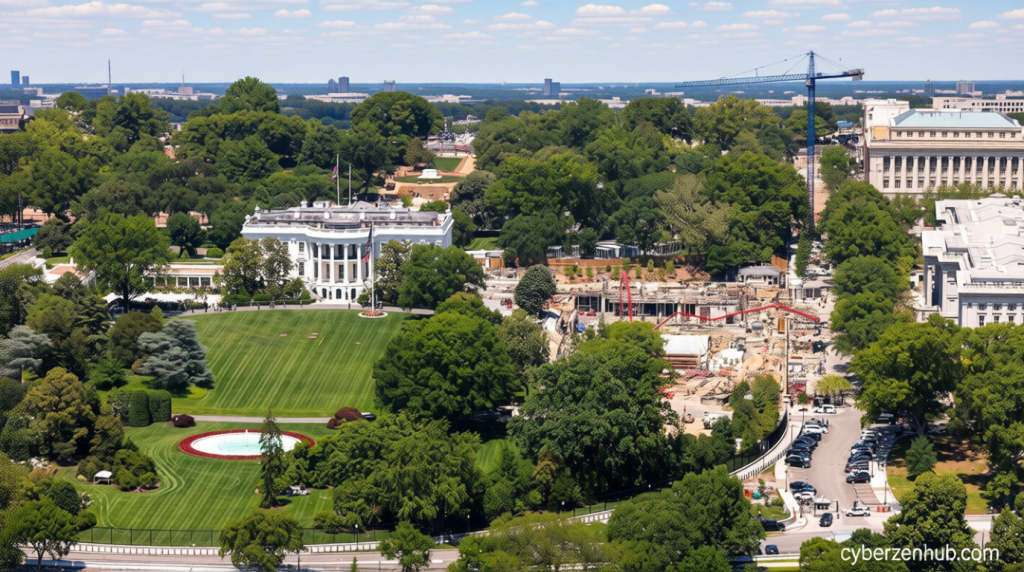
Construction of the ballroom, a prominent feature of the East Wing renovation, is progressing near the White House in Washington, as reported on May 12, 2026. The project has been underway for months, with its grand scale drawing attention from both supporters and critics. The White House has emphasized the necessity of this funding, citing the recent assassination attempt at the White House Correspondents’ Association dinner as a pivotal moment. Yet, despite this justification, Senate Republicans have expressed reservations about the $1 billion proposal following Curran’s briefing.
Senate Reactions and Concerns
Republican Senator John Kennedy voiced lingering doubts, stating that while the breakdown provided more clarity, “there are still a lot of questions.” He highlighted the Senate’s broader concern about increasing the national deficit, noting that the ballroom project represents one of the largest financial commitments on their agenda. Similarly, Senator Jim Justice, a longtime Trump ally, described the cost as “enormous” during an interview with ABC News Capitol Hill Correspondent Jay O’Brien.
“I can’t imagine spending a billion dollars on security, but I’m not a security expert,” Justice remarked.
Justice acknowledged support for the ballroom’s construction and the use of public funds for security but stressed the need for a more transparent explanation of the $1 billion budget. He argued that with many Americans struggling financially, the administration should clarify how the money would be spent to justify its allocation. “We don’t need to spend one extra dollar,” he added, emphasizing the urgency of fiscal responsibility.
Senate Majority Leader John Thune remains confident that the funding request could be incorporated into the ongoing reconciliation process, a procedural strategy that allows for faster legislative passage. However, the measure faces a challenging path to securing 50 Republican votes, as doubts persist about its necessity and cost-effectiveness. The Senate’s meticulous review process further complicates its approval, with opponents preparing arguments against its inclusion.
Democratic Opposition and Political Strategy
Democrats have actively contested the proposal, arguing that the spending is unnecessary and detracts from more pressing priorities. During a speech on the Senate floor on Wednesday, Senate Minority Leader Chuck Schumer criticized the administration for focusing on the ballroom rather than addressing rising consumer costs. “At a time when 77% of Americans say Trump’s policies have increased their cost of living, Trump and the Senate GOP try to force through a bill that would spend a billion taxpayer dollars on a gilded ballroom and not one penny on lowering costs,” Schumer said, referencing a recent CNN poll.
“Trump may be trying to build a ballroom but clearly he is living in the theater of the absurd,” Schumer added, underscoring the perceived disconnect between the project and public needs.
Since the Republicans’ intention to include the funding became public last week, the proposal has drawn intense scrutiny. Critics argue that the ballroom’s construction is a symbol of excess, especially in an era of economic uncertainty. The $1 billion request comes on top of the annual USSS budget, which totals $3.2 billion for fiscal year 2025. This adds to the perception that the project may be a political maneuver rather than a purely practical necessity.
While the White House maintains that the funds are essential for security and resilience, the debate has intensified. The Secret Service’s role in the project is central, with some senators questioning whether the money would be used efficiently. Others argue that the ballroom’s design and purpose align with the administration’s vision of a modernized presidential residence. Yet, the lack of detailed justification for the allocation has left room for skepticism.
Public Sentiment and Policy Impact
A recent poll by ABC News, Washington Post, and Ipsos revealed that two-thirds of Americans oppose the ballroom funding, with an even larger majority disapproving of Trump’s signature on the money. This public sentiment reflects broader concerns about fiscal discipline and the prioritization of luxury projects over essential services. Critics contend that the $1 billion could be better spent on infrastructure, healthcare, or education programs that directly benefit citizens.
Despite the controversy, the ballroom remains a focal point of the East Wing renovation. Its construction is part of a larger initiative to modernize the White House, which includes updates to security systems, visitor facilities, and event spaces. However, the cost of these upgrades has become a political lightning rod, with opponents framing the project as a symbol of wasteful spending. The White House, in turn, has framed it as a necessary investment in safety and presidential operations.
The reconciliation process, which typically streamlines the passage of legislation, presents a potential pathway for the $1 billion request. Yet, the debate over its inclusion highlights the growing divide between the administration and the Senate. While Republicans may push for its approval, Democrats are expected to challenge the proposal, arguing that its expenses are extraneous and should be excluded from the bill. The outcome will depend on whether the administration can convince lawmakers of the project’s urgency and value.
As the ballroom neared completion, the conversation surrounding its funding continues to evolve. The project serves as a microcosm of the larger political discourse about priorities, transparency, and the role of government spending in shaping public trust. With the Senate’s review process underway, the fate of the $1 billion request remains uncertain, pending further debate and justification from the White House team.