Algae Outbreak Persists in Lincoln Memorial Reflecting Pool Following Renovation
Cyberzenhub.com – Two days after the completion of its recent renovation, the Lincoln Memorial Reflecting Pool continues to face a persistent algae problem, prompting the National Park Service to deploy new methods to restore its clarity. Visitors and locals gathered near the iconic site on Tuesday, noting the water’s unusual green hue, which contrasted with the pool’s original deep blue appearance. The Department of the Interior (DOI) confirmed that both hydrogen peroxide treatments and nanobubble ozone technology are being used to address the algae blooms, a challenge that has emerged despite the project’s completion on June 14, 2026.
Combating Algae with Advanced Technologies
According to a DOI spokesperson, the algae outbreak is attributed to residual buildup from reactivated supply lines. The agency has implemented a dual strategy: applying hydrogen peroxide directly to the water and utilizing nanobubble ozone technology. This latter method introduces microscopic ozone bubbles into the pool, which target and neutralize algae and other contaminants. The process is designed to break down organic matter and prevent future blooms, though the water remains visibly cloudy due to algae that has yet to be fully removed, as noted by a Park Service ranger.
“The algae is residual and comes from reactivated supply lines,” stated the DOI spokesperson. “Hydrogen peroxide will have no harmful side effects to marine life or the environment.”
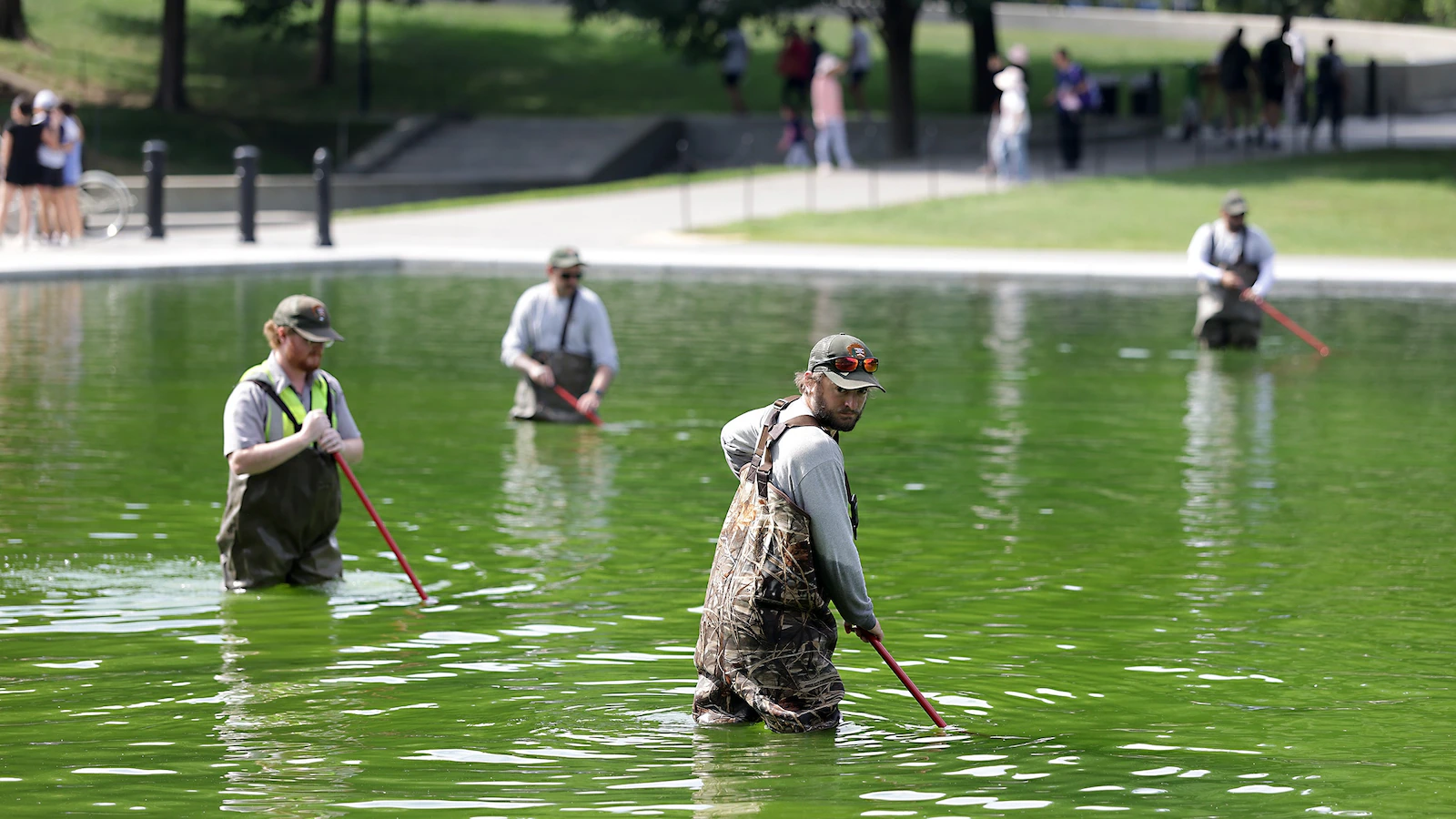
Efforts to clean the pool include workers manually scraping algae from the bottom and setting up a tubing system to siphon contaminated water into storm drains. Videos posted on X showed staff dumping hydrogen peroxide into the pool, a step aimed at accelerating the decomposition of algae. The cleanup is part of an ongoing battle to maintain the pool’s aesthetic appeal, which has been marred by the green tinge since the renovation’s completion.
Renovation Project Overshadowed by Algae Crisis
The algae issue has cast a shadow over the $15 million renovation project, originally planned as a quick fix to resurface the pool and upgrade its filtration system ahead of America’s 250th birthday. However, the project has expanded, with federal contract records revealing additional costs beyond initial estimates. The algae problem has also sparked public criticism, with some viewing it as a setback for the administration’s efforts to modernize the historic site.
White House spokeswoman Taylor Rogers highlighted the use of nanobubble ozone technology as a key component of the cleanup, stating, “Under regular NPS maintenance, high-tech nanobubble ozone will be deployed to kill the algae and keep the Reflecting Pool crystal clear.” This statement underscores the administration’s commitment to resolving the issue, even as the pool’s appearance remains a point of contention for some visitors.
Historical Context and Previous Renovations
The Lincoln Memorial Reflecting Pool has a long history of algae-related challenges. Built in the 1920s, the pool’s design—its broad, shallow structure—creates an ideal environment for algae and Cyanobacteria to thrive, particularly during warm summer months. A prior attempt to address these issues was made in 2012 by former President Barack Obama, who allocated $35 million to install a new plumbing system that draws water from the Tidal Basin and purifies it in a treatment plant.
Despite these efforts, the algae problem persists, suggesting that the pool’s ecosystem remains delicate. The recent $1.7 million payment to Greenwater Services, an Ohio-based firm specializing in water purification, highlights the ongoing reliance on specialized technology to combat the issue. Employees from Greenwater were observed collecting water samples from the pool on Tuesday, a task that aids in monitoring the effectiveness of the treatment.
“The nanobubble process actively kills algae and other contaminants,” the DOI spokesperson explained. “It releases tiny gas bubbles filled with ozone, which helps eliminate algae blooms.”
Public Reaction and Legal Challenges
Local residents and tourists have expressed mixed reactions to the algae outbreak. Redmond Walsh, a longtime Washington resident, noted the change in the pool’s appearance while biking near it on Tuesday. “It’s not the same as before,” he remarked, highlighting the disappointment among those who had anticipated a more visually striking result from the renovation.
The algae issue has also drawn attention to a broader legal challenge. A recent lawsuit questions the effectiveness of Trump’s planned “National Garden of American Heroes,” which includes the Reflecting Pool renovation. Critics argue that the project’s complexity and cost have created more problems than solutions, particularly as the algae blooms detract from the pool’s intended restoration.
Algae’s Impact on the Park’s Image
The algae crisis has become a focal point for discussions about the park’s maintenance and the success of the renovation. While the pool’s redesign was meant to enhance its visual appeal, the algae growth has raised questions about the long-term sustainability of the project. The National Park Service’s current efforts aim to address this issue before it becomes a recurring problem, but the challenge remains significant.
Historical data shows that algae has been a recurring issue for the Reflecting Pool since its creation. The 2012 overhaul by Obama, which included a state-of-the-art filtration system, was a major step toward managing the problem. However, the recent renewal of the pool’s surface and the introduction of new technology have not yet resolved the issue, indicating that the park’s maintenance team must continuously adapt to the changing conditions of the water.
Environmental and Aesthetic Considerations
The National Park Service has emphasized that the chosen treatments are environmentally safe. The use of hydrogen peroxide, for instance, is designed to avoid harming marine life or the surrounding ecosystem. This approach reflects a balance between addressing the algae problem and preserving the pool’s natural state. Nevertheless, the visible discoloration and cloudiness have sparked debate about the effectiveness of these measures.
As the cleanup continues, the Reflecting Pool serves as a reminder of the complexities involved in maintaining historic landmarks. While the renovation aimed to modernize the site, the algae issue highlights the challenges of integrating advanced technology with traditional conservation practices. The National Park Service remains dedicated to resolving the problem, even as it faces public scrutiny and the need to prove the project’s long-term viability.
Broader Implications for the Park Service
The algae outbreak has also raised questions about the efficiency of the National Park Service’s maintenance protocols. Critics argue that the project’s initial promise of quick results was not fully realized, with costs ballooning and public visibility of the issue increasing. The situation underscores the importance of thorough planning and continuous monitoring in large-scale restoration efforts. For now, the focus remains on the immediate cleanup, but the broader implications for the park’s management are clear.
As the sun sets over Washington, D.C., the Lincoln Memorial Reflecting Pool stands as a symbol of both the triumphs and challenges of preserving national landmarks. The algae issue, while frustrating, serves as a case study in the delicate balance between innovation and tradition in park conservation. With each new effort to combat the green tinge, the National Park Service continues its mission to protect and enhance one of America’s most cherished sites.