Legal Action Filed by Men Who Discovered Birth Switch at North Dakota Hospital
Men sue hospital after DNA tests – Two families are pursuing legal remedies after learning that their sons were exchanged at birth nearly four decades ago. The lawsuit, recently submitted to state court, alleges that a North Dakota medical facility deprived these men of the lives they were destined to experience. Kyle Bylin and Jeremy Morrison, both born on January 26, 1988, at Unity Medical Center in Grafton, represent the only infants delivered at that facility on that particular day.
The Discovery Begins with a Random Gift
The remarkable revelation started when Kyle Bylin participated in a Christmas gift exchange and selected a DNA testing kit at random. This seemingly casual decision opened a door to his biological heritage. Through a genealogy platform, Bylin connected with his biological aunt, who subsequently arranged for her nephew, Jeremy Morrison, to undergo genetic testing. The results proved conclusive.
“That’s when my mind was just completely blown,” Bylin recalled. “We could have never imagined that it was an actual birth switch that occurred.”
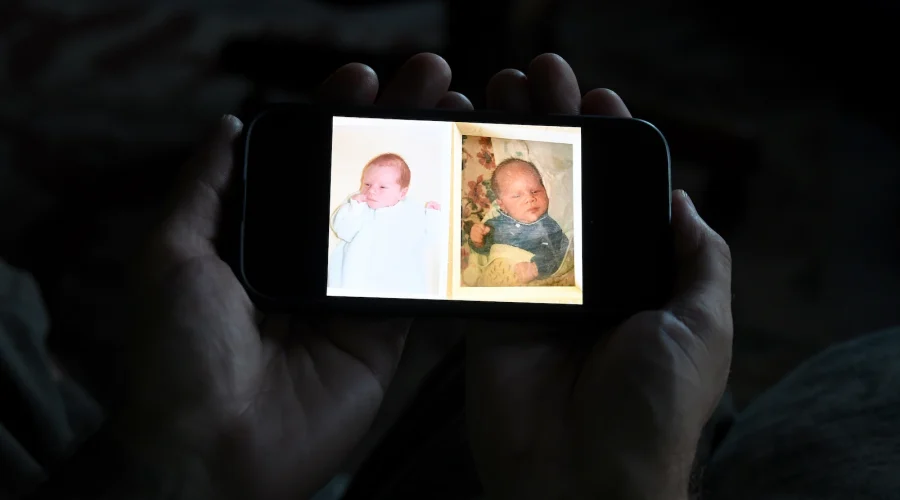
Morrison became convinced of the truth upon seeing a photograph of Bylin’s brother. The resemblance between the two men was striking and undeniable.
Life After the Revelation
Two years have elapsed since the DNA results transformed both men’s understanding of their identities. The discovery brought disorienting experiences, emotional reunions, and countless reflections on alternate possibilities. Evelyn Newton, who raised Kyle as her own child, expressed her feelings to the Associated Press during a telephone conversation.
“Kyle is still my son — that is never going to change,” Newton stated. “But I feel robbed of the life I should have had with my biological son. You can’t go back and replace 35 years. First steps, driving a car, getting married — how do you make up for that?”
The hospital maintains that while the babies were indeed exchanged, there is no proof that hospital personnel caused the error. Officials note that medical and staffing documentation from that era no longer exists, and none of the delivery team members remain employed at the facility.
“We recognize the profound impact this discovery has had on them and their families,” Unity Medical’s official statement reads. “Unfortunately, because of the passage of nearly four decades, the medical and staffing records that might have provided additional clarity no longer exist, and no members of the delivery team from that time are still employed by the hospital.”
Personal Reflections and New Realities
For Morrison, who now resides in Colorado City, Colorado, and works as a welding inspector for a wind energy company, the DNA results did not diminish his love for the parents who raised him—Elizabeth O’Toole and Terry Morrison. He acknowledged some difficult periods, particularly when he was seven years old and wished for a sibling to support him during his parents’ divorce. Nevertheless, he considers his childhood satisfactory.
“I was loved. I played sports. I did well in school,” Morrison explained. “A DNA test is not going to take away 38 years of memories.”
Had circumstances been different, Morrison believes he would remain near his biological brother and father, working on the North Dakota grain farm where Bylin spent his youth.
Newton admitted she never questioned whether Kyle was their biological son during his upbringing. Although the immediate family possessed light hair while Kyle’s was dark, her husband had dark-haired relatives, and Newton herself was adopted, so she understood that appearance could vary within families.
For Bylin, who pursued higher education and an academic path away from North Dakota, the nature versus nurture question became deeply personal. He once attributed political disagreements during Thanksgiving gatherings to typical American family dynamics.
“You’re just kind of shaking your fist, like, how can this be my family? How am I so different from them?” Bylin said. “It turns out that we’re just totally different people, period.”
Both men have now encountered their biological parents in meetings they describe as welcoming yet somewhat awkward. While they have not yet met face-to-face, they have communicated by telephone. Bylin expressed hope that everyone would navigate this complex situation together.
“We’ve tried to unite as a group and just recognize that no matter what, there’s different ways that this can be socially messy,” Bylin said. “Everyone’s getting to know people that they didn’t know before.”
Such occurrences remain uncommon, but the men continue to adjust to their new understanding of who they are and where they belong.