Flash Floods Along the Nepal-Tibet Border Leave Hundreds Dead and Nearly 1,000 Missing
Cyberzenhub.com – A catastrophic wall of water surged down the Trishuli River valley on Wednesday morning, August 27, 2026, sweeping through communities straddling the Nepal-China frontier and leaving at least 543 confirmed dead. Two days later, rescue crews still comb through mud-choked terrain while roughly 977 people remain unaccounted for on the Nepali side and another 558 are listed missing in Tibet’s border districts, bringing the combined missing count close to 1,500. Authorities in Kathmandu confirmed that at least 1,545 survivors had been pulled from the wreckage and treated for injuries, and that 8,380 police officers had been mobilized to secure roads, manage displaced populations, and coordinate with military units.
The Trigger: A Massive Landslide in the High Himalaya
The disaster began at approximately 8:40 a.m. local time in the northern Rasuwa district, where a landslide roughly 12 miles northeast of the Rasuwagadhi border post tore through a mountain pass. The U.S. Geological Survey registered the event as a 5.2-magnitude seismic signal; the agency initially misclassified it as a 4.4-magnitude earthquake before correcting the record. Ben Mirus, a research geologist at the USGS, stated Thursday that the agency estimates more than 100 million cubic meters of ice, rock, and debris were displaced in a single event.
A geophysicist at Columbia University in New York told ABC News that the evidence points to a landslide that removed a large glacier, or significant portions of one, from a cliff face standing approximately 16,000 feet above sea level. The resulting debris avalanche then cascaded roughly 6,000 feet down the slope, unleashing a torrent that inundated the Trishuli River corridor. The exact geological mechanism behind the initial slope failure remained unclear as of Thursday.
Scale of Destruction Far Beyond the Border
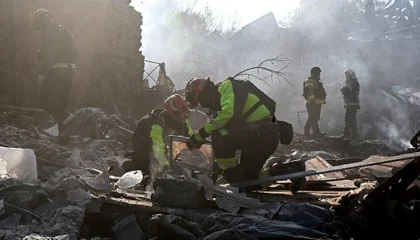
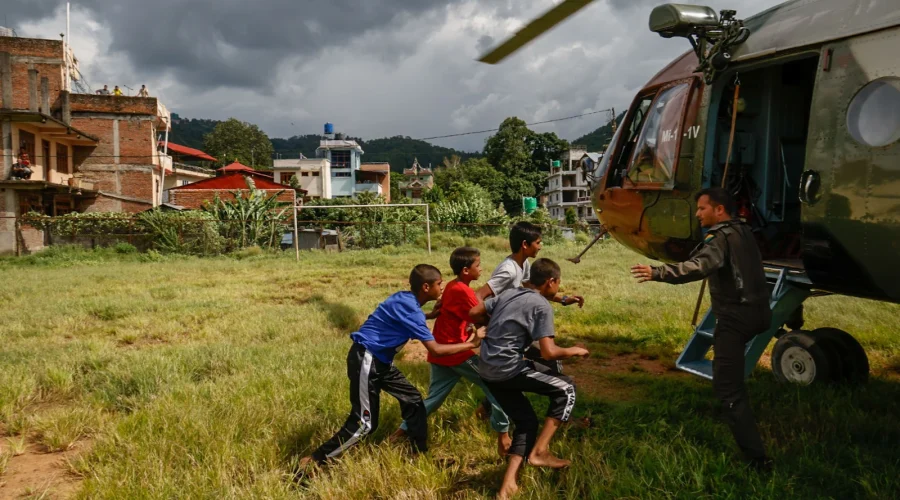
Analysis of verified video footage and satellite imagery indicates the flood’s destructive reach extended at least 62 miles downstream from the Nepal-Tibet boundary, well into Nepal’s interior. Buildings were buried under meters of sediment, bridges collapsed, and roadways connecting remote villages to district centers were severed. In Nuwakot district, aerial imagery captured on Thursday showed entire neighborhoods in Devighat, Bidur Municipality, submerged in sludge. A Nepal Army helicopter was filmed ferrying stranded residents from rooftops at an undisclosed location on August 27.
On the Chinese side, state-run Xinhua News Agency reported Thursday, citing local officials, that three fatalities had been confirmed in Tibet and that 558 residents remained missing. Nepal’s National Disaster Risk Reduction and Management Authority placed the Nepali death toll at 538, with five additional fatalities recorded in China, for a combined total of 543.
Rescue, Registration, and Government Response
By Friday, August 28, survivors rescued from cut-off areas in Nuwakot district were lining up at army camps to register their names and claim assistance. Nepal’s disaster agency reported that 823 people were still out of contact as of August 27, more than 24 hours after the flood struck. The missing count has fluctuated considerably as recovery operations accelerate and families report relatives to authorities.
The Nepali government moved quickly to centralize coordination. On Thursday, the Ministry of Foreign Affairs announced the creation of an “Emergency Control Room … to facilitate search, rescue, information verification and consular assistance in respect of foreign nationals affected by, missing in, or otherwise connected to the flood incident.” The office also noted that dozens of foreign nationals, including Americans, were among those unaccounted for.
Nepal’s Office of the Prime Minister issued a statement expressing “deep sorrow” over the loss of life.
“Offering heartfelt tribute to all those who lost their lives in this natural disaster, it extends its sincere condolences to the bereaved families and relatives.”
Why This Region Is Especially Vulnerable
The Rasuwa corridor sits in one of the most seismically active and glacially loaded zones on the planet. The Trishuli River, a major tributary of the Ganga system, drains steep Himalayan valleys where monsoon-season rainfall, permafrost degradation, and frequent slope failures combine to create recurring flash-flood hazards. Communities along its banks have experienced periodic inundation events, but the scale of the August 27 event—driven by a single, enormous mass-wasting episode rather than sustained rainfall—marked it as an outlier in recent memory. The concentration of displaced material, exceeding 100 million cubic meters, dwarfs typical landslide volumes recorded in the region and underscores how quickly a high-altitude slope failure can translate into a lowland catastrophe within minutes.
As search teams continue working through the debris field, the full human toll is expected to rise. International aid agencies and neighboring governments have signaled readiness to assist, while Nepal’s military and police maintain a sustained presence across the affected districts to prevent secondary disasters and manage the growing displaced population.
Related Reading
Frequently Asked Questions
What is Hundreds dead as nearly 1 000 remain?
Hundreds dead as nearly 1 000 remain is the main topic of this guide. The article explains the context, practical details, and next steps readers should understand.
Why does Hundreds dead as nearly 1 000 remain matter?
Hundreds dead as nearly 1 000 remain matters because readers are looking for a useful answer, not just a short summary. Good content should match search intent and help them decide what to do next.