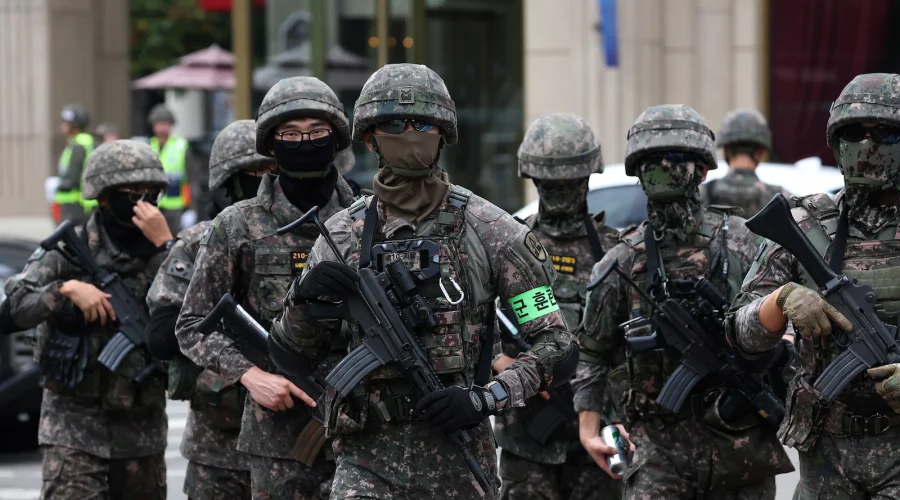
Joint U.S.-South Korea Exercises Cut Short After Presidential Directive
Cyberzenhub.com – The annual Ulchi Freedom Shield exercise, which kicked off Monday across the Korean Peninsula, will wrap up on August 21 — six days ahead of its original schedule — after President Donald Trump directed the Pentagon to scale down the combined operations. South Korea’s Joint Chiefs of Staff confirmed the shortened timeline in a Wednesday statement, noting that both allies had agreed to modify the exercise’s duration and overall scope in response to a U.S. proposal.
The decision lands at a moment of heightened sensitivity between Washington and Pyongyang. Trump, speaking on his social media platform on Sunday, framed the annual drill as unnecessary friction with a neighbor he described as cooperative. He pointed to what he called his “very good” personal rapport with North Korean leader Kim Jong Un as the rationale for pulling back.
“Based on my very good relationship with Kim Jong Un, of North Korea, I am not happy with the fact that the United States has, long ago, agreed to participate in Joint Military Exercises with South Korea,” Trump wrote. “Therefore, and based on the fact that it is too late to cancel, I have instructed Secretary of War, Pete Hegseth, to substantially reduce the Joint Military Exercises!”
What Changes on the Ground
A Pentagon official confirmed to reporters that the exercise had been “substantially reduced” on “direction from the president and secretary of war.” The official elaborated that associated live-training events had been trimmed, with certain field exercises canceled outright or converted into simulation-based scenarios. The stated aim was to preserve essential readiness and training objectives without degrading U.S. military preparedness.
South Korea’s Joint Chiefs of Staff added that the two sides were still negotiating specifics around scaled-back combined field training elements. The statement closed with a forward-looking commitment: both nations would continue discussing and implementing measures to achieve the exercise’s objectives while maintaining a strong combined defense posture.
Pyongyang’s Reaction and the Broader Tension
North Korea has long treated joint U.S.-South Korean drills as provocative acts that destabilize the peninsula. This week, Pyongyang labeled Ulchi Freedom Shield an “open threat” to its security, reinforcing its routine diplomatic protests against the exercises. Trump, for his part, dismissed the annual event as “inappropriate and hostile” toward North Korea, a country he characterized as having been “unthreatening and respectful” toward the United States throughout his presidency.
The friction over drills is not new. Since the Korean War of 1950–53 — a conflict that technically never concluded with a peace treaty — the peninsula has remained divided, and the roughly 28,500 U.S. troops stationed in South Korea have served as a visible deterrent against renewed cross-border hostilities. North Korea tested its first nuclear weapon in 2006 and has since expanded its atomic arsenal and ballistic-missile program, producing munitions capable of reaching the continental United States, all while operating under successive rounds of international sanctions.
Strategic Calculus Beyond the Peninsula
The U.S. military footprint in South Korea also functions as a critical node in the wider strategic competition between Washington and Beijing. China has long acted as Pyongyang’s principal patron, providing economic lifelines and diplomatic cover. Reducing the scale of joint exercises, even temporarily, sends a signal to both Seoul and Beijing about how much weight the current administration places on the alliance’s visible military dimension versus its diplomatic overtures toward the North.
For South Korea, the adjustment raises questions about force-readiness timelines and the degree to which combined training cycles can be compressed without eroding interoperability. The Joint Chiefs of Staff’s language — emphasizing continued discussion and implementation of measures to meet exercise objectives — suggests Seoul is attempting to absorb the disruption while preserving the institutional framework of the alliance.
What Comes Next
The shortened exercise window means that certain combined field training events originally slated for late August will either be folded into earlier dates, converted to tabletop or simulation formats, or dropped entirely. Details remain under bilateral negotiation. Both governments have signaled that the adjustment is operational rather than structural: the alliance’s combined defense posture, they insist, remains intact.
Whether the reduced scope of this year’s Ulchi Freedom Shield marks a one-time accommodation or the opening of a longer recalibration of U.S.-South Korean military cooperation will depend on how Trump’s stated preference for direct engagement with Kim Jong Un translates into sustained policy. For now, the drills end early, the simulations replace the live-fire events, and the peninsula’s most visible symbol of allied readiness shrinks by a full week — a small calendar change with outsized geopolitical resonance.
Related Reading
Frequently Asked Questions
What is US South Korea military drills to end?
US South Korea military drills to end is the main topic of this guide. The article explains the context, practical details, and next steps readers should understand.
Why does US South Korea military drills to end matter?
US South Korea military drills to end matters because readers are looking for a useful answer, not just a short summary. Good content should match search intent and help them decide what to do next.