The Military’s Recruiting Surge Is Real — But Not for the Reason Washington Wants You to Believe
Cyberzenhub.com – For the first time in several years, the Pentagon’s annual enlistment targets are being met, and in some branches exceeded well before the fiscal year closes. The numbers are unambiguous: after a stretch of shortfalls that stretched across multiple administrations, young Americans are once again walking through processing centers in meaningful volume. Yet the explanation the White House and its defense leadership prefer to attach to that turnaround bears little resemblance to what the recruits themselves say they are doing.
A Hallway in Northern Virginia
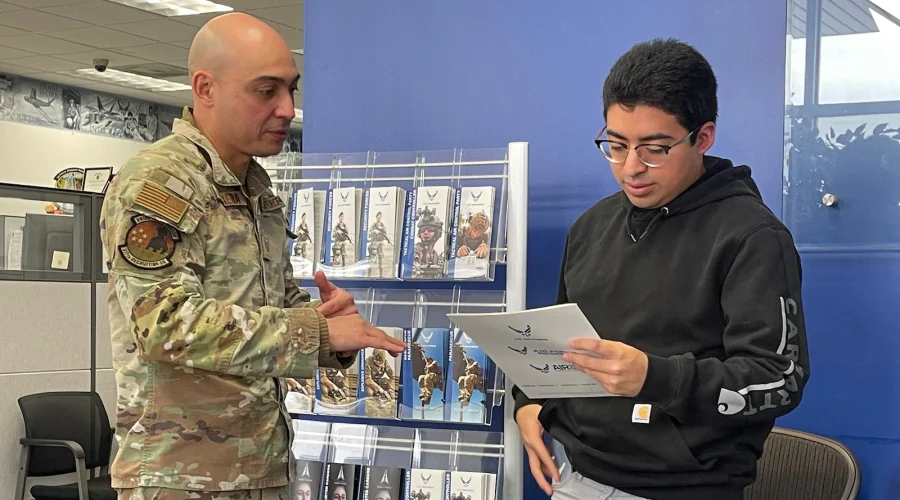
Picture a midday scene at a suburban high school just outside Washington, D.C. Students stream past a cafeteria, headphones in, phones out, finishing assignments or trading jokes. Tucked against the far wall, a folding table holds the usual recruiting spread: laminated career pamphlets, a foam-model F-35, branded water bottles dispensed as rewards for a quick set of pushups. Behind the table sits Tech Sgt. Omar Herrera, an Air Force recruiter, fielding questions from teenagers who stop long enough to ask what a diesel mechanic’s pay looks like, what the path to a JAG officer commission requires, or how a daughter of an Army veteran might continue a family tradition while funding a college degree.
The interaction is quiet, almost mundane. Herrera describes his role not as selling but as mentoring. “I don’t do sales, I hate sales. I was that kid who couldn’t sell a candy bar,” he told prospective recruits. “I’m approaching this as more of a mentor.” By the end of a single school visit, dozens of conversations have taken place, and a substantial slice of the Air Force’s yearly quota has already been filled.
The Political Framing
Defense Secretary Pete Hegseth, himself an Army National Guard veteran, has made recruiting performance the centerpiece of his public narrative. In a December address to roughly two dozen senior recruiters gathered at the Pentagon, he recast improved enlistment figures as a referendum on the administration’s legitimacy.
“You can talk about polls, you can talk about money, but men and women willing to serve and put on the uniform is a reflection of the belief they have in civilian leadership and military leadership.”
Pentagon spokesperson Sean Parnell echoed the sentiment in a written statement, describing Americans as “prouder than ever to serve in our unmatched military that prioritizes lethality, merit, and protecting our nation from those who seek to harm it.” The language positions the recruiting rebound as validation of a broader conservative overhaul of the force — a culture-war victory dressed in uniform.
What the Recruits Actually Say
The motivations behind the numbers tell a far less ideological story. Interviews with nearly forty recruits and prospective recruits at various stages of the enlistment pipeline, supplemented by conversations with two dozen recruiters across the services and by current and former defense officials, paint a consistent picture: steady pay, tuition assistance, trade training, and a structured route into the middle class. The Pentagon’s own internal data corroborates this, ranking financial compensation and benefits among the leading reasons young people choose to enlist.
That calculation has not changed since the United States abandoned conscription and moved to an all-volunteer force in 1973. What has shifted is not the product being offered but the political narrative wrapped around it. The military has, in essence, been marketing the same proposition — job stability, education benefits, a measure of adventure — for over five decades. The packaging has gotten louder; the contents have not.
Timing and Structural Factors
The recruiting turnaround did not begin with a change in administration. It was already underway before President Donald Trump returned to office, and it has been assisted by policy adjustments made under former President Joe Biden regarding how the Pentagon identifies, screens, and qualifies candidates. Those structural changes — expanded outreach channels, revised qualification thresholds, and adjusted incentive structures — did the heavy lifting before any new political messaging entered the equation.
Yet Hegseth has increasingly cast those gains as a referendum on his own leadership and on the ideological reorientation he has pushed through the ranks. The tension is not merely rhetorical. The modern force depends heavily on women, on minority communities, and on recruits drawn from Democratic-leaning urban areas — precisely the populations some defense officials worry the administration’s culture-war posture could alienate over time.
The Family Thread
One statistic underscores how deeply enlistment is embedded in intergenerational economic strategy rather than partisan loyalty: roughly eighty percent of recruits each year have a family member who has served or is serving in the military. For many of those young people, the decision is less a political statement than a continuation of a household plan — a way to fund education, acquire a trade, and maintain a family’s long-standing relationship with the services.
In an affluent Virginia suburb with access to one of the nation’s strongest labor markets, the conversations at Herrera’s table still circled back to careers and economic security. A soon-to-be graduate wanted to become a diesel mechanic. Another asked about the requirements for a military legal career. A young woman saw service as a means to pay for college while honoring her father’s Army career. None of those motivations required a culture-war framework to explain them.
The recruiting numbers are genuine. The pride in service is real. But attributing the rebound to confidence in a particular administration’s ideological project misreads the transaction. Young Americans are making the same economic calculation they have made for decades, and the Pentagon’s own data confirms it. The politics surrounding that bargain have changed; the bargain itself has not.
Related Reading
Frequently Asked Questions
What is New recruits are joining the military?
New recruits are joining the military is the main topic of this guide. The article explains the context, practical details, and next steps readers should understand.
Why does New recruits are joining the military matter?
New recruits are joining the military matters because readers are looking for a useful answer, not just a short summary. Good content should match search intent and help them decide what to do next.