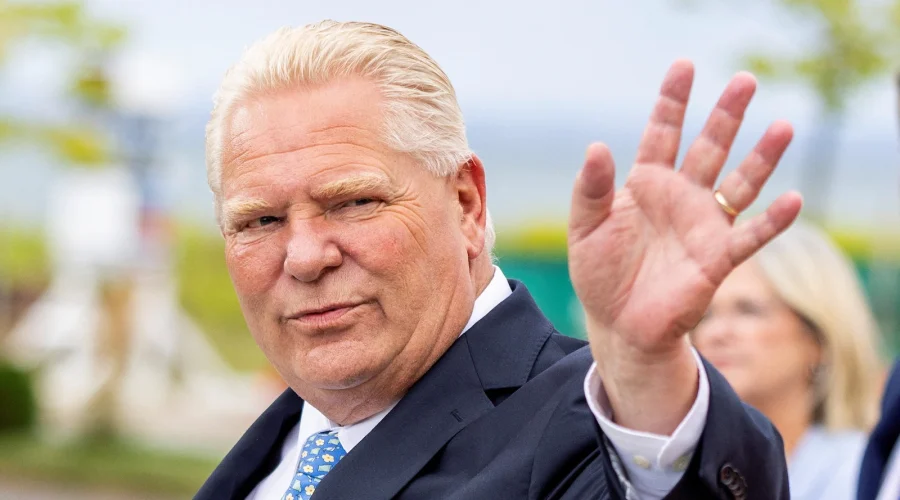
Ontario Premier Warns Escalating Trade Conflict Will Wreck Both Economies
Cyberzenhub.com – The transborder economic relationship between the United States and Canada has entered its most turbulent phase in decades, and Ontario Premier Doug Ford has made clear he believes the current trajectory will inflict severe damage on both sides of the 49th parallel. Speaking this weekend to ABC News’ “This Week” co-anchor Martha Raddatz, Ford laid out his case that the tariff measures imposed by President Donald Trump represent a fundamental misreading of how deeply intertwined the two economies remain.
“Everyone’s feeling bullied by President Trump, and this is the worst thing you could do for the American economy,” Ford told Raddatz. “I just don’t see the purpose. It’s absolutely backwards.”
The Numbers Behind the Dispute
The scale of bilateral commerce makes the stakes of this confrontation difficult to overstate. The United States accounts for more than 70 percent of all Canadian exports, while roughly 60 percent of goods flowing into Canada originate in American factories and warehouses. Prime Minister Mark Carney has highlighted the energy dimension of that dependency, noting that of the crude oil the United States purchases from foreign suppliers, 60 percent arrives from Canadian pipelines and terminals.
That interdependence is precisely what Ford argues makes a tit-for-tat tariff spiral irrational. When Washington moved to impose 50 percent duties on a broad swath of Canadian products following the collapse of bilateral trade negotiations, Ottawa answered in kind, rolling out retaliatory levies on numerous American goods effective September 8. Each round of escalation, Ford contends, raises prices for ordinary consumers on both sides while doing little to correct any structural imbalance.
Venezuela’s Oil and the Question of Leverage
The weekend brought an additional wrinkle to an already volatile situation. The United States and Venezuela announced a deal under which Washington would acquire a majority stake in more than 65 billion barrels of Venezuelan oil reserves. Raddatz pressed Ford on whether that arrangement hands the president an added bargaining chip over Ottawa.
“Well, you know something? That’s going to be up to President Trump. Who do you want to deal with? An unstable government like Venezuela, or do you want to deal with your No. 1 trading partner, your No. 1 ally?” Ford said.
The question carries weight given that Canadian crude already supplies the bulk of America’s foreign oil imports. A shift toward Venezuelan barrels would mean longer transport routes, different quality grades, and dependence on a government whose political stability has fluctuated for years. Ford’s point is straightforward: the existing pipeline infrastructure connecting the two countries represents a logistical and economic advantage that no new arrangement can replicate overnight.
Auto Tariffs and the January 2027 Threat
The confrontation is not limited to the current round of duties. Last week, Trump posted on social media that he intended to double the existing automobile tariffs applied to Canadian vehicles beginning January 1, 2027, adding the line that “Canada will be treated like a state no longer.” Ford reacted sharply, describing the prospective doubling as “devastating” for both nations, though he insisted the blow would land hardest on American buyers and manufacturers.
“It’d be devastating on both countries, but it’d be definitely devastating on the U.S. We’re the largest purchaser of vehicles in the entire world off the U.S. … and they’re already seeing the effect,” Ford said. “A tariff on Canada is nothing more than a tax on American people, and it’s probably the worst move he could ever do.”
Canadian provinces, particularly Ontario, host major assembly plants for American-brand nameplates. A sudden doubling of duties on finished vehicles would compress margins for those plants, raise retail prices for U.S. consumers, and potentially accelerate the relocation of production capacity south of the border — an outcome Ford argues would hollow out manufacturing communities in both countries.
“Lake America” and the Personal Dimension
The dispute has spilled well beyond trade policy into symbolic territory. After a series of pointed social-media jabs at Canadian leaders, Trump signed an executive order last week renaming Lake Ontario — one of the five Great Lakes shared by the two nations — as “Lake America.” Ford, whose province borders the lake, called the gesture “disappointing” and compared it to a sketch from a late-night comedy show.
“It was like something out of ‘Saturday Night Live’ when he signed documents saying change to Lake America. No one’s going to call it Lake of America. It’s been Lake Ontario for hundreds of years. It’s going to continue being Lake Ontario, and it’s just so, so disappointing,” Ford said.
The renaming has drawn quiet attention from cartographers, state agencies, and residents along the lake’s shores, where maps, signage, and municipal records all reference the traditional name. Whether the executive order will be implemented in practice, or simply remain a rhetorical flourish, remains to be seen.
Drawing the Line Between People and Government
Despite the volume of public criticism, Ford was careful to separate his objections to policy from his regard for ordinary Americans. With midterm elections approaching in the United States and Canadian tariffs already a salient issue along New York’s northern border, the distinction matters politically on both sides.
“I love the American people. Canadians love the American people,” Ford said. “We differentiate between the great American people and the president.”
That framing — affectionate toward the populace, pointed toward the administration — mirrors a tone many Canadian provincial leaders have adopted since the trade talks broke down. The underlying message is consistent: the economic architecture linking the two countries was built over generations, and dismantling it through tariff warfare will leave scars that outlast any single administration’s tenure.
Related Reading
Frequently Asked Questions
What is Ontario s premier says trade war would?
Ontario s premier says trade war would is the main topic of this guide. The article explains the context, practical details, and next steps readers should understand.
Why does Ontario s premier says trade war would matter?
Ontario s premier says trade war would matters because readers are looking for a useful answer, not just a short summary. Good content should match search intent and help them decide what to do next.