Trump Signs Granite Slab as White House Helipad Rises on the South Lawn
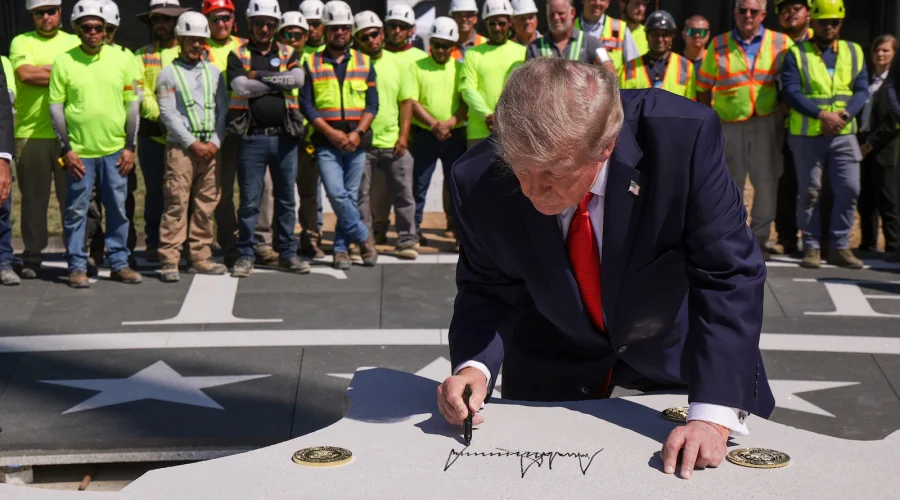
Cyberzenhub.com – On a Wednesday morning in August 2026, President Donald Trump walked across the partially finished construction zone on the White House South Lawn, picked up a chisel, and etched his name into one of the freshly laid granite slabs that will form the surface of a new helicopter landing pad. The gesture, captured on camera by a pool of reporters he had personally invited for a walkthrough, marked the first public unveiling of a project that has drawn sustained scrutiny over its funding, its scale, and its place in the long history of presidential modifications to the executive mansion’s grounds.
“It’s very exciting, very exciting, and I think it will be here for a long time,” Trump told the assembled press corps as he gestured toward the unfinished pad and the surrounding scaffolding.
The Funding Question
The most persistent question surrounding the build is who ultimately bears the cost. When Trump first announced the helipad from the Oval Office in July, he stated that Sikorsky — the manufacturer behind the Marine One helicopter fleet that ferries the president between the White House and other destinations — would cover the full expense. At the time he put the figure at roughly five to six million dollars.
“They are paying for the cost of it. It’s about $5 or $6 million. They’re paying the full cost,” Trump said during the July announcement.
By the Wednesday tour, however, the president had broadened the financial picture, telling reporters that Sikorsky was footing “much of the bill” while additional funds would come from “donations from numerous people, including me.” A spokesperson for Lockheed Martin, the parent company of Sikorsky, had told ABC News in a statement the previous month that the company’s contribution was “made to the National Park Service,” the federal agency that oversees the White House grounds. The spokesperson added that the firm’s collaboration with the administration was being “guided by rigorous ethics and compliance standards.” Whether the arrangement constitutes a corporate gift, a contractor offset, or something in between remains a point of debate among watchdogs and congressional staff monitoring executive-branch spending.
What the Pad Will Do
The landing zone is designed to accommodate the newest generation of Marine One helicopters, which Lockheed Martin delivered to the Air Force in 2024. Those aircraft, however, have been unable to operate from the South Lawn since their rotor wash damages the turf. The older fleet has therefore continued to handle presidential arrivals and departures at the White House, while the newer machines have been restricted to other airfields. The granite surface eliminates that constraint by providing a hard, heat-resistant platform.
Beyond routine presidential travel, Trump outlined several additional uses. Foreign heads of state arriving for state visits would land on the pad. It would double as an outdoor cocktail terrace preceding events at the new White House ballroom he is simultaneously constructing. He also noted that press conferences might be staged there, giving reporters a vantage point overlooking the South Lawn.
The Signature and the Seal
The completed pad will bear the Great Seal of the United States at its center. Trump explained that his own signature, along with those of the project’s principal leaders, will be inscribed on the reverse of the eagle’s head within the seal design — a location that will render the names invisible once the granite is fully set and polished. ABC News has asked the White House Historical Association whether any previous president has carved his or her name into a structure on the executive grounds; no answer had been received as of publication.
Construction Tempo and Delays
Workers on site told the president that crews were operating in near-continuous shifts, beginning at six in the morning and continuing until midnight. Despite that pace, the schedule has already slipped. Trump acknowledged that work was paused for roughly a week and a half after he directed that the pad be raised to compensate for a natural slope in the lawn’s topography.
“Sorry to take an extra week and a half, but lifting it up was one of the best things we’ve ever done, right?” Trump said, turning to the construction crew gathered around him.
A worker told the president the pad could be finished by “the 21st,” though it was unclear whether he meant August or September. The ambiguity matters because Trump is scheduled to welcome Chinese President Xi Jinping to Washington on September 24. Asked whether the pad might be ready in time for that state visit, the president replied, “Oh, so we might make it for President Xi? That would be great.” He softened the remark shortly afterward: “Not imperative, but it would be very nice to have it done.”
Context: The South Lawn and Presidential Construction
The South Lawn has long served as the White House’s primary ceremonial and operational outdoor space — the site of inaugural addresses, military flyovers, and, since the mid-twentieth century, helicopter operations. Earlier presidents added or modified helipad infrastructure, but those efforts were modest in scale and funded through standard appropriations. A multimillion-dollar granite installation, financed in part by a private aerospace contractor and supplemented by unnamed individual donors, represents a different order of intervention on the grounds. The National Park Service’s custodial role over the White House property means that any permanent alteration, however well-intentioned, passes through federal land-management channels — a fact that complicates the optics of a corporate contribution flowing through that same agency.
The broader construction picture on the South Lawn is equally ambitious. From the vantage of the Washington Monument, workers can be seen simultaneously erecting the helipad and advancing the new ballroom project, a pair of undertakings that have blanketed much of the lawn in construction netting and temporary fencing. For visitors and residents of Washington, the familiar green expanse south of the White House has become, for months, a staging area for what the administration describes as a permanent upgrade to presidential infrastructure.
Whether the pad will endure beyond a single administration — as Trump suggested it will — or whether future occupants will repurpose, modify, or remove it remains an open question. What is certain is that, for the first time in the building’s history, a sitting president has publicly branded a piece of its permanent architecture with his own name, however discreetly the inscription may be hidden beneath the wings of the national eagle.
Related Reading
Frequently Asked Questions
What is Trump shows off multimillion dollar White?
Trump shows off multimillion dollar White is the main topic of this guide. The article explains the context, practical details, and next steps readers should understand.
Why does Trump shows off multimillion dollar White matter?
Trump shows off multimillion dollar White matters because readers are looking for a useful answer, not just a short summary. Good content should match search intent and help them decide what to do next.