
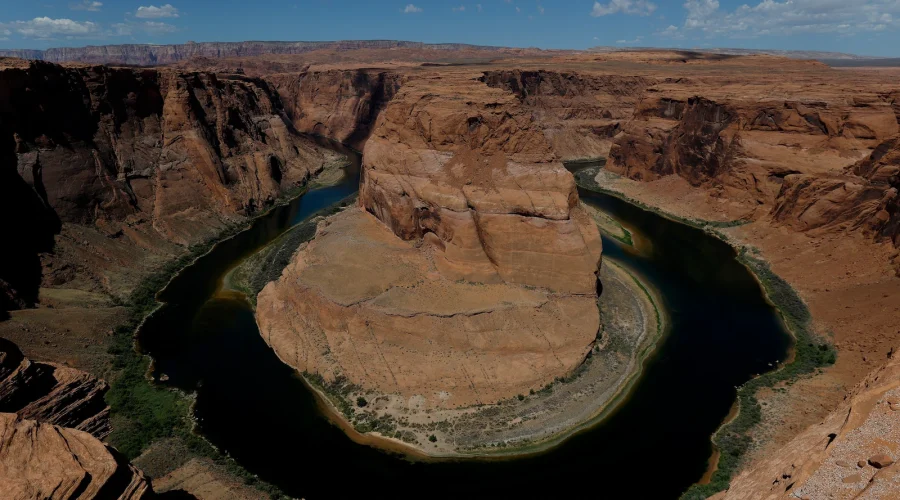
Colorado River Water Allocations Face Historic Federal Mandate as Reservoirs Hit Record Lows
Cyberzenhub.com – The Colorado River system, which sustains more than 35 million people across seven U.S. states and Mexico, is entering a new era of federally imposed scarcity. With Lake Mead and Lake Powell — the nation’s two largest reservoirs by water capacity — sitting at record-low levels after years of drought intensified by climate change, the U.S. Department of the Interior (DOI) moved on Friday to mandate substantial reductions in the volume of river water delivered to the Lower Basin states of California, Nevada, and Arizona.
The order takes effect beginning in 2027 and will trim 1.25 million acre-feet of annual deliveries over a two-year window. An acre-foot, for context, represents roughly 325,000 gallons of water — enough to fill a standard swimming pool about 12 times — so the mandated cut equates to removing the equivalent of tens of millions of Olympic pools from the system each year. The DOI simultaneously warned that further reductions could be ordered over the following decade, depending on how hydrological conditions evolve.
How the Cuts Are Divided Among the Three States
While the federal government set the overall ceiling on reductions, the internal allocation among the three affected states rests on a voluntary framework those states negotiated in May. Under that arrangement, Arizona absorbs the largest share at 760,000 acre-feet, California faces a 440,000-acre-foot cut, and Nevada’s reduction stands at 50,000 acre-feet. The DOI’s operating guidelines go further, urging the three states to voluntarily conserve and store an additional 700,000 acre-feet over the two-year period “to protect the system, in addition to the 1.25 million acre-feet per year of reductions.”
The stakes for each state differ sharply. Arizona’s agricultural valleys in the Phoenix and Tucson corridors rely heavily on Colorado River allocations, and a 760,000-acre-foot cut will pressure growers to fallow land or shift to less thirsty crops. California, whose Central Valley and Southern California urban centers draw enormous volumes from the river, must recalibrate municipal and agricultural schedules. Nevada’s smaller but critical allocation underpins Las Vegas’s growth trajectory and the state’s already-stressed Lake Mead supply.
A Narrow Escape From the Worst-Case Scenario
The final numbers, while severe, represent a significant improvement over the federal government’s July proposal, which floated annual cuts of up to 3 million acre-feet for the Lower Basin. That earlier figure would have threatened to collapse irrigation districts and forced emergency rationing in major metropolitan areas. The negotiated outcome landed well below that ceiling, though the DOI left the door open for additional trims if reservoir levels continue to deteriorate.
Upper Basin States Left Outside the Mandate
The DOI did not impose equivalent reductions on the Upper Basin states — Colorado, Utah, Wyoming, and New Mexico — because it lacks the same legal authority over the upper reaches of the river. Instead, the agency is asking those states to voluntarily operate the Flaming Gorge, Navajo, and Aspinall reservoirs in a manner that sends water downstream to protect Glen Canyon Dam and its hydropower generation. The DOI’s operating guidelines set a floor for Lake Powell at or above 3,510 feet, which sits 20 feet above the elevation at which Glen Canyon Dam can no longer produce electricity.
Official Statements
“We are grateful for the Seven Basin States, the thirty Basin Tribes, Mexico, and many other basin stakeholders who have provided the feedback and voluntary arrangements necessary for the development of the 2027-2028 Operating Guidelines,” said Secretary of the Interior Doug Burgum in a statement. “Forty million people, millions of acres of farmland and ranchland, industries that power the American West, and some of our nation’s fastest growing metropolitan areas depend on the Colorado River.”
“These decisions provide a water management strategy for Basin stakeholders to respond to the prolonged drought by incorporating flexible tools and voluntary actions while leaving room for consensus agreements,” said Andrea Travnicek, Interior’s Assistant Secretary of Water and Science, in a statement. “The Department and Reclamation will continue to work with all Basin stakeholders to identify areas to maximize efforts through”
Why This Moment Matters
The Colorado River has fed the American Southwest for over a century, but the climate trajectory now embedded in long-range forecasts suggests that the river’s average annual flow will continue to decline through at least the middle of this century. The mineral-stained bathtub rings visible along the shorelines of Lake Mead near Boulder City, Nevada, and the receding waterline at Lake Powell near Page, Arizona, are not temporary anomalies; they are the physical record of a multi-decade drying trend. The federal mandate issued this week is, in practical terms, the first time the government has moved from encouraging conservation to compelling specific volume reductions in the Lower Basin. For farmers, municipal water managers, tribal nations, and downstream communities in Mexico, the message is unambiguous: the era of assuming the river will deliver what it always has is over, and every acre-foot now carries a price that must be negotiated, stored, or surrendered.
Related Reading
Frequently Asked Questions
What is Federal government orders steep Colorado River?
Federal government orders steep Colorado River is the main topic of this guide. The article explains the context, practical details, and next steps readers should understand.
Why does Federal government orders steep Colorado River matter?
Federal government orders steep Colorado River matters because readers are looking for a useful answer, not just a short summary. Good content should match search intent and help them decide what to do next.