
SCOTUS considers Trump’s bid to end Temporary Protected Status for Haitians and Syrians
SCOTUS considers Trump’s bid to end Temporary Protected Status for Haitians and Syrians
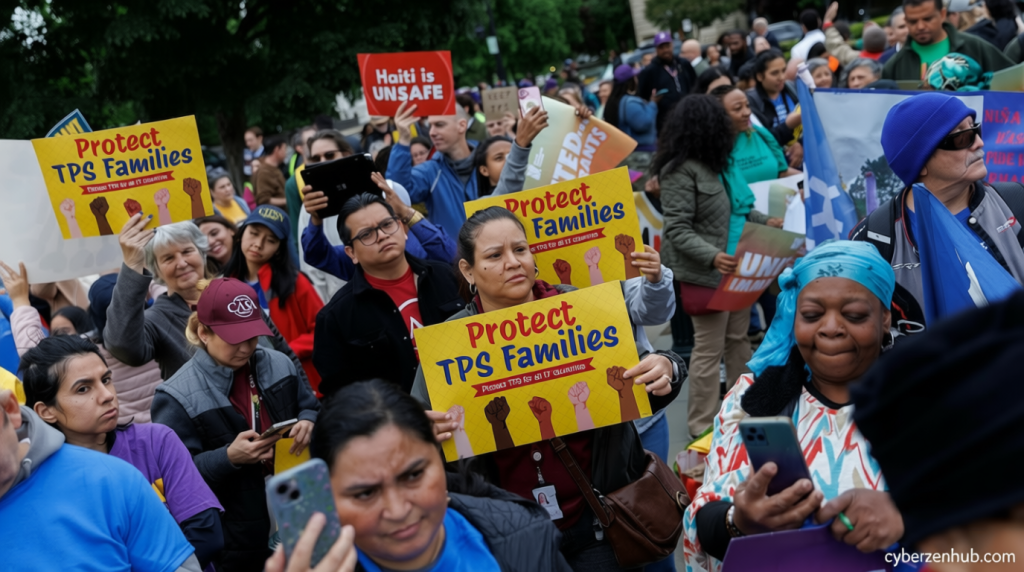
SCOTUS considers Trump s bid to end – On Wednesday, the U.S. Supreme Court addressed whether the Trump administration had the authority to terminate Temporary Protected Status (TPS) for Haitians and Syrians without facing judicial scrutiny. While the justices heard arguments in a separate case regarding the Voting Rights Act, their focus remained on the legal battle over the cancellation of these protections. Solicitor General D. John Sauer defended the administration’s decision, asserting that Congress had granted the Secretary of Homeland Security broad discretion to manage TPS designations. He argued that judicial review would lead to “micromanagement” of foreign policy, as quoted in the original.
Opposing Perspectives: Procedural Requirements and Congressional Intent
Attorneys representing the TPS holders contested the government’s stance, insisting that the Homeland Security Secretary must follow specific procedural steps outlined by Congress. These steps include evaluating country conditions, consulting with other agencies, and providing 60 days’ notice before termination. “The secretary can terminate TPS, but he must turn square corners and follow the rules Congress set,” said Ahilan T. Arulantham, who defended the immigrants. He criticized the administration’s interpretation as a “blank check” for expelling non-citizens, emphasizing the importance of procedural safeguards in preventing arbitrary decisions.
“Congress balanced the risk there might be some decision that’s erroneous or baseless… that would evade judicial review, against the risk of what we’re living through here, which is judicial micromanagement of the sorts of foreign policy laden in determinations and decisions that are naturally conferred upon the political branches,” Sauer said.
Arulantham underscored that the procedural framework was designed to ensure transparency and accountability, arguing that it provided a necessary check on executive power. “In contrast, as we’ve heard today, the government reads the statute like a blank check today. They want to use it to expel non-citizens, but the power that they seek is a double-edged sword,” he added. The debate centered on whether the administration’s actions, though compliant with procedural rules, undermined the core purpose of TPS by allowing for abrupt policy changes without thorough justification.
Justice Barrett’s Skepticism on Judicial Review
Justice Amy Coney Barrett questioned the practical significance of the legal challenge, suggesting it amounted to a “box-checking exercise.” She implied that Congress intended for the decision to be based on substance rather than procedural form. “If it’s just kind of a box-checking exercise, I mean, why would Congress permit review of the procedural aspect, when really what everybody cares about much more is the substance?” Barrett asked.
“Correct,” Sauer said.
Arulantham countered by emphasizing that the consultation process ensures decisions are well-informed. “Congress and us too, and the millions of people who live with TPS holders, have some faith in government, and they believe that if there is consultation, the decisions will be better,” he explained. This exchange highlighted the tension between judicial oversight and executive flexibility in shaping immigration policy.
Justice Sotomayor’s Focus on Substantive Intent
Justice Sonia Sotomayor challenged the government’s claim that procedural adherence was sufficient, pointing out that even a simple notice on social media, such as “I hereby terminate Syria’s TPS program effective tomorrow,” would bypass judicial review. Sauer agreed, acknowledging that the procedural steps could be met without deeper examination. “Correct,” he said, agreeing with the idea that the process itself does not guarantee the correctness of the decision.
The justices pressed Sauer on the connection between President Donald Trump’s public remarks and the decision to end TPS, emphasizing the need for clear intent in the policy change. Sotomayor cited Trump’s disparaging comments about Haitian TPS holders, calling them “undesirables” from a “s——- country” and accusing them of “eating the dogs and eating the cats of Americans.” She argued that these statements indicated a discriminatory purpose behind the cancellation, framing the case as a test of the administration’s commitment to equitable treatment of immigrants.
Trump’s Rhetoric and the Court’s Inquiry
Justice Ketanji Brown Jackson further highlighted the administration’s rhetoric, noting that Trump’s public comments and social media posts about Haitian immigrants suggested a discriminatory motive. She referenced statements where Trump labeled them as undesirables, emphasizing that the government’s actions were influenced by prejudice rather than purely policy-driven considerations. The justices sought to determine whether the TPS cancellation was an exercise of executive power or a targeted effort to remove specific groups from the country.
“The President has disparaged Haitian TPS holders specifically as undesirables from a ‘s——- country,’ and days after falsely accusing them of ‘eating the dogs and eating the cats of Americans,’ he vowed that he would terminate Haiti’s TPS, and that is exactly what happened,” Justice Sonia Sotomayor said.
Jackson pointed to remarks where Trump praised immigrants from Norway or Denmark, contrasting them with his harsh criticism of Haitians. “If the position of the United States is that we have to have an actual racial epithet… [and] we aren’t allowed to look at all the context,” Jackson said, then the court would be ignoring a “prime example” of discriminatory intent. This line of questioning underscored the broader implications of the case, linking the administration’s actions to potential violations of equal protection under the law.
Related: America is My Home
TPS holders, who have relied on these protections for years, face significant uncertainty as the Supreme Court weighs their fate. For many, the decision could mean deportation or permanent separation from their families. The stakes are high, with the outcome potentially affecting thousands of lives. Advocacy groups have rallied to support the immigrants, arguing that TPS is a critical lifeline for those displaced by natural disasters or political instability.
Related: Judge Blocks TPS Termination
Earlier in the week, a U.S. district judge had already taken a decisive stance, blocking the administration from ending TPS protections for over 350,000 Haitian immigrants. The ruling cited procedural flaws in the government’s approach, reinforcing the argument that the Homeland Security Secretary must follow the “procedural guard