Trump Administration Defends White House UFC Event Amid Legal Challenge
Cyberzenhub.com – On Tuesday, the U.S. Department of Justice filed a motion with a federal court, urging a judge to dismiss a lawsuit aimed at halting the upcoming White House-sponsored Ultimate Fighting Championship (UFC) event. The administration criticized the plaintiffs, two Virginia residents, for leveraging the judicial system to impose their personal preferences on the broader public. In the filing, the department described the lawsuit as an attempt to “enlist the power of a federal court to impose their idiosyncratic preferences” and argued that the plaintiffs lacked “reasonable standing” to challenge the event. The timing of the lawsuit, which was submitted just days before the event, was deemed “inexcusable” by the administration, as the White House had publicly announced its plans over a year prior.
“It would be easy enough to simply avert their gazes for the weekend. Instead, they seek to use the authority of a federal court to impose their idiosyncratic preferences on the rest of the country and ruin an event designed to celebrate the United States of America,” the Justice Department stated.
The administration emphasized that the public interest favors allowing the event to proceed, asserting that the plaintiffs were attempting to exercise a “heckler’s veto” at the last minute. This argument follows the administration’s claim that the UFC fight, titled “UFC Freedom 250,” is a legitimate use of public land under a temporary rule established for the 250th anniversary of American Independence. The rule, which the department says was designed to streamline events on National Park Service grounds, is now being invoked to justify the UFC’s presence on the South Lawn of the White House.
Meanwhile, the lawsuit filed by the Public Integrity Project—representing a political activist and Vietnam veteran—has accused the Trump administration of engaging in “extraordinary” practices by permitting the event without proper environmental review. The plaintiffs argue that the UFC’s use of the White House grounds for the fight card represents an improper allocation of public resources, as the event is not explicitly tied to the 250th anniversary of American Independence. They further claim that the temporary rule allows the administration to bypass standard permitting procedures, thereby enabling a “deeply corrupt” event that serves the interests of President Donald Trump and his allies.
“Calling the event ‘deeply corrupt,’ the lawsuit alleges that the Trump administration misused a temporary regulation to circumvent the usual requirements for hosting events on federal land,” the plaintiffs’ filing stated.
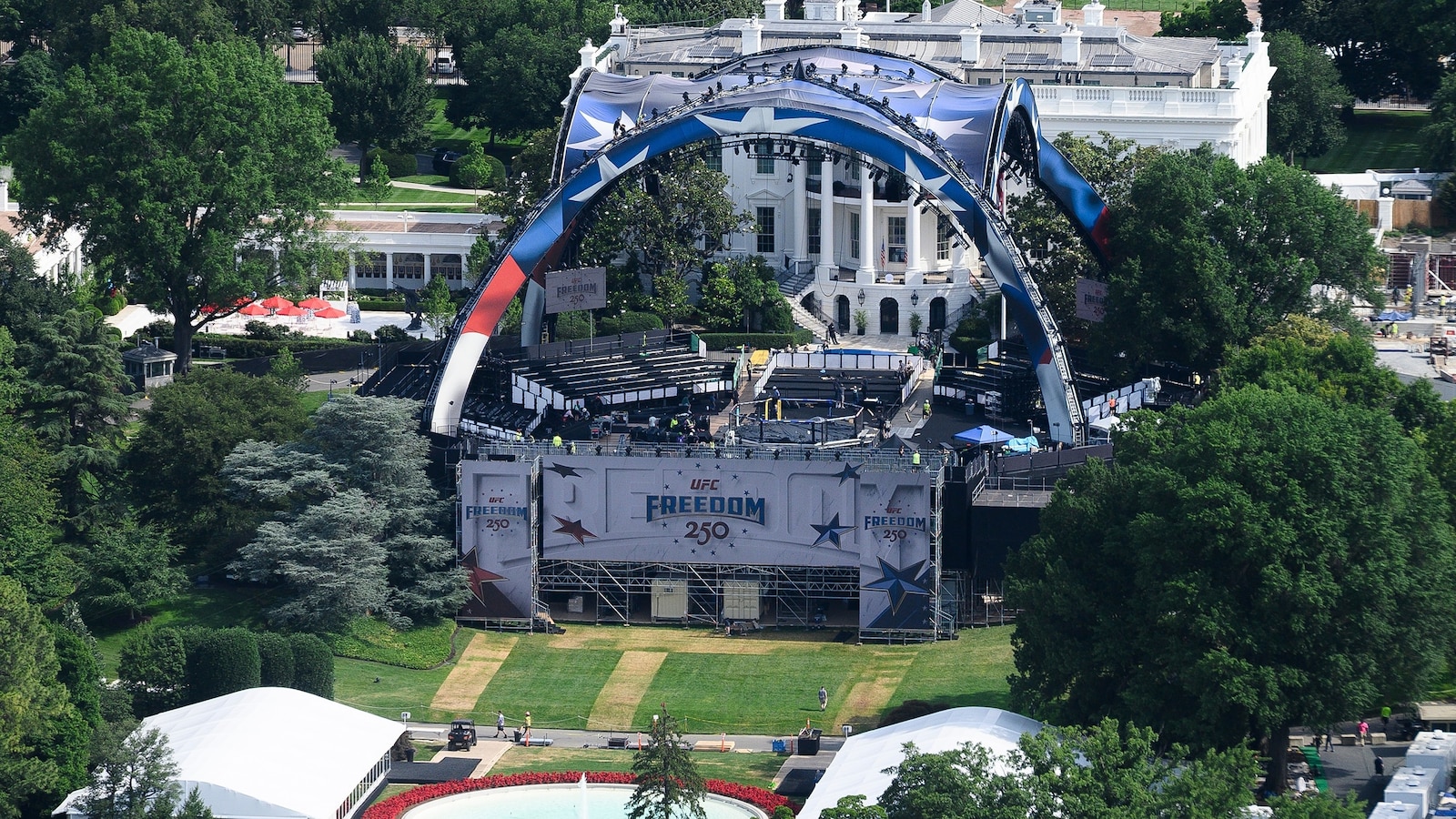
The White House’s collaboration with the UFC has been described as “extraordinary” in the administration’s defense. The filing highlighted the extensive effort invested in preparing for the event, noting “well over $60 million and tens of thousands of hours of labor” that have been dedicated to construction on the South Lawn. This includes setting up a temporary arena for the fight, which is expected to attract more than 4,000 spectators and feature 14 world-class athletes from across the globe. Among them are fighters competing for two major world championships, according to the administration’s records.
The lawsuit also points to the event’s timing, arguing that the White House should have anticipated objections earlier. The plaintiffs claim that the UFC’s use of public land for the fight was not properly reviewed, despite the event’s high-profile nature. “No one is holding Plaintiffs in a jiu jitsu lock, forcing them to watch UFC Freedom 250 against their will,” the Justice Department added, underscoring its stance that the public should not be compelled to participate in the event.
As the legal battle unfolds, the administration has informed Judge Amit Mehta that attorneys will be available on Thursday if the court wishes to schedule oral arguments. The filing included details about the event’s logistics, such as the anticipated attendance of over 120,000 viewers on the Ellipse, who have secured free tickets through a lottery system. The department likened the UFC event to other longstanding White House traditions, such as the annual Easter Egg Roll and the Congressional Picnic, suggesting its cultural relevance.
Public Land and Event Permits: A Point of Contention
The crux of the lawsuit revolves around whether the UFC’s use of the South Lawn qualifies as a permissible event under the temporary rule for “America 250.” The Public Integrity Project argues that the rule was intended for events celebrating the nation’s 250th anniversary, such as historical reenactments or educational programs, not for combat sports. They contend that the UFC’s event, while hosted on federal grounds, does not align with the rule’s original purpose and has therefore been granted an unfair advantage in terms of permitting.
The Justice Department, in contrast, maintains that the rule’s flexibility allows for a range of activities, including modern events like the UFC. “The public interest does not favor allowing them to exercise a heckler’s veto, particularly at this late date,” the filing emphasized. This argument underscores the administration’s belief that the event’s timing and significance justify its continuation, even as legal challenges mount.
Construction Progress and Public Interest
Workers have been actively constructing the temporary arena on the White House’s South Lawn, with the setup complete by June 3, 2026. The structure, which will host the UFC Freedom 250 fight card, has been described as a “highly anticipated” event within the series of celebrations marking the 250th anniversary of the United States. The administration’s filing noted that the event has drawn significant attention, with more than 1,000 military personnel expected to attend in person and a large audience anticipated via the Ellipse.
The government has also highlighted the broader impact of the event, suggesting that its cancellation would disrupt not only the planned festivities but also the public’s engagement with the 250th anniversary theme. “All these hopes could be dashed at the very last moment, however, by the whim of two people who believe they have superior taste and want to spoil the event for everyone else,” the administration’s document stated, framing the plaintiffs’ objections as personal rather than systemic.
Context and Related Legal Issues
The lawsuit is part of a larger debate over the use of public land for events that serve political or personal interests. Earlier this year, the Trump administration faced similar challenges when it was accused of using the Eiffel Tower comparison to argue that the UFC arena at the White House could remain a permanent fixture. This analogy, which the administration has employed in its defense, suggests that the structure’s presence is justified by its public appeal and historical significance.
Additionally, the event has been linked to other controversies surrounding the use of the White House grounds. A separate lawsuit has questioned the administrative process for approving the UFC’s temporary setup, alleging that it was conducted without sufficient transparency. These legal actions reflect growing scrutiny of how public spaces are being utilized for events that may not fully adhere to standard permitting protocols.
As the case moves forward, the focus remains on whether the plaintiffs’ claim of “superior taste” is sufficient grounds to halt the event. The Justice Department’s argument hinges on the idea that the public should have the freedom to enjoy the event without interference, even if some individuals disagree with its content. This position aligns with the administration’s broader defense of the UFC’s role in the White House’s commemorative activities, emphasizing its ability to engage a diverse audience and celebrate American culture through a modern lens.
With the deadline approaching for the UFC event, the legal battle has intensified, drawing attention to the balance between individual preferences and public interest. The administration’s filing underscores its commitment to defending the event, while the plaintiffs continue to push for its cancellation, arguing that it represents an unnecessary use of public resources. The outcome of this case could set a precedent for future events hosted on federal property, shaping the discourse around the intersection of politics, public space, and entertainment.