
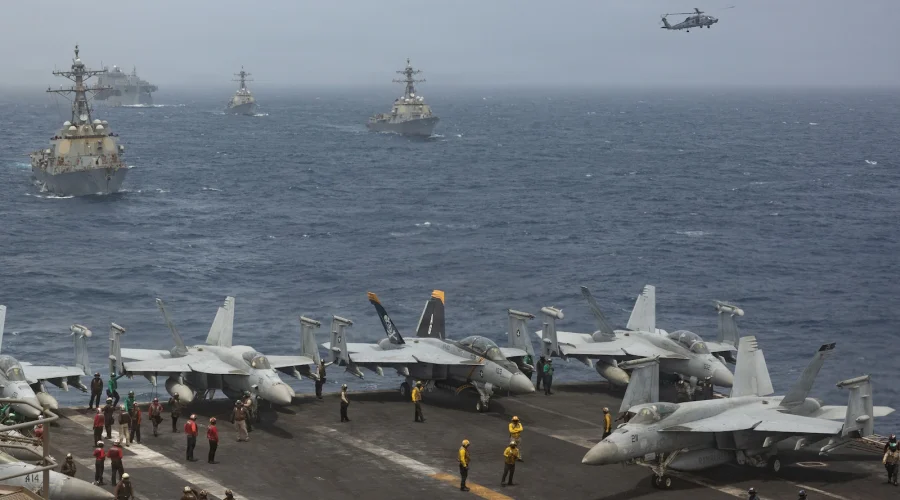
Six Months Into the Iran War: What Americans Are Paying and What Comes Next
Cyberzenhub.com – The conflict that President Donald Trump promised would wrap up in “four to five weeks” has now stretched across half a year. What began on February 28, 2026, as a joint U.S.-Israeli campaign to decapitate Iran’s leadership and strike key military installations has metastasized into a broader regional war, pulling in Gulf states and dragging American households into a sustained economic squeeze. As the sixth month closes, the question for ordinary citizens is no longer whether the war will end soon, but what its continuing costs look like and whether the strategic calculus has fundamentally changed.
How the Conflict Ignited
The opening salvo on February 28 targeted much of Iran’s senior leadership and damaged critical military infrastructure. Addressing the nation that same day, Trump framed the operation as a defensive necessity:
“Defend the American people by eliminating imminent threats from the Iranian regime,” including its continued pursuit of a nuclear weapon.
The strikes did not emerge from a vacuum. Back in June 2025, American forces had already executed penetrating attacks on Iran’s underground nuclear facilities during Operation Midnight Hammer. At the time, the administration declared the nuclear program “obliterated,” though it later conceded that enriched uranium sufficient to build a bomb still sat inside Iranian territory. That unresolved question loomed over every subsequent decision in Washington and Tehran.
The war’s first days carried a tragedy that has yet to be fully explained. An airstrike struck an all-girls school in southern Iran, killing roughly 160 civilians, including 120 schoolchildren. Tehran blamed both Washington and Jerusalem; neither government has formally assumed responsibility. U.S. Central Command opened an investigation and stated the United States will “never” target civilians. Under international law, the deliberate targeting of schools and universities during armed conflict is prohibited. As of now, the inquiry continues with minimal public updates.
Iran’s Retaliation and the Strait of Hormuz
Tehran answered the opening strikes almost immediately, launching missile and drone barrages at American installations in Bahrain, Kuwait, Jordan, and Iraq — a scale of sustained attack on U.S. bases that had not been witnessed since the Vietnam era. Low-cost, one-way attack drones proved particularly effective at reaching vulnerable interests near the Persian Gulf.
For months the two sides traded blows. U.S. Central Command, which commands American forces across the Middle East, reports it has struck more than 13,000 Iranian targets, spanning military headquarters, naval vessels, air-defense networks, and drone launch sites.
Yet Iran’s most consequential move came at sea. By shutting down commercial shipping through the Strait of Hormuz, Tehran turned a narrow waterway into a global household name almost overnight. The blockade strangled one of the world’s most critical oil and trade corridors, and in doing so, Iran dictated where the war’s economic frontline would be felt — rattling markets from Tokyo to New York.
In early March, Secretary of War Pete Hegseth told reporters that Iran was displaying “sheer desperation” in the strait and assured the public that the Pentagon had the situation handled. Six months later, the strategic priority has visibly shifted: blunting the economic fallout and reopening the waterway now sits at the center of the mission.
The Human and Economic Toll on Americans
Since February, 18 U.S. service members have been killed and more than 750 wounded. Trump has attended three dignified transfer ceremonies to honor fallen soldiers — two in March and one in July. At one such ceremony he told reporters the task was
“one of the hardest things to do as a president.”
Beyond the cost in lives, the war has landed directly on American wallets. Global oil prices have climbed roughly 25 percent since the conflict began. The average gallon of gasoline nationwide now hovers above four dollars — approximately a dollar more than pre-war levels, according to GasBuddy data. A Brown University energy-cost tracker estimates the typical American household has spent nearly $700 more on fuel since February.
Trump has dismissed the price concerns. Speaking at the White House in May, he characterized the oil-price spike as
“a very small price to pay for getting rid of a nuclear weapon from people that are really mentally deranged.”
For the driver filling up in Falls Church, Virginia, or anywhere else across the country, that framing offers little comfort. A dollar-per-gallon increase compounds across thousands of gallons per household per year, and the cumulative effect on grocery prices, freight costs, and inflation expectations extends well beyond the gas pump.
What Lies Ahead
With talks reportedly stalled and Iran signaling continued economic pressure, the next phase of the conflict will likely be shaped less by battlefield momentum than by economic endurance. The Pentagon, already described as depleted after six months of sustained operations, faces the question of whether it can maintain tempo while the administration weighs whether reopening the Strait of Hormuz requires a negotiated settlement or a renewed military push. For Americans, the answer will show up first at the pump, then in grocery receipts, then in the broader inflation picture that shapes interest rates and household budgets. The war Trump described as a brief, decisive action has become a prolonged contest of attrition — and the bill, in every sense, is still arriving.
Related Reading
Frequently Asked Questions
What is US marks 6 months of war?
US marks 6 months of war is the main topic of this guide. The article explains the context, practical details, and next steps readers should understand.
Why does US marks 6 months of war matter?
US marks 6 months of war matters because readers are looking for a useful answer, not just a short summary. Good content should match search intent and help them decide what to do next.