
Second Straight Day of Drone Barrage Leaves Kyiv Region Reeling as Winter Infrastructure Campaign Intensifies
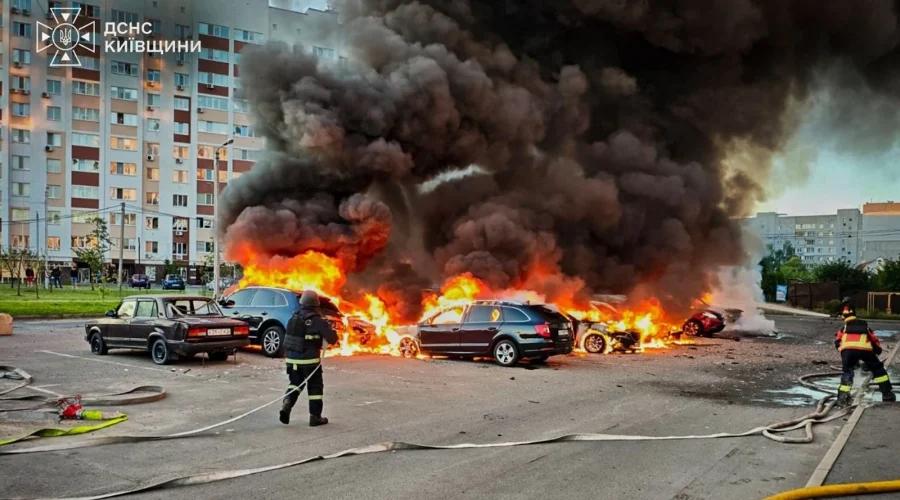
Cyberzenhub.com – Ukraine’s capital region endured another night of sustained aerial bombardment on Friday, marking the second consecutive day of large-scale drone and missile strikes aimed at residential neighborhoods, logistics hubs, and energy infrastructure. Officials confirmed that more than a dozen apartment complexes and storage facilities were struck, extending a pattern of attacks that has increasingly targeted the civilian fabric of daily life more than four and a half years into Russia’s full-scale invasion.
The cumulative effect of Thursday’s prolonged air raid — which the Foreign Ministry described as effectively shutting down the capital for roughly 15 hours — compounded Friday’s damage, choking economic activity and disrupting transportation, commerce, and essential services across the region. For residents of areas nearer the front line, such extended alert periods have become an unrelenting daily condition rather than an exceptional event.
Damage Assessment in the Kyiv Region
Tymur Tkachenko, head of the Kyiv regional military administration, itemized Friday’s toll: fourteen warehouses, sixteen private homes, three apartment buildings, and sixteen vehicles were damaged. One fatality and two injuries were confirmed among civilians. The State Emergency Service noted that a second drone struck a single location after rescue crews had already been dispatched to the initial impact site — a tactic the military labels a “double tap,” designed to strike first responders at the moment they converge on a blast site.
The Russian Defense Ministry claimed its forces hit a warehouse in the Kyiv region housing Ukraine’s Flamingo cruise missiles along with propellant for rocket boosters. Ukrainian authorities did not immediately corroborate that assertion, and independent verification remained unavailable. In recent weeks, strikes have repeatedly damaged warehouses across the capital and surrounding oblasts, including facilities holding books, foodstuffs, and other consumer goods — suggesting a deliberate effort to degrade both military logistics and civilian supply chains.
Tkachenko urged residents to remain in designated shelters and respond promptly to air-raid sirens as attacks stretched into daylight hours. Regional authorities also issued air-quality advisories, warning inhabitants of affected zones to keep windows sealed and minimize outdoor exposure amid smoke and particulate fallout from the explosions.
“Weaponizing Winter”: The Infrastructure Gambit
Ukrainian officials frame the current campaign of strikes against the power grid as an annual Russian strategy to “weaponize winter” — exploiting the season’s heightened demand for heating and electricity to maximize civilian suffering and strain national resilience. In the Black Sea coast’s Kherson region, where glide bombs delivered a day earlier forced a combined heat-and-power plant into shutdown, authorities forecast extended outages lasting weeks rather than hours.
Oleksandr Prokudin, head of the Kherson regional military administration, addressed tens of thousands of residents in a late-Thursday social media post, urging those able to relocate toward safer oblasts before the coldest months arrive.
“Kherson may be without electricity and heat not for hours or days, but for a long time. And we need to prepare for this now.”
Prokudin noted that roughly seventy percent of the Kherson region remains under Russian military control and that the area has absorbed one hundred seventy glide bombs since July 1 — a figure exceeding the total delivered during the preceding six months of the year. Authorities pledged logistical assistance, transportation, resettlement support, and social services for residents choosing to evacuate.
Tactical Picture: Saturation and Exhaustion
Andrii Kovalenko, who leads Ukraine’s Center for Countering Disinformation within the National Security and Defense Council, characterized the latest wave as a calculated saturation effort. Russia is releasing small batches of fast-moving, jet-powered drones in successive salvos with the explicit objective of paralyzing the capital’s air-defense response and civilian morale.
“The goal is to exhaust air defenses and the population,”
he wrote on social media on Friday. Ukraine’s air force tallied one hundred sixty-four drones launched at the country overnight, though it did not specify whether missiles accompanied the drone salvo — a detail typically included in Russian aerial operations.
The broader drone picture underscores the scale of the campaign. Over the past two months, Russia has launched more than seventeen hundred attack drones, increasingly favoring jet-powered Shahed and Gerbera variants aimed at critical infrastructure. Smaller-drone strikes alone reached six thousand five hundred in the preceding week, according to Prokudin’s figures.
Sumy Region: Postal Hub Destroyed, Civilian Killed
Four Russian glide bombs obliterated a sorting center operated by the Nova Poshta postal service in the northern Sumy region, while a separate drone destroyed one of the company’s depots within the Kyiv region, the carrier announced. In Sumy, Oleh Hryhorov, head of the regional military administration, confirmed that a sixty-one-year-old man was killed and seven others wounded when a glide bomb struck the oblast on Friday.
The Russian Defense Ministry separately announced that its air-defense systems intercepted five hundred twelve Ukrainian drones over eighteen Russian regions during the overnight period, framing the exchange as evidence of sustained Ukrainian pressure on Russian territory.
For Ukrainians in both the capital and the southern coast, the coming weeks carry a stark calculus: endure prolonged darkness and cold under intermittent bombardment, or evacuate under conditions that authorities acknowledge will grow more severe as temperatures fall. The infrastructure campaign, layered atop residential strikes and logistics disruption, is designed to make that calculus as painful as possible.
Related Reading
Frequently Asked Questions
What is Russian drones batter Ukraine s Kyiv?
Russian drones batter Ukraine s Kyiv is the main topic of this guide. The article explains the context, practical details, and next steps readers should understand.
Why does Russian drones batter Ukraine s Kyiv matter?
Russian drones batter Ukraine s Kyiv matters because readers are looking for a useful answer, not just a short summary. Good content should match search intent and help them decide what to do next.