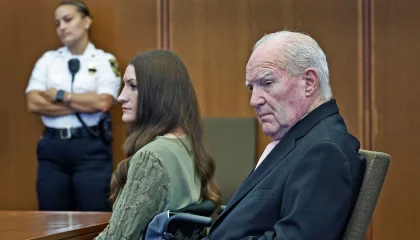

Juror Describes Tense Deliberations That Ended Lindsay Clancy Murder Trial in Mistrial
Cyberzenhub.com – A member of the jury in Lindsay Clancy’s murder trial has described a deliberation room divided by one juror’s refusal to join the other 11 in finding Clancy not guilty by reason of insanity.
The case ended in a mistrial on Sept. 4, 2026, following five weeks of testimony and roughly a week of jury deliberations. Clancy, a former nurse from Duxbury, Massachusetts, has pleaded not guilty to first-degree murder charges stemming from the deaths of her three children in January 2023.
Nick Dargie, 25, was one of three men on the 12-member panel. He said the final vote was 11-1 in favor of an insanity verdict, while one unidentified juror continued to favor conviction. Dargie said that juror did not point to testimony or trial exhibits that supported his position when challenged by others in the room.
“There was several times I would ask him to show us evidence or, you know, describe a witness testimony that helped to prove what he was saying, and … he couldn’t.”
A Deadlock Despite Reasonable Doubt
Dargie and three other jurors who later spoke publicly said the holdout juror expressed reasonable doubt but still would not shift his vote from conviction. In criminal trials, unanimity is required for a verdict. A single juror’s continued disagreement can therefore leave a court unable to resolve the case, resulting in a hung jury and mistrial.
Dargie said the problem was not simply that the juror saw the evidence differently. Jurors are entitled to reach opposing conclusions, he said, but he believed the holdout did not explain why his view was grounded in the evidence presented during trial.
“There wasn’t a single piece of evidence or witness testimony that he used to prove why he was thinking the way he was, which is why we ultimately sent in that note.”
The note, delivered by the jury foreperson to Judge William Sullivan, led to the mistrial declaration. Dargie emphasized that a genuine impasse is part of the justice system.
“Otherwise, like there’s nothing wrong with somebody having a completely opposite opinion … that would be a hung jury. That is our justice system.”
Exercise Band Incident
Dargie also recalled an episode involving an exercise band that had been admitted as evidence. Prosecutors said Clancy used the band to strangle her children. During deliberations, Dargie said the holdout juror removed it from an evidence bag, placed it around an empty water bottle and pulled it tight.
He said he confronted the juror and asked why he was doing it.
“I was shocked. It didn’t make any sense to me. We’re not in here to play detective or it’s not a game of ‘Clue.’ This is serious.”
Dargie further said the juror often did not engage in group discussion and at times looked at his phone while the panel deliberated. The holdout juror has not been publicly identified.
The Central Question of Clancy’s Mental State
The trial focused heavily on Clancy’s mental health on the night her children died. Her daughter, Cora, was 5; her son Dawson was 3; and her infant son, Callan, was still a baby. They died at the family’s home in Duxbury, a suburb south of Boston, on Jan. 24, 2023.
Clancy also attempted suicide that night. State prosecutors have said she was left paralyzed and uses a wheelchair.
Much of the evidence addressed whether Clancy was suffering from postpartum psychosis at the time of the killings. The condition is regarded as a psychiatric emergency by the American College of Obstetricians and Gynecologists. The legal issue was not limited to whether the children were killed; the jury also had to determine whether Clancy could be held criminally responsible for her actions.
Massachusetts jury instructions place a significant burden on prosecutors when insanity is at issue. To establish criminal responsibility, prosecutors must prove beyond a reasonable doubt that the defendant did not have a mental disease or defect when the alleged crime occurred. That standard made expert testimony, medical history and the interpretation of Clancy’s mental condition central to the deliberations.
An insanity verdict is distinct from an ordinary acquittal. It reflects a conclusion that a person was not criminally responsible under the law because of mental illness or defect at the relevant time. The mistrial means the jury did not reach a final legal determination on that question or on Clancy’s guilt.
Family Faces False Online Claims
Dargie, a military veteran who was deployed outside the United States when charges were filed, said he was troubled after the trial to see online conspiracy theories accusing Clancy’s former husband, Patrick Clancy, of killing the children.
Those claims are false. Patrick Clancy’s attorney issued a statement Tuesday urging an end to the allegations.
“Enough is enough.”
The case has drawn intense public attention because of its devastating facts and the difficult questions surrounding postpartum mental illness, culpability and the limits of criminal law. The mistrial leaves those questions unresolved in court while the families involved continue to live with the consequences of the children’s deaths.
Related Reading
Frequently Asked Questions
What is Clancy holdout juror mimicked strangling during?
Clancy holdout juror mimicked strangling during is the main topic of this guide. The article explains the context, practical details, and next steps readers should understand.
Why does Clancy holdout juror mimicked strangling during matter?
Clancy holdout juror mimicked strangling during matters because readers are looking for a useful answer, not just a short summary. Good content should match search intent and help them decide what to do next.