
Trump responds to Xi’s ‘Thucydides Trap’ comment about America’s decline
Trump Responds to Xi’s ‘Thucydides Trap’ Comment About America’s Decline
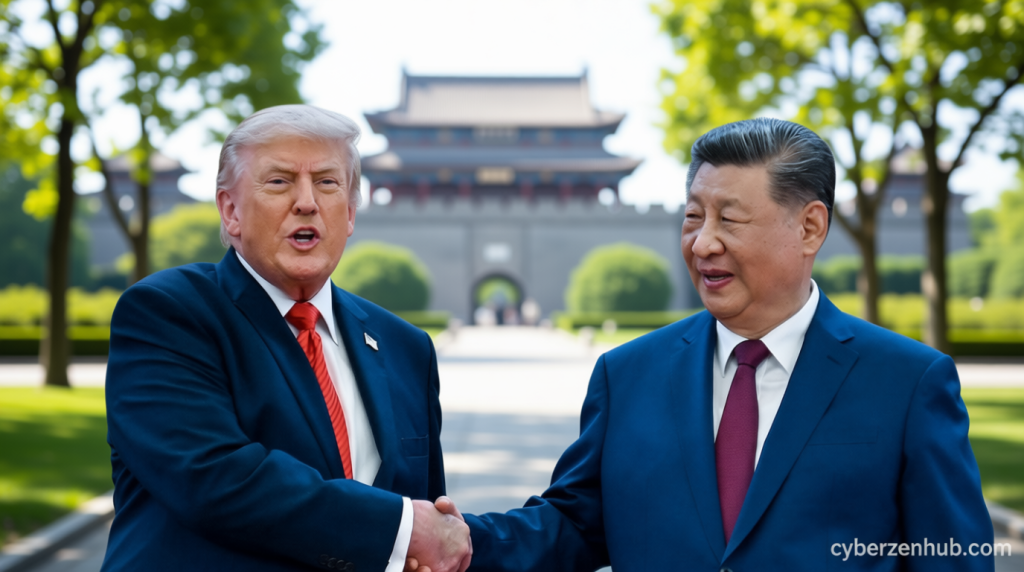
Trump responds to Xi s Thucydides – During their state visit on Thursday, President Donald Trump addressed remarks by Chinese President Xi Jinping regarding the “Thucydides Trap” and America’s perceived decline. The exchange occurred as part of a broader dialogue between the leaders, with Trump countering Xi’s assertion that the United States might be entering a period of relative decline. Trump emphasized that the statement pertained specifically to the four-year period under former President Joe Biden, rather than the current administration. A handshake between Trump and Xi took place at the Great Hall of the People in Beijing on May 14, 2026, as captured by photographer Kenny Holston/Pool/AFP via Getty Images.
Xi’s Reference to the ‘Thucydides Trap’
Xi Jinping, during his opening remarks on Wednesday, suggested that the global order had reached a critical juncture. According to a live translation, he posed a question: “Can China and the U.S. overcome the ‘Thucydides Trap’ and create a new paradigm of major country relations?” This metaphor, rooted in classical political theory, implies that a dominant power’s apprehension of a rising rival could lead to conflict. The phrase, Xi’s choice of words, drew immediate attention for its strategic implications.
“When President Xi very elegantly referred to the United States as perhaps being a declining nation, he was referring to the tremendous damage we suffered during the four years of Sleepy Joe Biden and the Biden Administration, and on that score, he was 100% correct.”
Trump’s response, shared on his social media platform Truth Social, sought to clarify Xi’s intended message. He argued that the “Thucydides Trap” was not a general critique of the U.S. but a specific acknowledgment of challenges faced during Biden’s presidency. The president highlighted his own administration’s achievements, framing the current state of the nation as one of renewed strength. This contrast between past and present underscored the core of their debate.
Historical Context of the ‘Thucydides Trap’
The “Thucydides Trap” originates from a concept introduced by Harvard Professor Graham Allison in his analysis of international relations. The term derives its name from the ancient Greek historian Thucydides, who chronicled the Peloponnesian War between Athens and Sparta. In his account, Thucydides noted that the rise of Athens and the corresponding fear it instilled in Sparta were key factors leading to war. Allison’s modern interpretation extends this idea to contemporary geopolitics, suggesting that when a rising power challenges a dominant one, the risk of conflict increases.
Xi’s invocation of the term during the summit appeared to align with this framework. By positioning China as the ascending power and the U.S. as the established hegemon, Xi hinted at the potential for rivalry. However, his statement also conveyed optimism, implying that both nations could navigate this tension through collaboration. The historical reference served to frame the current relationship in a broader context, emphasizing the cyclical nature of power dynamics.
Trump’s Defense of the U.S. Position
Trump, in his post, defended the U.S. from the accusation of decline. He argued that the nation had undergone a transformation under his leadership, emerging as a leader in global affairs. “In fact, President Xi congratulated me on so many tremendous successes in such a short period of time,” Trump wrote, showcasing a positive take on the dialogue. He further asserted that the U.S. was not on a downward trajectory but rather a rising force, citing the nation’s economic and military strength.
“In fact, President Xi congratulated me on so many tremendous successes in such a short period of time. Two years ago, we were, in fact, a Nation in decline. On that, I fully agree with President Xi! But now, the United States is the hottest Nation anywhere in the world, and hopefully our relationship with China will be stronger and better than ever before!”
Trump’s remarks highlighted a shift in perspective, suggesting that the U.S. had overcome the challenges of the previous administration. He framed the “Thucydides Trap” as a lesson that could be applied to the future, arguing that China and the U.S. had the opportunity to redefine their partnership. The comment also served to reinforce his narrative of American resurgence, positioning his leadership as a counter to the perceived decline.
Broader Implications of the Debate
The discussion around the “Thucydides Trap” reflects a deeper geopolitical conversation about the balance of power between the U.S. and China. While Xi’s statement emphasized China’s growth and the potential risks of U.S. complacency, Trump’s response focused on American resilience and strategic foresight. This exchange came at a pivotal moment in their diplomatic engagement, with both leaders seeking to project confidence in their nations’ trajectories.
Analysts note that the “Thucydides Trap” is not a prediction of war but a warning. It suggests that the path to conflict is often paved by misunderstandings or miscalculations in international relations. By invoking the term, Xi may have aimed to encourage dialogue while acknowledging the natural tension between rising and established powers. Trump’s rebuttal, meanwhile, reinforced his vision of a United States that is both dominant and dynamic.
Related Developments in Trump-Xi Summit
The summit, held in Beijing, included a series of discussions on trade, technology, and global security. Trump’s response to Xi’s “Thucydides Trap” remark was part of a larger narrative about the U.S.-China relationship. As the leaders engaged in their talks, the focus on mutual challenges and opportunities highlighted the complex interplay of competition and cooperation. The summit’s first day yielded significant insights, with both nations expressing a commitment to shaping the future of their partnership.
Other topics of interest during the visit included U.S. policy toward Taiwan, which is expected to be a key issue in the ongoing diplomatic engagement. The Trump administration’s approach to this policy will be closely watched, as it may influence the broader strategic relationship with China. The summit also touched on military alliances, with officials discussing the U.S. presence in regions such as Europe and the Indo-Pacific. These discussions underscored the multifaceted nature of the U.S.-China dynamic.
Historical Parallels and Modern Applications
The use of the “Thucydides Trap” by Xi and Trump draws a direct line between ancient history and modern geopolitics. Thucydides’ analysis of the Peloponnesian War remains a cornerstone of political science, offering a framework to understand the challenges of power transitions. Graham Allison’s adaptation of the theory has been widely cited in recent years, particularly as China’s economic and military influence grows. The phrase encapsulates the idea that a rising power’s ascent can provoke a reaction from the established one, often leading to conflict.
While the term is often associated with U.S.-China relations, its applicability extends to other global power shifts. For instance, the Cold War era saw similar dynamics between the United States and the Soviet Union. The relevance of the “Thucydides Trap” in today’s context is underscored by the rapid advancements in technology, economic integration, and military capabilities. As such, the debate between Xi and Trump is not merely a political exchange but a reflection of broader historical patterns.
By referencing the “Thucydides Trap,” Xi and Trump both acknowledged the complexities of their relationship. The term serves as a reminder of the delicate balance between cooperation and competition in international politics. Trump’s response, however, added a layer of optimism, suggesting that the U.S. was not only resilient but also proactive in addressing these challenges. The dialogue set the stage for future negotiations, with both leaders striving to shape a narrative that aligns with their national interests.