
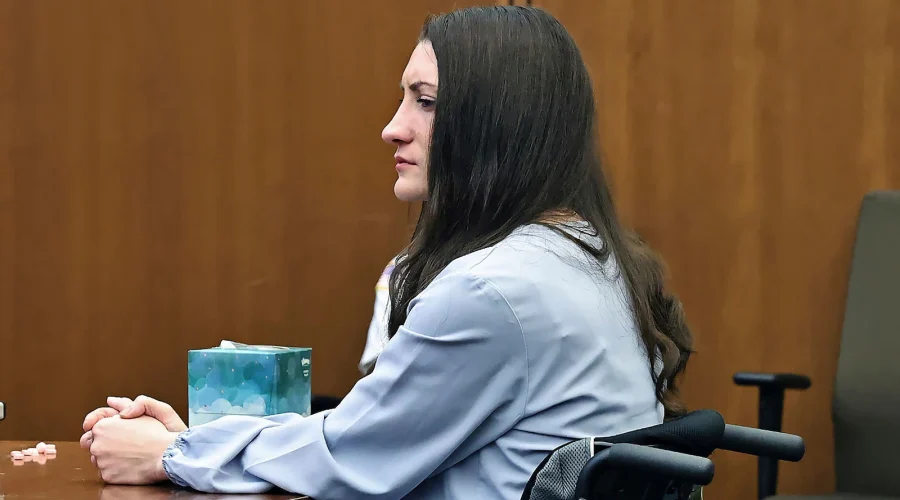
Massachusetts Jury Weighs Fate of Mother Accused of Killing Three Young Children
Cyberzenhub.com – The jury in the high-profile murder case of Lindsay Clancy has been sent home for the evening without reaching a verdict, continuing a tense cycle of deliberation over whether the Massachusetts mother should be held criminally accountable for the deaths of her three small children. The trial, which has drawn sustained public attention, centers on a question that sits at the intersection of criminal law and psychiatry: whether a woman experiencing a severe postpartum psychiatric episode can be found legally responsible for acts of extreme violence committed against her own offspring.
What Happened on January 24, 2023
On the morning of January 24, 2023, Clancy’s three young children were found dead in the family home in Massachusetts. According to the evidence presented at trial, Clancy strangled each child and then attempted to end her own life. She survived and was transported to a hospital, where she later gave testimony and entered a plea of not guilty on all three counts of first-degree murder.
The case has since become one of the most closely watched criminal trials in the state in recent years, not only because of the heartbreaking circumstances but also because it forces a jury to grapple with a complex medical-legal question that rarely reaches a courtroom in such stark form.
The Defense: Postpartum Psychosis
Clancy’s legal team has built its case around a diagnosis of postpartum psychosis, a rare but severe psychiatric condition that can develop in the weeks following childbirth. The defense contends that at the time of the killings, Clancy was in the grip of a psychotic episode that rendered her unable to form the intent required for first-degree murder. Under this theory, she was not acting as a rational agent making choices; she was experiencing a break from reality in which her perception, thought processes, and behavior were profoundly distorted.
Postpartum psychosis affects roughly one to two women per thousand deliveries. Symptoms can include hallucinations, delusions, severe agitation, confusion, and a loss of contact with reality. Unlike postpartum depression, which is far more common and typically manageable, postpartum psychosis is considered a medical emergency. It most often emerges within the first two weeks after birth, though onset can extend into the third or fourth week. Treatment generally involves hospitalization, antipsychotic medication, and sometimes mood stabilizers.
The defense argues that Clancy’s condition at the time of the incident met the threshold for a finding of not criminally responsible, meaning she understood the facts of what she was doing but could not appreciate its wrongfulness because her psychosis had severed her connection to reality.
The Prosecution’s Position
Prosecutors, by contrast, maintain that Clancy was criminally responsible for the deaths of her three children. They contend that the evidence does not support a conclusion that she was so incapacitated by psychosis that she lacked the mental state required for first-degree murder. In their framing, Clancy made deliberate choices, and the law requires that those choices be met with accountability.
The distinction between the two positions is not merely academic. It determines where Clancy will spend the rest of her life and what label will be attached to her record.
What the Verdict Means in Practice
If the jury returns guilty verdicts on all three counts of first-degree murder, Massachusetts law mandates a sentence of life imprisonment without the possibility of parole. Clancy would be incarcerated for the remainder of her natural life.
If, however, the jury finds her not criminally responsible on the three murder charges, she will be committed to a state mental health facility for treatment. In that scenario, no prison sentence is imposed. Instead, the court orders involuntary hospitalization, and Clancy’s continued confinement is governed by periodic psychiatric review rather than by a fixed term of years.
A third possibility exists in Massachusetts law: a finding of criminally responsible but with a diminished capacity, which could affect sentencing. Yet the two primary outcomes the jury is weighing are the ones outlined above.
The Jury’s Deliberation
Jurors have been sequested and have spent multiple days in closed deliberation. The fact that they were sent home for the day without a verdict indicates that consensus has not yet been reached. In Massachusetts, criminal verdicts require unanimity among all twelve jurors. A single holdout can extend deliberation indefinitely, and judges routinely allow jurors to return home overnight when progress appears stalled, provided they remain available to reconvene the following morning.
The length of deliberation in cases involving insanity or diminished-capacity defenses tends to exceed that of straightforward homicide trials, because jurors must weigh medical testimony, understand psychiatric terminology, and apply a legal standard that differs from the everyday notion of “crazy” or “not crazy.” They are asked to determine whether, at the precise moment of each killing, the defendant could have understood the nature and quality of her act or known that it was wrong.
Reader Note: Mental Health Resources
For anyone who is struggling with thoughts of suicide or who knows someone who is, free and confidential support is available around the clock. Call or text 988, or visit 988lifeline.org to start a chat. Help is available 24 hours a day, seven days a week. You do not have to face those thoughts alone.
The Clancy trial is expected to resume deliberation the following morning. A verdict, when it comes, will close one of the most emotionally charged chapters in Massachusetts criminal jurisprudence and will set a public example of how the state balances accountability with compassion in cases where mental illness and lethal violence intersect.
Related Reading
Frequently Asked Questions
What is Lindsay Clancy trial?
Lindsay Clancy trial is the main topic of this guide. The article explains the context, practical details, and next steps readers should understand.
Why does Lindsay Clancy trial matter?
Lindsay Clancy trial matters because readers are looking for a useful answer, not just a short summary. Good content should match search intent and help them decide what to do next.