Ebola Death Toll in Eastern Congo Surges Past 300 in Seven Days
Cyberzenhub.com – The deadliest week yet of Congo’s ongoing Ebola crisis has passed, with more than 300 fatalities recorded across the eastern provinces in a single seven-day span. Government health figures released on Monday confirmed the grim tally, underscoring how rapidly the epidemic is outpacing every available containment strategy. Health workers on the ground describe a situation where the virus is moving faster than surveillance systems can track, faster than treatment centers can admit patients, and faster than communities can be convinced to seek care.
A Scale That Defies Precedent
By Saturday, the cumulative count stood at 5,514 confirmed cases and 2,642 deaths nationwide. Of those fatalities, 317 fell within the most recent week alone. Congolese epidemiologists have cautioned that the true magnitude of the epidemic may be roughly three times larger than what official tallies capture, given that transmission began circulating in communities weeks before the outbreak was formally confirmed.
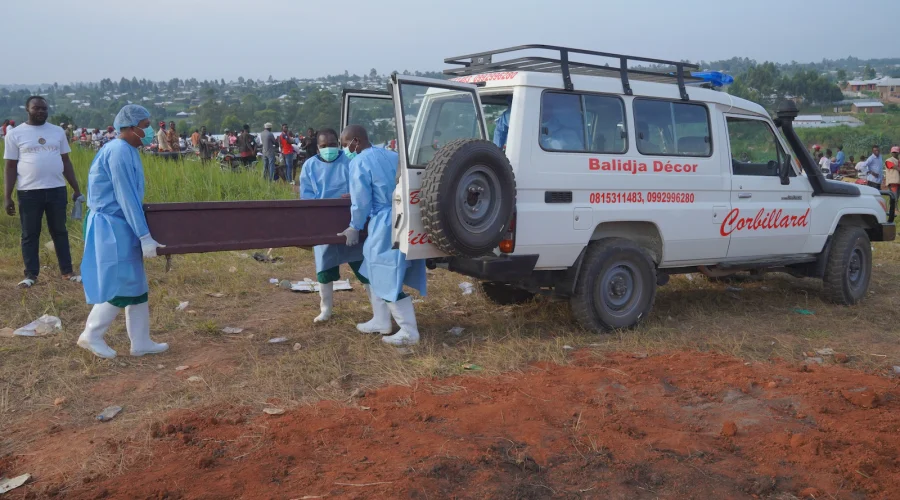
The pace of growth places this event in a category of its own. At the current stage of its trajectory, the Congo epidemic has already produced seven times the number of deaths that the 2014–2016 West African outbreak reached at an equivalent point. That earlier epidemic, spanning Guinea, Liberia, and Sierra Leone, ultimately claimed more than 11,000 lives and remains the deadliest Ebola event ever documented. Many of the new Congolese deaths are occurring outside hospital walls, in homes and transit points where no clinician is present to intervene.
The Bundibugyo Problem
A complicating factor distinguishing this outbreak from prior epidemics is the viral subtype involved. The agent at work here is the Bundibugyo strain of Ebola virus, a rarer lineage for which no approved vaccine or specific antiviral treatment had been available at the time the crisis escalated. The absence of a tailored therapeutic tool means that frontline teams rely on supportive care, isolation protocols, and community education — measures that, while essential, cannot match the speed at which the virus transmits through dense, mobile populations.
Vaccine Arrival and Uncertainty
On Friday, a shipment of more than 16,000 doses of the Ervebo vaccine reached Congolese authorities. Ervebo has demonstrated strong efficacy against the more prevalent Zaire strain of Ebola in earlier outbreaks, but its protective value against the Bundibugyo lineage remains unproven in human populations. The World Health Organization has stated that definitive evidence of cross-protection is not yet available, though preliminary laboratory assays and animal-model data indicate the vaccine may confer at least partial immunity. The agency has also announced that Ervebo will be incorporated into ongoing clinical trials aimed at developing a dedicated Bundibugyo-specific vaccine.
Government officials have not announced a timeline for deploying the doses to frontline health workers. In Ituri province — the current geographic epicenter of transmission — residents greeted the arrival with cautious hope. Héritier Ramazani, a local resident, voiced the sentiment of many:
“I am very pleased that these vaccines have finally arrived. We are fed up with recording new cases of Ebola every day.”
Operating in Hostile Terrain
The outbreak is unfolding across some of the most operationally difficult landscapes in the world. Armed rebel groups contest portions of the affected territory, forcing frequent evacuations of medical posts and disrupting supply chains. Population movements driven by conflict and economic displacement mean that infected individuals cross provincial borders daily, seeding new clusters before surveillance teams can map them.
Compounding these external threats, medical teams in Ituri and neighboring provinces have faced work stoppages by responders whose salaries have gone unpaid for extended periods. Communities already traumatized by years of instability have grown skeptical of health messaging, and misinformation — including claims that Ebola does not exist — circulates through local networks. Road infrastructure in many affected zones is poor or nonexistent, delaying both patient transport and the delivery of vaccines, protective equipment, and laboratory supplies.
A Timeline That Raises Questions
Experts now believe the virus was already circulating in the mining town of Mongbwalu as early as February, months before authorities officially declared the outbreak on May 15. That gap between initial transmission and formal recognition means the epidemic gained a substantial head start in areas where no containment infrastructure existed. Most newly identified cases in Ituri still originate from individuals who were not previously tracked as monitored contacts of known patients, suggesting the virus has established footholds in communities beyond the reach of active surveillance.
Mortality Rates That Vary by Geography
The overall case-fatality ratio stands at 47.9 percent — nearly half of all confirmed infections ending in death. Yet that national average masks severe regional variation. In North Kivu province, where access to treatment centers is limited by distance and insecurity, the fatality rate climbs to 68.6 percent. The disparity highlights how geography, infrastructure, and conflict shape survival odds in ways that clinical interventions alone cannot offset.
As the epidemic enters its next phase, the central question for Congolese and international health authorities is whether the combination of expanded surveillance, eventual vaccine deployment, and sustained community engagement can bend the transmission curve before the virus establishes permanent endemic pockets in the region’s most remote and conflict-affected districts.
Related Reading
Frequently Asked Questions
What is Congo s Ebola outbreak records one?
Congo s Ebola outbreak records one is the main topic of this guide. The article explains the context, practical details, and next steps readers should understand.
Why does Congo s Ebola outbreak records one matter?
Congo s Ebola outbreak records one matters because readers are looking for a useful answer, not just a short summary. Good content should match search intent and help them decide what to do next.