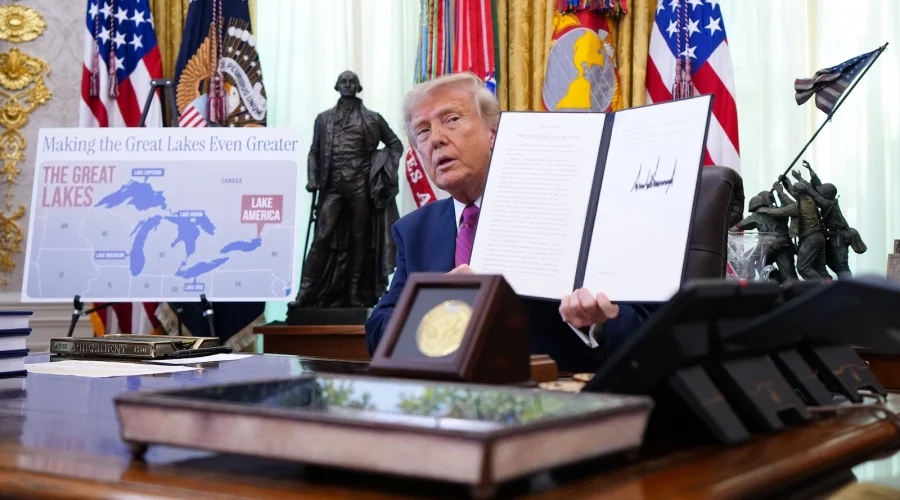
Cyberzenhub.com – Trump signs executive order renaming Lake Ontario to “Lake America,” a designation that took effect immediately upon signature. President Donald Trump on Thursday issued the executive order, formally changing the name of one of North America’s five Great Lakes. The move, announced with minimal advance notice, prompted swift reactions from residents, officials, and commentators on both sides of the U.S.-Canada border.
The Executive Order and Its Immediate Effect
Under the order, the body of water long known as Lake Ontario — the smallest of the Great Lakes by surface area and the easternmost of the five — is now officially called “Lake America.” The directive states the name change is “effective immediately,” meaning no transition period or phased implementation was included. Federal agencies, cartographic products, and official documents are expected to reflect the new name going forward, though the practical rollout across state and provincial systems may take additional time.
Lake Ontario sits at the eastern end of the Great Lakes chain, bordered by the Canadian province of Ontario to the north and the U.S. state of New York to the south. It drains into the St. Lawrence River, which carries water ultimately to the Atlantic Ocean. The lake supports major ports, including Toronto and Buffalo, and has been a focal point of trade, shipping, and environmental regulation for well over a century.
“Effective immediately.” — Language from the executive order directing the name change.
What the Name Change Means in Practice
When Trump signs executive order renaming a geographic feature, the question of how quickly the change permeates everyday life becomes central. Federal maps, postal addresses, and regulatory filings tied to the lake will need updating. State and provincial governments in New York and Ontario have not yet confirmed timelines for adopting the new name in their own official documents. Residents who have lived near the water for generations may continue using the traditional name in casual speech even as formal records shift.
The order does not appear to alter the lake’s physical boundaries, water levels, or jurisdictional arrangements between the United States and Canada. It is a nomenclature change, not a territorial or regulatory one. Still, the symbolic weight of renaming a shared international waterway has drawn attention from diplomats, historians, and local communities alike.
Frequently Asked Questions
Does the name change affect shipping or trade routes?
No. The executive order changes the official name of the lake but does not modify shipping lanes, customs procedures, or trade agreements. Vessels transiting the St. Lawrence Seaway and ports along the lake will continue operating under existing international and domestic regulations.
Will Canadian provinces be required to use “Lake America”?
The order is a U.S. executive action. It binds federal agencies and U.S. jurisdictions. The Canadian province of Ontario has not announced whether it will adopt the new name in provincial documents, and bilateral agreements referencing the lake by its traditional name remain in force until formally amended.
Can the name be changed back by a future administration?
Executive orders can be revoked or superseded by subsequent presidents. Unless the name change is codified into statute by Congress, a future administration could issue a new order restoring the previous name.