
Senate Democrats press White House over loosened record-keeping policy
Senate Democrats press White House over loosened record-keeping policy
Senate Democrats press White House over – Senate Democrats have raised alarms about the White House’s recent shift in record-keeping protocols, warning that the new approach could enable the Trump administration to “unlawfully destroy important records” under the Presidential Records Act. In a letter sent to White House Counsel David Warrington on Wednesday, thirteen senators expressed deep concern over the administration’s efforts to redefine how presidential documents are retained. The Democrats argued that the policy changes risk undermining the legal framework established to preserve records for public accountability, particularly after the Justice Department’s Office of Legal Counsel (OLC) issued an opinion last month that challenged the constitutionality of the 1978 law.
OLC opinion casts doubt on Presidential Records Act
The OLC’s legal opinion, released this month, claimed that the Presidential Records Act (PRA) is unconstitutional and “untethered from any valid and identifiable legislative purpose.” This assessment has sparked a debate over the law’s role in ensuring public access to presidential records, which were previously held by the executive branch. Critics, including the Democrats, see the opinion as a potential tool for the Trump administration to prioritize personal or political interests over institutional transparency. The ruling effectively argues that the PRA’s requirement for former presidents to transfer records to the National Archives within 12 years lacks a clear legislative foundation.
“The 1978 law is a significant departure from historical practice. For 200 years the presidency existed without the legislative branch invading the rights of the executive branch,” Warrington stated in a memo later included in a court filing.
White House Counsel David Warrington swiftly responded by issuing updated guidance for staffers, aligning with the OLC’s findings. The memo outlined a new framework for document retention, allowing the administration to determine which records should be kept or disposed of. This shift has been framed as a return to pre-1978 practices, where the executive held exclusive control over presidential materials. However, Democrats argue that the change opens the door for the White House to selectively discard records that could be critical to future investigations.
Democrats fear misuse of revised policy
Sen. Adam Schiff of California led the effort in the letter, emphasizing that the revised policy could be leveraged to “unlawfully destroy important records covered by the [Presidential Records Act].” The senators highlighted concerns about President Trump’s alleged “personal retention and mismanagement of classified documents” during his first term, which resulted in an indictment. Though the case was later dismissed due to concerns over the appointment of special counsel Jack Smith, the Democrats believe the current policy exacerbates risks of similar actions.
White House spokesperson Abigail Jackson countered by stating that the Democrats’ letter reflects a “fundamental misunderstanding of the Administration’s policy.” She cited the new retention guidelines as proof that the White House remains committed to preserving essential records, adding that the policy “makes it clear that important records will be preserved.” The administration, however, has faced scrutiny for its approach, which critics argue blurs the line between official and personal documentation.
Historical context and legal implications
Drafted in the wake of the Watergate scandal, the PRA was enacted to ensure that presidential records, such as emails, phone logs, and other materials created during official duties, remain in public hands after a president leaves office. Since Ronald Reagan, every administration has adhered to the law, which mandates that former presidents transfer their records to the National Archives within a 12-year window. This process is designed to prevent the executive branch from hoarding documents that could be used to shield past decisions or actions.
Under the PRA, the National Archives and Records Administration oversees the preservation of records, while Congress retains oversight authority. The law’s framework has been a cornerstone of transparency, but the recent OLC opinion threatens to redefine its legal standing. By arguing that the PRA exceeds congressional oversight, the Justice Department’s stance could reshape how future presidents manage their records, potentially allowing for more discretion in what is kept or discarded.
Trump’s record-keeping practices under scrutiny
During his second term, the Trump administration has taken steps to dismantle existing record-keeping protocols, including the OLC’s opinion on the PRA. Assistant Attorney General T. Elliot Gaiser’s recent analysis argued that the law imposes unnecessary burdens on the executive branch, stating that it “serves no identifiable and valid legislative purpose.” This perspective has been used to justify the White House’s claim that former presidents are no longer obligated to follow the PRA’s handover requirements.
The Democrats, in their letter, pointed to Trump’s actions at Mar-a-Lago as evidence of the administration’s tendency to prioritize personal control over institutional accountability. They noted that the president was indicted for allegedly storing classified documents at his estate and obstructing investigators, though the case was dismissed by U.S. District Judge Aileen Cannon. The senators now seek clarity on whether the new policy would enable similar tactics during Trump’s remaining years in office.
Historians and advocates challenge the policy
The White House’s reinterpretation of the PRA has drawn criticism from legal scholars and historians. A group of historians recently filed a lawsuit against the administration, arguing that its efforts to circumvent the law could set a dangerous precedent for future presidents. The case underscores concerns about the balance between executive autonomy and the public’s right to access historical records. With three years left in Trump’s second term, the debate over record-keeping has intensified, as the administration seeks to redefine its obligations under the PRA.
While the OLC’s opinion has provided a legal rationale for the revised policies, it has also sparked questions about the long-term impact on governmental transparency. The White House’s guidance allows for a more flexible approach to document retention, which could be beneficial for efficiency but also raise risks of information loss. As the deadline for Trump’s term approaches, the tension between preserving records and allowing executive discretion remains a focal point of political discourse.
Key moments and ongoing debates
The OLC’s legal opinion came just days after the White House issued its new retention guidelines, signaling a coordinated effort to reshape record-keeping practices. The timing of these moves has drawn attention, as they coincide with the final months of Trump’s presidency. Critics argue that the administration’s actions are not just procedural but strategic, aimed at reducing the amount of documentation available for future scrutiny. Meanwhile, supporters of the policy contend that it reflects a necessary adjustment to modern governance, where digital records and administrative efficiency require updated rules.
With the upcoming transition, the question of who controls presidential records has become central. The PRA’s original intent was to prevent the executive branch from keeping records indefinitely, ensuring they serve the public interest. However, the current policy shifts this responsibility to the White House, raising concerns about potential conflicts of interest. As the debate continues, the fate of the PRA and its role in preserving presidential history will likely remain a topic of contention in the months ahead.
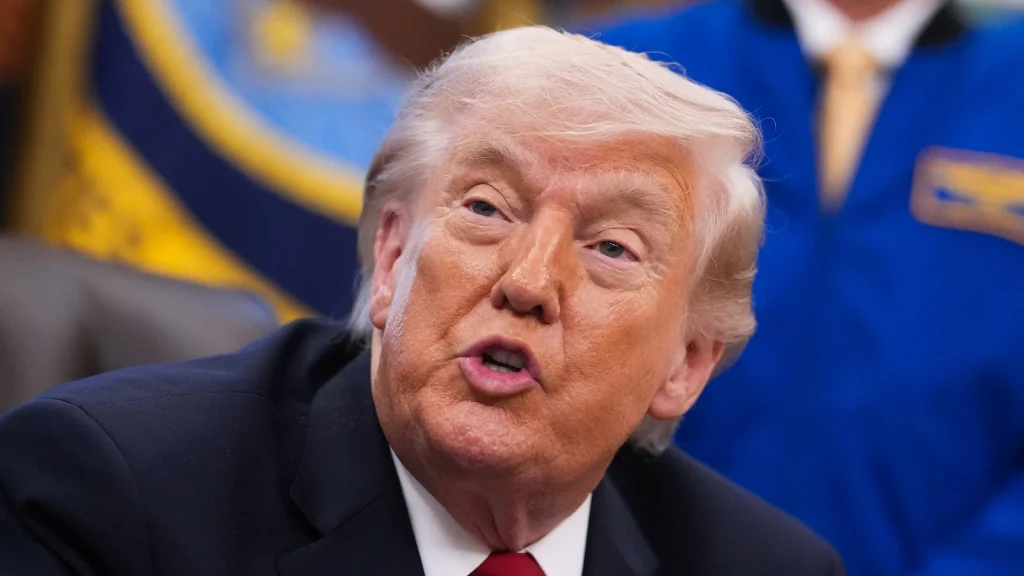
President Donald Trump speaks during an event with Artemis II astronauts in the Oval Office at the White House in Washington, April 29, 2026. Andrew Harnik/Getty Images