
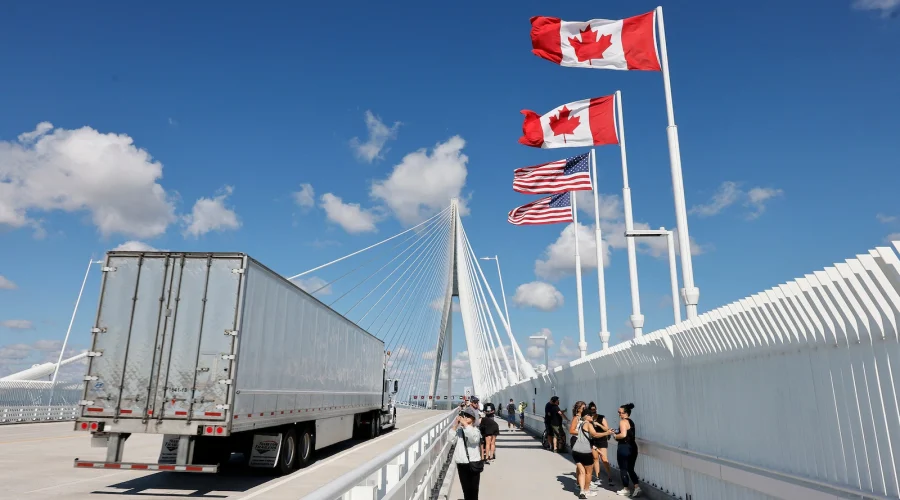
Canada’s Trade Retaliation Takes Effect as Cross-Border Tensions Sharpen
Cyberzenhub.com – At one minute past midnight Eastern Time on Tuesday, a new wave of Canadian import duties snapped into force, sweeping across hundreds of American-made goods and deepening what has become the most consequential trade confrontation between two North American neighbors in decades. The measures, calibrated to mirror the scale of recent U.S. levies imposed on Canadian goods, carry rates reaching 50 percent and collectively target roughly $20 billion in annual American shipments — a figure that, per U.S. Census Bureau data for 2025, represents close to six percent of total U.S. exports flowing into Canada.
The affected product list stretches from everyday household items such as aluminum foil and raincoats to specialty foods including cheese. Canadian officials framed the package as a proportional response: the dollar value of goods now subject to the new duties was deliberately matched to the value of the most recent tranche of American tariffs that took effect the previous month.
How the Dispute Escalated
The tit-for-tat cycle ignited last month when formal bilateral negotiations broke down and a fresh tranche of U.S. import duties landed on Canadian products. Within days, Ottawa announced what it characterized as equivalent retaliatory tariffs, with implementation scheduled for the second week of September. The collapse of talks removed the last institutional buffer between the two economies, leaving tariff schedules as the primary instrument of leverage.
Elected officials in border states have moved quickly to flag the domestic fallout. Republican Senator Susan Collins of Maine, among others, cautioned that the escalating dispute would weigh on local manufacturers, retailers, and consumers who depend on cross-border supply chains. The warning underscores that the economic pain of a trade war rarely respects political party lines.
Trump Threatens Further Escalation
President Donald Trump has signaled he views the Canadian measures as a provocation warranting a forceful counter-response. On Monday afternoon, he threatened to block sales of aircraft produced by Bombardier, the Montreal-headquartered aerospace firm, unless the company committed to manufacturing its products on American soil. Late the previous month, he pledged to double the tariff rate on Canadian-built automobiles and auto components from 25 percent to 50 percent, effective in January.
“On Trade, and in other ways, also, they are among the worst Nations in the World to deal with. They feel entitled, and yet, WE DON’T NEED CANADA, THEY NEED US!”
Those remarks, posted to his personal social media platform, captured the combative tone that has come to define the administration’s posture toward its northern neighbor. The rhetoric sits in stark contrast to scenes just weeks earlier: in June 2026, Trump and Canadian Prime Minister Mark Carney shared a working lunch alongside other G7 and Middle East leaders in Évian-les-Bains, France, projecting a veneer of diplomatic normalcy that has since evaporated.
The Lake Ontario Naming Fight
The dispute has spilled into symbolic territory. On August 27, Trump signed an executive order renaming Lake Ontario as “Lake America.” Days later, he shared an AI-generated video on social media depicting birds sporting his signature hairstyle marching in formation with firearms to “protect” a body of water labeled with the new name. Ottawa responded that it would continue using the traditional designation.
“This lake is called Lake Ontario — today and forever.”
Carney posted that declaration on X late last month, turning a geographic naming question into a broader statement about sovereignty and mutual respect between the two countries.
Carney’s Rebuke and the Negotiation Stalemate
The Canadian prime minister went further last week, accusing the U.S. administration of signaling a refusal to seek a negotiated settlement. His comments pointedly criticized the tone of American public messaging:
“When the Americans stop doing memes, stop throwing shade and stop trying to be tough, and start being serious about having those discussions, we can have those discussions.”
The remark framed the impasse not as a matter of tariff arithmetic alone but as a breakdown in diplomatic tone — a characterization that, whether or not it resonates in Washington, will shape how Canadians interpret the next round of negotiations.
Economic Stakes and Expert Assessment
The scale of the underlying trade relationship makes the stakes tangible. In the first half of 2026, the United States shipped $175.8 billion in goods to Canada, making it the second-largest export destination after Mexico and accounting for 14 percent of all American merchandise exports, per Census Bureau figures. For now, the duties in force touch only a fraction of the goods that move daily across the border, which tempers the immediate macroeconomic shock. Yet the trajectory matters more than any single tariff line: each retaliatory step invites another, and the cumulative effect compounds.
Campbell Harvey, a professor at Duke University’s Fuqua School of Business who researches commodity markets, has described the dynamic in blunt terms:
“This is a classic trade-war situation: Somebody puts on a tariff, another country retaliates dollar for dollar and then more tariffs are added. Then we get into this really bad equilibrium.”
That equilibrium — in which both sides absorb higher input costs, consumers face elevated prices, and investment decisions stall pending clarity — is precisely the outcome that border-state legislators, Canadian manufacturers, and American exporters now fear is becoming the new normal rather than a temporary phase. Whether the two governments can step back before the next escalation cycle remains the central question of the autumn trade calendar.
Related Reading
Frequently Asked Questions
What is Canada s retaliatory tariffs hit US products?
Canada s retaliatory tariffs hit US products is the main topic of this guide. The article explains the context, practical details, and next steps readers should understand.
Why does Canada s retaliatory tariffs hit US products matter?
Canada s retaliatory tariffs hit US products matters because readers are looking for a useful answer, not just a short summary. Good content should match search intent and help them decide what to do next.