
S. Korean court sentences ex-Pres. to 7 years for charges including resisting arrest
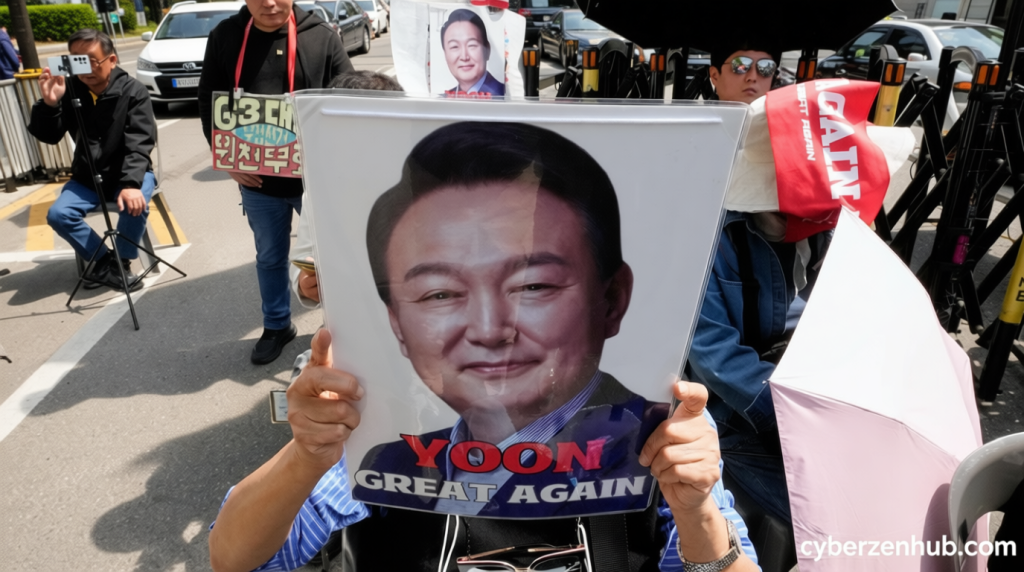
S. Korean Court Hands Ex-President 7-Year Sentence for Resisting Arrest and Cabinet Misconduct
S Korean court sentences ex Pres – SEOUL, South Korea — A South Korean appeals court has delivered a landmark verdict, sentencing former President Yoon Suk Yeol to seven years in prison for charges encompassing resisting arrest and improperly convening a Cabinet meeting prior to his brief declaration of martial law in December 2024. This ruling adds to a previous life sentence he received for rebellion charges, which stemmed from his controversial push toward authoritarian governance, sparking one of the most profound democratic crises in the nation’s recent history.
The conviction for obstruction of justice and other related offenses marks a significant escalation in the legal battles surrounding Yoon’s tenure. Judge Yoon Sung-sik of the Seoul High Court emphasized that the former president had manipulated procedural norms by skipping a legally required full Cabinet session before imposing martial law, a move that raised eyebrows across the political spectrum. The judge further stated that Yoon had falsified documents to hide the procedural shortfall and deployed security personnel in a manner resembling a private military force to thwart arrest attempts in the weeks following his impeachment.
“The conservative former president sidestepped a legally mandated full Cabinet meeting before declaring martial law, falsified documents to conceal the lapse, and deployed security officials ‘like a private army’ to resist law enforcement efforts to arrest him,” stated Judge Yoon Sung-sik during the proceedings.
The conviction also overturned a prior acquittal on abuse-of-power charges related to the Cabinet meeting. In January, a lower court had sentenced Yoon to five years in prison but partially cleared him of responsibility for the failure to attend the meeting by two members. However, the Seoul High Court has now ruled that Yoon was directly accountable for the oversight, violating the rights of not only those two officials but also seven others who were not informed during the process. This decision underscores the broader implications of his actions, which were seen as undermining institutional integrity and democratic norms.
Yoon’s Dec. 3, 2024 decree to impose martial law briefly suspended civilian governance, plunging the country into political turmoil. The move disrupted routine operations, paralyzed high-level diplomatic negotiations, and triggered a sharp decline in investor confidence, sending financial markets into a frenzy. The crisis reached its peak when Yoon’s allies attempted to justify the decree as a necessary response to internal instability, but critics argued it was a calculated effort to consolidate power.
Following his suspension on Dec. 14, 2024, Yoon was formally removed from office by the Constitutional Court in April 2025. His refusal to comply with a detention order issued by a Seoul court in early January 2025 led to a tense standoff, with dozens of investigators attempting to enter the presidential residence but being halted by barricades and security personnel. This resistance culminated in his arrest later that month, though he was released in March by another court before being re-detained in July. Since then, Yoon has remained in custody as a series of criminal trials continue, each adding layers to his legal woes.
The court’s ruling came just a day after it increased the sentence of Yoon’s wife, Kim Keon Hee, to four years for charges involving accepting luxury gifts from the Unification Church. The church, known for its influence in South Korean politics, had allegedly lobbied Yoon’s administration for political advantages. Kim was also implicated in a stock price manipulation scheme, which prosecutors claimed was part of a broader effort to secure financial gains for the family. This separate case highlights the intertwined legal challenges facing Yoon’s family and their political network.
In a separate trial, prosecutors sought a 30-year prison term for Yoon, alleging that he intentionally escalated tensions with North Korea in 2024 by authorizing drone flights over Pyongyang. The claim is that these flights were designed to create a pretext for his domestic martial law decree, which he used to justify a shift toward centralized control. The prosecution argued that Yoon’s actions were not merely defensive but strategically calculated to provoke a crisis that would support his political agenda.
The legal proceedings have been emblematic of the broader political realignment that occurred during Yoon’s term. His administration’s authoritarian measures, such as the rapid imposition of martial law and the bypassing of formal legislative processes, drew sharp criticism from opposition parties and civil society groups. These actions were seen as a direct challenge to the principles of democratic governance, which were further tested during the subsequent political chaos.
Yoon’s downfall was catalyzed by the impeachment process initiated by the liberal-led legislature, which accused him of undermining the rule of law and acting in defiance of constitutional procedures. The Constitutional Court’s formal removal of Yoon in April 2025 marked the end of his presidency and the beginning of a new era of political reckoning. His liberal rival, Lee Jae Myung, capitalized on this moment by winning an early presidential election in June, which brought a measure of stability to the country’s political landscape.
While Yoon’s term ended with his removal, the legal battles are far from over. The seven-year sentence for resisting arrest and Cabinet misconduct is a pivotal moment in his case, reflecting the severity of his alleged transgressions. The conviction not only addresses his direct actions but also serves as a symbolic rebuke of the broader authoritarian tendencies that characterized his administration. As the trials continue, Yoon faces the prospect of a lengthy prison sentence, potentially extending his time in detention beyond the current phase.
South Korea’s legal system has played a central role in resolving the crisis, with courts acting as arbiters of political accountability. The conviction of Yoon Suk Yeol represents a critical step in this process, reinforcing the judiciary’s role in upholding democratic institutions. The case also illustrates the challenges faced by leaders when they push the boundaries of constitutional authority, as their actions can trigger a cascade of legal consequences.
The implications of Yoon’s sentencing extend beyond his personal fate. It has set a precedent for future leaders, emphasizing the importance of procedural compliance and transparency in governance. The ruling also highlights the resilience of South Korea’s democratic framework, which has weathered the storm of Yoon’s authoritarian ambitions. As the nation continues to process this verdict, the focus remains on restoring public trust in the rule of law and ensuring that similar crises are not repeated in the future.