Hawk Fire Surpasses 10,000 Acres Near Reno, Triggering Widespread Evacuations Across Washoe County
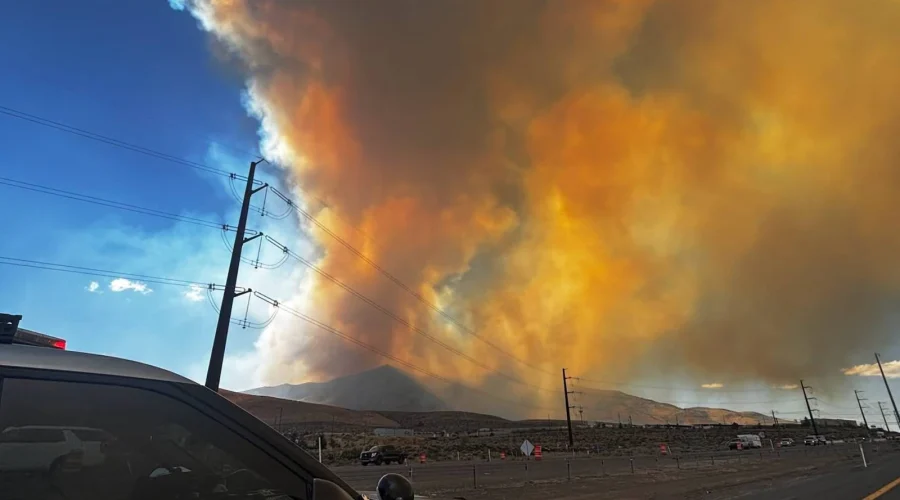
Cyberzenhub.com – A brush fire that ignited on a hillside east of Reno on Saturday afternoon has ballooned into one of the largest wildfires in recent Northern Nevada memory, consuming more than 10,500 acres by evening and forcing thousands of residents to abandon their neighborhoods. The blaze, designated the Hawk Fire, raced through dry grass and scattered shrubs with a speed that caught even veteran firefighters off guard, pushing evacuation orders outward in successive waves as the front advanced toward residential subdivisions.
The National Interagency Fire Center confirmed the expanded acreage in its latest status bulletin, noting that the fire had already scorched structures in its path. Washoe County Sheriff’s Office personnel reported that roughly 1,000 homes sat within the threatened perimeter, prompting the agency to broaden mandatory evacuation zones throughout the afternoon and into the evening.
State of Emergency Declared
Nevada Governor Joe Lombardo moved swiftly to formalize the state’s response, declaring a state of emergency for Washoe County so that additional resources, mutual-aid agreements, and federal coordination channels could be activated without bureaucratic delay. In a social-media statement, the governor characterized the situation as urgent:
“The fire is spreading quickly and threatening homes and structures.”
The declaration authorizes state agencies to coordinate with county and municipal responders, request mutual-aid personnel from neighboring counties, and, if conditions worsen, seek federal disaster assistance through FEMA. For residents, it signals that the state government is treating the event as a major incident requiring sustained, multi-agency operations.
Wind-Driven Behavior Complicates Suppression
Truckee Meadows Fire Chief Richard Edwards addressed the public in a video posted to social media, explaining why the Hawk Fire proved so difficult to contain. He emphasized that prevailing winds were the primary accelerant, pushing the flame front directly into populated areas at speeds that outpaced ground crews.
“The Hawk Fire is a very dynamic incident for us as it’s being driven by the winds. The wind-driven fires move very rapidly into our residential areas, creating a lot of challenges for our firefighters to save homes and protect lives.”
Edwards urged residents to monitor official channels continuously, depart early when directed, and keep a go-bag assembled with medications, identification, and essentials. In Northern Nevada’s semi-arid climate, late-summer brush fires fueled by low humidity and gusty winds are a recurring seasonal hazard, but the speed at which this particular fire crossed the hillside and entered developed land marked it as an unusually aggressive event.
Infrastructure Disruptions and Service Closures
The fire’s footprint extended well beyond the burn scar itself. Thousands of customers across the eastern Reno metro area lost electrical service as utility crews either preemptively de-energized lines near the fire front or dealt with damage to poles and transformers. A segment of U.S. Highway 395, a primary north-south corridor through the region, was closed to through traffic to give ground crews and evacuation convoys clear access.
Northern Nevada Health Systems announced the temporary closure of its emergency department at North Valleys, located just north of Reno, citing evacuation-related patient surges and staffing constraints. Residents needing urgent care were directed to alternative facilities farther from the fire zone.
Local Leadership Calls for Compliance
Reno Mayor Hillary Shieve issued a public statement expressing solidarity with displaced residents and praising the crews working around the clock. She confirmed that some structures had already been lost to the flames and implored neighbors to heed evacuation directives without delay.
“My heart goes out to anyone in our community who has been impacted by the dangerous and fast-moving Hawk Fire.”
The mayor’s message continued with a tribute to first responders:
“Our firefighters and first responders are heroically fighting the fire and the high winds to save lives, homes, businesses, livestock and pets.”
Monitoring and Ongoing Operations
The Washoe County Sheriff’s Office reported that the fire was burning in proximity to the county detention center, prompting heightened vigilance and contingency planning at that facility. Truckee Meadows Fire & Rescue indicated the flame front was tracking in a northeasterly direction as of Saturday evening, a trajectory that carried it toward additional residential corridors and agricultural land.
Brush fires of this scale in the Truckee Meadows basin are uncommon but not unprecedented; the region’s combination of sagebrush steppe, scattered ponderosa pine, and rapidly developing suburban edges creates a fuel-continuity problem that intensifies every time wind speeds exceed twenty miles per hour. Fire managers typically rely on aerial retardant drops, dozer lines, and aggressive interior attack to slow such events, but sustained gusts can render those tactics temporarily ineffective, leaving crews to defend structures on a home-by-home basis.
As of the latest available information, the Hawk Fire remained active and the situation was still evolving. Authorities advised residents to check official county and state channels for updated evacuation maps, road closures, and shelter locations, and to assume that conditions could change rapidly with any shift in wind direction or speed.
Related Reading
Frequently Asked Questions
What is Fast growing Hawk Fire explodes to more?
Fast growing Hawk Fire explodes to more is the main topic of this guide. The article explains the context, practical details, and next steps readers should understand.
Why does Fast growing Hawk Fire explodes to more matter?
Fast growing Hawk Fire explodes to more matters because readers are looking for a useful answer, not just a short summary. Good content should match search intent and help them decide what to do next.