
Supreme Court halts order for Alabama to use House map with 2 largely Black districts
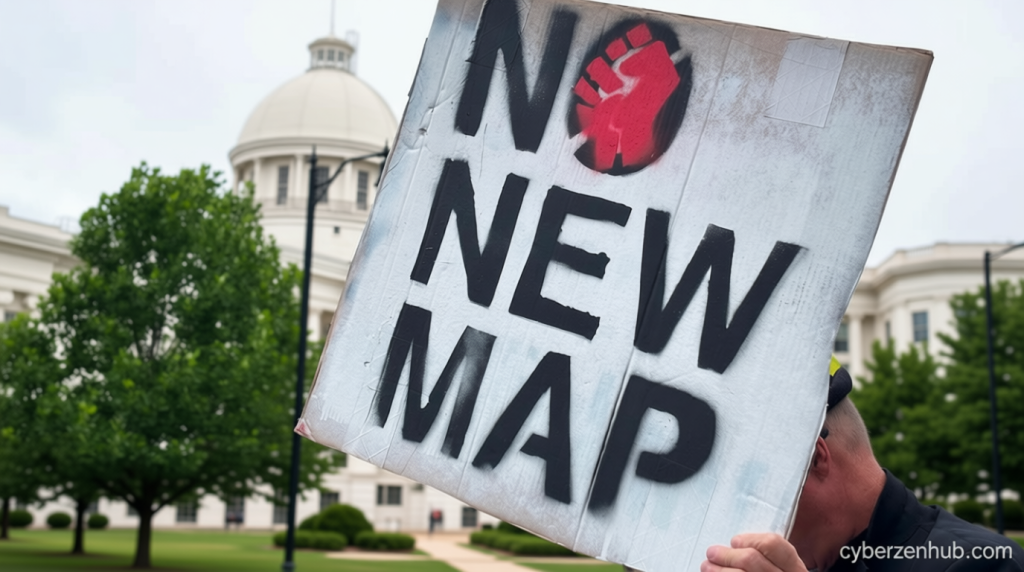
Supreme Court Halts Order for Alabama to Use House Map with 2 Largely Black Districts
Supreme Court halts order for Alabama – The U.S. Supreme Court’s recent ruling has created a pivotal shift in Alabama’s congressional district boundaries, paving the way for the state to eliminate one of its two majority-Black districts before the upcoming midterm elections. This decision opens the door for Republicans to potentially secure an extra House seat in a fiercely contested race for control of the closely divided chamber. The court’s action comes after overturning a previous directive that required Alabama to maintain the current map until after the 2030 census, a move that had been supported by judicial orders.
Central to this development was the April Supreme Court ruling that invalidated a majority-Black district in Louisiana as an unconstitutional racial gerrymander. That decision significantly undermined a key provision of the federal Voting Rights Act, which had been used to protect minority voters from discriminatory mapmaking. Alabama officials had cited the Louisiana case as a justification for ending the judicial order, arguing that the Supreme Court’s interpretation of the act had weakened its enforcement. Now, the high court has directed a lower court to reassess the Alabama case in light of this new precedent, which could allow the state to adopt a different map.
The revised map, approved by Alabama’s Republican-led legislature in 2023, includes only a single district where Black residents form a majority. This change aligns with broader efforts by Republicans to reshape districts in a way that maximizes their electoral advantage. By reducing the number of majority-Black districts, the state aims to dilute the political power of Black voters, a strategy that has been employed in several other regions. Alabama officials, anticipating this reversal, quickly enacted legislation to invalidate the results of a May 19 primary for certain districts. This allows them to hold a new primary under the updated boundaries, ensuring the revised map can be implemented by August.
The implications of this ruling are particularly significant for Black communities and advocacy groups who have fought for years to preserve equitable representation. Justice Sonia Sotomayor, in her dissent, warned that the decision does not fully resolve the issue, as the lower court could still determine that Alabama’s actions violated the 14th Amendment. She noted that while the Voting Rights Act violation had been addressed, the state might still be engaging in intentional discrimination against Black voters. “We are not defeated by this,” said Evan Milligan, the lead plaintiff in the Alabama congressional case. “This could be a call to action for voters to rally and make their voices heard.”
“
We are not defeated by this,” said Evan Milligan, the lead plaintiff in the Alabama congressional case. “This could be a call to action for voters to rally and make their voices heard.”
The Supreme Court’s intervention in Alabama is part of a larger national trend in redistricting. As the 2024 elections approach, states across the country are actively adjusting their congressional maps to favor their party. This effort has been particularly aggressive in Republican-controlled states, where legislative leaders have used their power to redraw boundaries for political gain. President Donald Trump had previously encouraged Texas Republicans to adopt similar strategies, aiming to maintain a narrow House majority. This approach has since been replicated in Missouri, North Carolina, Ohio, Florida, and Tennessee, where Republicans anticipate winning up to 14 additional seats through strategic map changes.
In contrast, Democrats have been working to defend minority voting rights in states like California and Utah, where they believe new districts could expand their representation. However, their progress has faced setbacks, such as the Virginia Supreme Court’s reversal of a voter-approved redistricting amendment that might have added four seats to their advantage. The Alabama decision, though, represents a major blow to Democratic efforts, as it reinforces the ability of Republican lawmakers to manipulate district lines for partisan benefit.
Redistricting is typically a process that occurs every decade following the census, but the urgency of the 2024 elections has accelerated these changes. With population shifts and political realignments, states are now using the opportunity to secure favorable boundaries well before the next census. Alabama’s case highlights how the Supreme Court’s evolving stance on the Voting Rights Act has emboldened states to challenge existing protections. The Louisiana ruling, which removed a key tool for safeguarding minority voters, has made it easier for lawmakers to prioritize partisan interests over fair representation.
The potential impact on Alabama’s electoral landscape is clear. By allowing the state to use a map with only one majority-Black district, the Supreme Court has given Republicans a tactical edge. This could influence the outcome of the November elections, particularly in districts where Black voters have historically been a strong bloc. Advocacy groups, however, argue that the decision undermines decades of progress in ensuring equitable voting access. They are now preparing to challenge the revised map in court, hoping to prevent the erosion of minority representation.
As the clock ticks toward August, Republican Governor Kay Ivey faces the responsibility of setting the date for a special primary election. This election will determine the winners of the revised districts, with the results potentially reshaping the balance of power in the U.S. House. The outcome will also serve as a test case for how the Supreme Court’s new approach to redistricting affects voter rights across the nation. For now, the ruling has created a critical window for Alabama to implement its plan, but the fight over fair representation is far from over.
Popular Reads
Trump calls Iran’s latest response to proposal ‘TOTALLY UNACCEPTABLE’ May 11, 4:05 AM
Hantavirus live updates: 16 at facility in Nebraska, 2 at hospital in Atlanta May 11, 4:10 PM
Hantavirus: American oncologist who became cruise ship’s de facto head doctor speaks May 9, 6:21 PM
The nationwide redistricting battle has intensified in recent months, with states like Alabama, Texas, and others vying to reshape their political landscapes. While Republicans have managed to gain momentum in this effort, Democrats remain determined to counteract the trend. The Supreme Court’s decision in Alabama underscores the ongoing struggle over how to balance partisan gains with constitutional protections, leaving the future of voting rights in a state of flux. As the election date draws closer, the stakes for both parties—and for the communities they represent—will only grow higher.