
ICE agent charged with assault will surrender to Minnesota authorities, attorney says
ICE Agent Charged with Assault Will Surrender to Minnesota Authorities, Attorney Says
ICE agent charged with assault will – An Immigration and Customs Enforcement (ICE) agent from Temple Hills, Maryland, named Gregory Morgan Jr. faces two counts of assault with a dangerous weapon after allegedly brandishing a firearm at a motorist during a tense encounter on February 5. His attorney, Ryan Pacyga, confirmed that Morgan will turn himself in to Minnesota authorities on Thursday, as reported by ABC News. The charges were announced by the Hennepin County Attorney’s Office in April, following an incident that unfolded on a busy road as Morgan was returning to the Whipple Federal Building.
Details of the Roadway Encounter
According to the complaint filed by prosecutors, Morgan was driving back to the Whipple Federal Building after completing his shift on February 5. At the time, a motorist allegedly cut him off while he was attempting to overtake another vehicle. The complaint states that Morgan then produced a firearm and pointed it directly at the drivers of the other car. This action reportedly happened in a matter of seconds during congested rush-hour traffic.
“The allegations against Gregory Morgan arise from a brief, frightening, and highly stressful roadway encounter that happened in a matter of seconds during congested rush-hour traffic. An encounter that Mr. Morgan did not initiate.”
The complainant, who was in the other vehicle, told police they were unaware the person behind the wheel was an ICE agent until investigators revealed the identity. The complaint notes that Morgan’s car had no visible law enforcement markings, and it wasn’t equipped with sirens or flashing lights. Despite this, the complaint claims Morgan continued driving on the shoulder, seemingly bypassing traffic, before pulling alongside the complainant’s vehicle and aiming a black handgun at the occupants.
Contrasting Accounts from Both Sides
Morgan’s attorney, Ryan Pacyga, argued that the complaint contains “inaccurate and incomplete information.” He emphasized that Morgan did not instigate the incident, instead describing the situation as one where the other driver abruptly cut him off. According to the attorney, the encounter began when Victim 1 swerved into Morgan’s path, creating a sudden and alarming situation.
“Defendant acknowledged that his firearm was a Glock 19 with a laser light, which Defendant had holstered on his right hip at the time of the interview.”
During the incident, Morgan allegedly feared for his safety and the safety of others. He claimed to have drawn his weapon, yelled “Police Stop,” and positioned himself in front of the complainant’s car. The complaint states that Morgan then drove toward the Whipple Federal Building, where he was expected to report for duty. However, the attorney’s statement suggests the event was a spontaneous reaction rather than a premeditated act.
Supporting Evidence and Investigation
Investigators reviewed cellphone footage and traffic camera recordings to piece together the sequence of events. The complainant’s account, which was included in the prosecutor’s complaint, detailed the gun’s appearance, noting it resembled a Glock or Sig Sauer model with a red-dot sight. Victim 1 reportedly saw Morgan in a black t-shirt and observed the gun being pointed directly at their head.
Following the incident, law enforcement interviewed Morgan, his supervisor, and his partner. The complaint reveals that Morgan’s account aligns with the idea that the other driver’s actions triggered the confrontation. He described the moment as a “highly stressful traffic interaction” initiated by the complainant, not by himself. The attorney’s statement further asserts that the incident did not stem from any planned criminal activity but emerged from an unexpected, alarming situation.
DHS Response and Related Incidents
The Department of Homeland Security (DHS) did not immediately respond to ABC News requests for comment, nor did they provide a statement when the charges were first announced. This lack of response has fueled questions about the agency’s stance on the matter, especially as the case has drawn attention to broader issues involving ICE operations.
The incident has also been linked to a series of similar events. In a related story, an ICE agent was accused of pulling a gun on motorists in Minneapolis, sparking nationwide protests. These demonstrations were prompted by fatal shootings in the city, with critics arguing that such actions have heightened public distrust of federal law enforcement.
Context and Legal Implications
Mary Moriarity, the Hennepin County Attorney, outlined the charges during a news conference on April 16. She emphasized that Morgan’s actions occurred during a chaotic traffic scenario, with the vehicle he was driving described as “illegally” on the shoulder. The attorney’s office added that the encounter was “alarming” and occurred after several days of tension in the Twin Cities metro area.
Morgan’s attorney, in a statement released Thursday, highlighted the need to separate fact from perception. “The incident was a sudden response to an abrupt traffic maneuver, not a planned act of aggression,” Pacyga stated. The attorney also noted the importance of the complainant’s perspective, which was only confirmed after the investigation.
“There were no markings on Defendant’s vehicle that would identify it as law enforcement and the vehicle was not displaying or using lights or sirens.”
As the case unfolds, it underscores the complexities of law enforcement interactions, particularly in high-stress environments. The charges against Morgan have raised questions about the use of force by ICE agents and their visibility to the public. The attorney’s insistence on the incident’s spontaneity adds another layer to the narrative, suggesting that the outcome may depend on the interpretation of the event’s circumstances.
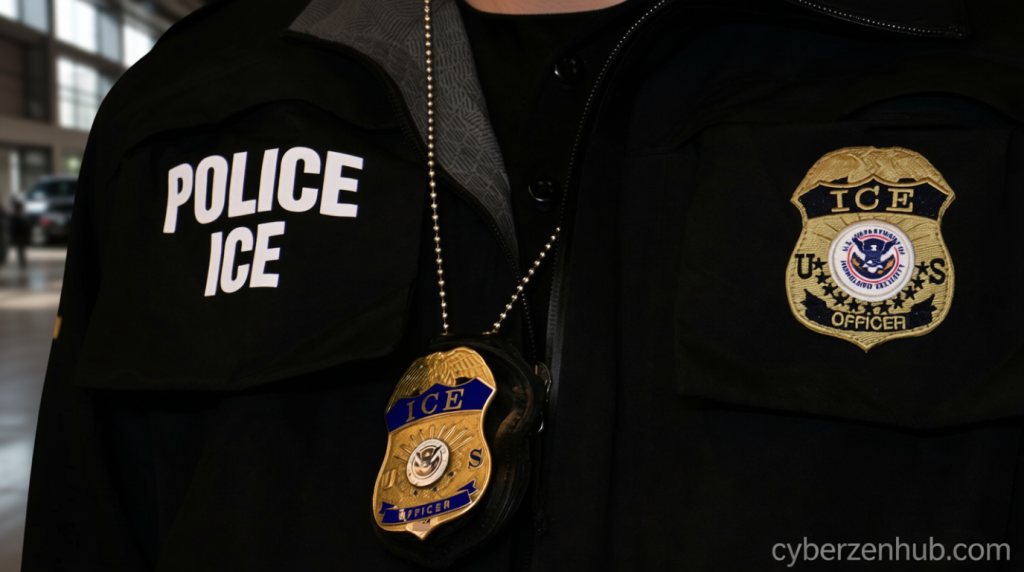
In a January 22, 2026, file photo, an ICE badge and patch are visible on a DHS agent in Minneapolis, Minnesota, highlighting the agency’s presence in the region. The image, taken by Jim Watson, serves as a reminder of the public’s awareness of ICE’s role in daily traffic and law enforcement activities. However, the incident in question appears to have occurred without the other driver recognizing Morgan’s official status until after the fact.
The legal proceedings will likely focus on the details of the encounter, including the sequence of events and the intent behind Morgan’s actions. Prosecutors must prove that the use of the firearm was justified, while the defense argues for a more nuanced understanding of the situation. The case also has the potential to influence public perception of ICE, especially as it coincides with ongoing discussions about the agency’s conduct in Minnesota and beyond.
As the surrender date approaches, the story continues to gain traction in media and public discourse. The attorney’s statements, combined with the evidence presented, offer a compelling argument for Morgan’s side of the story. Meanwhile, the Minnesota authorities remain committed to holding the agent accountable, emphasizing the seriousness of the charges and the need for transparency in the investigation.
The incident serves as a microcosm of larger debates about law enforcement discretion and the balance between public safety and individual rights. With the charges now in the spotlight, the outcome may have lasting implications for how ICE agents are viewed in both professional and civilian contexts. The Twin Cities, already grappling with tensions over recent operations, may find this case to be a pivotal moment in their ongoing relationship with federal law enforcement.