A Day That Tested the Secret Service Beyond Its Usual Mission
Cyberzenhub.com – When coordinated terrorist attacks struck the United States on Sept. 11, 2001, the U.S. Secret Service faced a threat unlike any it had previously managed. Its responsibility was not limited to protecting individual officials. The agency had to help preserve the ability of the federal government to function while uncertainty spread across the country.
At Secret Service headquarters in Washington, D.C., Director Brian Stafford watched events unfold from the agency’s Crisis Center. The attacks on the World Trade Center had already transformed the morning, and President George W. Bush was away from Washington in Florida. Stafford had to track the safety of several protectees, assess rapidly changing intelligence and consider whether the attacks might be intended to cripple the nation’s leadership.
The possibility of what is often called a decapitation strike weighed heavily on the decisions being made that day: an effort to disrupt government by targeting top officials and the institutions around them. That risk made every movement, communication line and protective detail critically important.
Continuity Planning Became Reality
Stafford was confronted with the task of putting the federal Continuity of Operations Plan into effect under Presidential Decision Directive 67. The framework was intended to move key leaders to secure locations and maintain essential government functions during a national emergency.
It was a plan developed for an extreme scenario, one that had been practiced but never carried out in that full posture. Even during World War II, the country had not activated continuity preparations in the same way. On Sept. 11, Stafford had to direct an operation for which there was no modern precedent.
The challenge illustrated the broader importance of continuity planning. Protecting leaders is vital, but a crisis can also threaten communications, command authority and the ability to make decisions. The work occurring inside the Crisis Center was therefore inseparable from the visible security activity around the president and other officials.
Agents Inside the World Trade Center
While senior officials coordinated the national response, Secret Service personnel in New York were confronted with immediate danger at the World Trade Center. Special Agents Tom Armas and John Buckley had been at the New York Field Office in 7 World Trade Center for an annual United Nations General Assembly briefing when the attacks began.
They ran into the North Tower to assist. As they approached the 40th floor, the impact of the attack on the South Tower sent a shockwave through the building. The force knocked both agents to the ground as the tower shifted.
Armas and Buckley turned back and began descending. Before they could leave, the collapse of the South Tower trapped them in the lobby and shattered windows around them. When the roar and vibration eased, they moved outside with civilians and members of the Fire Department of New York.
Armas was dressed in gym shorts and a T-shirt, with his equipment attached to his belt. Amid smoke, debris and confusion, he and Buckley helped guide people away from danger. The two were separated briefly in the street, then found one another again within minutes and continued assisting those trying to escape the area.
Their actions reflected a defining feature of that morning: personnel assigned to a protective mission were suddenly operating in a mass-casualty emergency. The priority became getting people to safety in conditions where information was incomplete and the danger was still unfolding.
Protecting the President Far From Washington
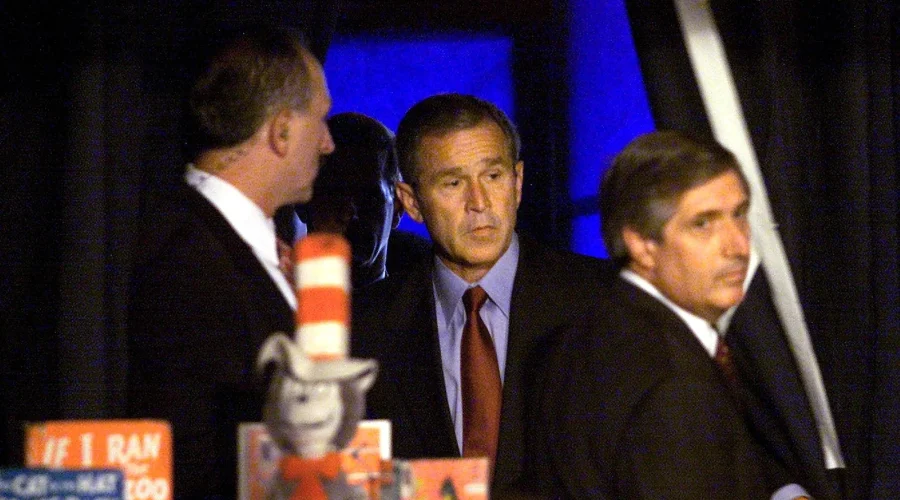
In Sarasota, Florida, Deputy Special Agent in Charge Edward “Eddie” Marinzel was leading President Bush’s protective detail during the presidential visit. The situation changed instantly when White House Chief of Staff Andy Card informed him that “America is under attack.”
“America is under attack.”
Marinzel, Card, the White House military aide and Air Force One advance teams had to determine how to move the president while the extent of the threat remained unclear. Bush initially wanted to return directly to Washington, but the capital was viewed as vulnerable. The group chose Barksdale Air Force Base in Louisiana, where secure communications would be available.
Air Force One later continued to Offutt Air Force Base in Nebraska, home to U.S. Strategic Command, or STRATCOM. By coincidence, the installation had been scheduled to conduct a nuclear-war exercise that day. That circumstance added to its readiness and made it a particularly secure location during the emergency.
Only after civilian airspace had been grounded and combat air patrols were in place over Washington did Marinzel agree to Bush’s wish to return to the capital. The route taken that day demonstrated the tension between presidential leadership and the protective obligation to keep the president out of a potentially active target zone.
A Nationwide Protective Response
Across Washington, Secret Service details moved quickly to secure officials in the presidential line of succession and other leaders under the agency’s protection. The response required individual agents to make immediate decisions while command staff worked through the much larger question of preserving national continuity.
The events of Sept. 11 are often remembered through images of the attacks, first responders and the leaders who addressed the nation. Less visible was the coordinated protective work that unfolded in offices, aircraft, military bases and city streets. It involved evacuation, secure transportation, communications and the constant reassessment of danger.
Twenty-five years later, the day remains a reminder that crisis response depends not only on public statements and high-profile decisions, but also on the people tasked with acting before there is time for certainty. From the World Trade Center lobby to Air Force One and the Secret Service Crisis Center, agents were forced to carry out their mission in circumstances that had changed the country within hours.
Related Reading
Frequently Asked Questions
What is Recalling the US Secret Service s seen?
Recalling the US Secret Service s seen is the main topic of this guide. The article explains the context, practical details, and next steps readers should understand.
Why does Recalling the US Secret Service s seen matter?
Recalling the US Secret Service s seen matters because readers are looking for a useful answer, not just a short summary. Good content should match search intent and help them decide what to do next.